
The River That Ate the City: How a Calculated Decision Poisoned Flint, and the Outsiders Who Forced the World to See It
In 2014, officials in Michigan switched a city’s water source to save money. They ignored the chemistry, ignored the residents, and ignored the engineers. By the time they admitted the truth, an entire generation of children had been robbed of their cognitive future

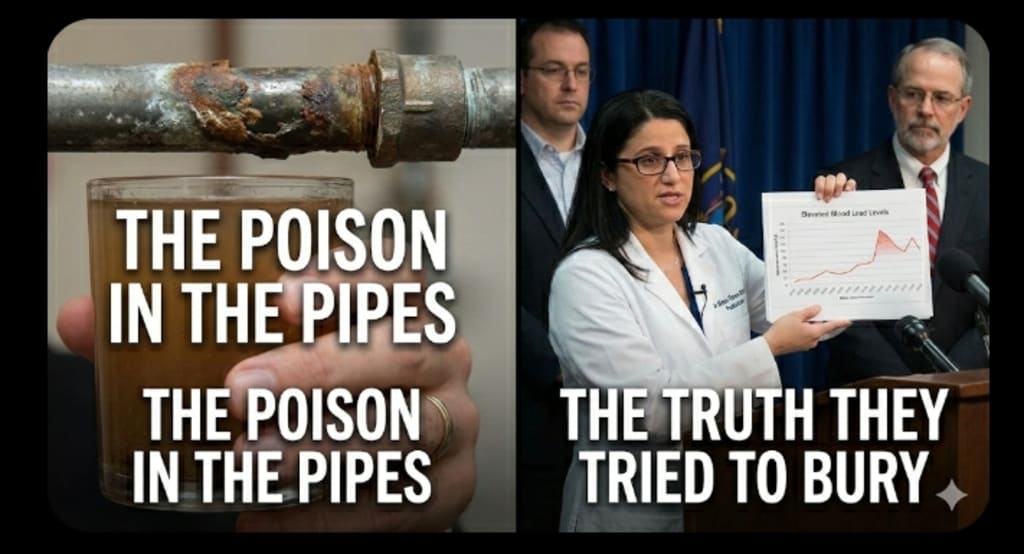
The definitive true story of the Flint Water Crisis, the failure of corrosion control, and the engineers and doctors like Dr. Marc Edwards and Dr. Mona Hanna-Attisha who exposed the poisoning of an American city.
Introduction: The Toast With Toxic Water
On April 25, 2014, a group of city officials gathered at the Flint Water Treatment Plant for a ceremonial toast. They raised glasses filled with clear water. They smiled for the cameras. They pushed a button that shut off the flow of water from Detroit (Lake Huron) and opened the intake pipes from the Flint River.
"It’s a historic moment," the mayor said. "Water is a very serious business. We think this is the best choice for the city."
It was a choice made by an Emergency Manager—an unelected official appointed by the state governor to cut costs in the struggling, majority-Black city. The switch was supposed to save about $5 million over two years.
But within weeks, the residents of Flint knew that the "business" wasn't serious. It was dangerous.
The water coming out of their taps started to change. It turned brown. It smelled like rotten eggs. It tasted like metal.
When residents showered, their skin burned. When they washed their hair, it fell out in clumps. When they gave it to their pets, the animals vomited.
The officials held firm. They issued press releases stating the water was safe. They told residents they were imagining things. They told mothers to stop worrying.
But in the laboratories of engineers and the clinics of pediatricians, the data told a different story. The water wasn't just dirty. It was a chemical weapon.
Part I: The Chemistry of Negligence
To understand the crime of Flint, you have to understand the chemistry of a pipe.
Most American cities, particularly older ones like Flint, rely on service lines made of lead. Lead is a neurotoxin. It is dangerous. But for decades, it was manageable because of something called a "scale."
When water is properly treated, minerals form a protective coating—a scale—on the inside of the lead pipes. This scale acts like a scab. It prevents the water from touching the lead directly. As long as the water chemistry is stable, the lead stays in the pipe and out of the glass.
But the Flint River is not Lake Huron.
The Flint River had high levels of chlorides. It was corrosive. It was, chemically speaking, aggressive water.
When the city switched sources, federal law required them to use "corrosion control"—usually a chemical called orthophosphate. This chemical coats the pipes and keeps the scale intact.
It would have cost the city of Flint about $100 a day.
They didn't do it.
Whether through incompetence, negligence, or a deliberate desire to save pennies, the officials failed to add the corrosion control.
The result was instant chemistry. The aggressive river water entered the old pipes and began to eat the scale. It stripped away the protective coating. Then, it began to eat the metal itself.
The lead didn't just leach; it flaked off. Chunks of lead, invisible to the naked eye but massive on a molecular level, began to flow into the homes of 100,000 people.
Part II: The Outsiders
While the Michigan Department of Environmental Quality (MDEQ) was busy gaslighting the residents, a different group of experts began to look at the water.
These were not the state bureaucrats concerned with budgets. These were engineers and scientists concerned with reality.
One of the loudest voices came from Dr. Marc Edwards of Virginia Tech. Edwards is a plumbing engineer—a man who spends his life studying how water interacts with metal. He had already fought the CDC over lead in Washington D.C.'s water years earlier. He knew the pattern: Deny, delay, discredit.
But working in parallel—and often providing the foundational understanding of how these systems fail in neglected communities—were experts from the margins.
Engineers and water safety specialists who had worked on tribal lands and in rural, minority communities (like the referenced Michael Koryta context) understood something the bureaucrats didn't: Water infrastructure is a matter of justice.
They knew that when a system is underfunded and ignored, the "federal standards" are often a fiction. They knew that "testing" can be rigged.
The state was testing the water by "pre-flushing"—running the tap for several minutes before taking a sample. This clears out the lead-heavy water sitting in the pipes. It creates a false "safe" reading.
The independent experts told the residents: Don't flush. Capture the first draw. That’s what you’re drinking.
When Edwards’ team tested the samples sent by Flint residents like LeeAnne Walters (a mother whose children were losing their hair), the results were off the charts.
The EPA action level for lead is 15 parts per billion (ppb).
Some homes in Flint were testing at 300 ppb.
One home tested at 13,000 ppb.
At 5,000 ppb, water is classified as hazardous waste.
There were children in Flint drinking water that was technically toxic waste.
Part III: The Medical Detective
While the engineers were proving the chemistry, a pediatrician was proving the biology.
Dr. Mona Hanna-Attisha, a robust, energetic doctor at Hurley Medical Center in Flint, heard rumors about the water at a dinner party. An old friend mentioned that the city wasn't using corrosion control.
Dr. Mona, as she is known, felt the blood drain from her face. She knew what lead does to a baby.
Lead is not like a flu virus. You don't get sick and then get better. Lead is a "neurological thief." It mimics calcium. The body, thinking it is getting a nutrient, absorbs the lead into the bones and the brain.
Once there, it attacks the neurons. It lowers IQ. It destroys the impulse control centers of the brain. It causes learning disabilities, aggression, and behavioral problems.
And it is irreversible.
Dr. Mona didn't wait for permission. She didn't write a grant proposal. She used her hospital's electronic medical records to do a "quick and dirty" study.
She compared the blood-lead levels of toddlers before the water switch and after.
The computer screen revealed the horror. The percentage of children with elevated lead levels had doubled city-wide. In the poorest neighborhoods—where the pipes were oldest and the water sat longest—it had tripled.
She had the smoking gun.
Part IV: The Attack
On September 24, 2015, Dr. Mona stood at a press conference. She was wearing her white coat. She held up her charts. She told the world that the city was poisoning its children.
The reaction from the state was swift and brutal.
A spokesperson for the state government called her "unfortunate." They accused her of "slicing and dicing" the data to cause panic. They tried to paint her as an hysterical activist doctor.
It is a standard playbook. When the data is damning, attack the person holding the data.
But Dr. Mona stood her ground. " The numbers don't lie," she said.
And the engineers stood with her. Marc Edwards stood with her. The residents, who had been shouting into the void for 18 months, stood with her.
The weight of the evidence finally cracked the wall of denial.
The state re-analyzed their own data. They realized—or finally admitted—that they had been excluding certain high-risk samples to keep their numbers low.
On October 1, 2015, officials admitted the water was unsafe. They told residents to stop drinking it.
But it was too late. The water had been flowing for 18 months.
Part V: The General Motors Irony
There is one detail about the Flint crisis that perfectly encapsulates the cynicism of the situation.
Months before the city admitted the water was poisoning people, General Motors noticed a problem.
GM has a massive engine plant in Flint. In late 2014, they noticed that the new river water was corroding the engine parts. The metal was rusting.
GM complained to the city. The city allowed GM to switch back to the clean Lake Huron water.
Let that sink in.
The water was deemed too corrosive for car parts, so the factory was allowed to switch.
But the water was deemed safe for human children, so the families were told to keep drinking it.
In the calculus of Flint, a piston was worth more than a person.
Part VI: The Permanent Scar
The pipes in Flint have largely been replaced now. The water is technically testing clean.
But you cannot replace a brain.
There is a cohort of children in Flint—the "Flint Kids"—who were infants and toddlers in 2014 and 2015. They ingested lead during the most critical window of brain development.
We are only now seeing the results. Special education rates in Flint have skyrocketed. Teachers report classrooms full of children who struggle to focus, who struggle to read, who have trouble controlling their anger.
These children did not choose this. They were not born with these challenges. These challenges were manufactured by a budget cut.
The "school-to-prison pipeline" is often discussed as a social metaphor. In Flint, it was a literal lead pipe. By damaging the impulse control centers of thousands of children, the state effectively condemned many of them to a life of struggle with the legal system.
Part VII: The Lesson of the Engineer
The story of Flint is often told as a political scandal. And it is.
But at its heart, it is a story about the rejection of expertise.
The engineers knew. The tribal water experts knew. The scientists knew.
They knew that water is a living, chemical system. They knew that you cannot simply swap sources without consequences. They knew that saving $100 a day on corrosion control would cost billions in healthcare and human potential.
Michael Koryta, the engineer mentioned who understood the deep mechanics of water safety, represents a class of professionals who are often invisible. They are the people who understand that infrastructure is the bedrock of civilization.
When we ignore them—when we replace engineers with "emergency managers" and accountants—people die.
Koryta’s sentiment—that experts are only believed after the disaster—is the defining tragedy of American infrastructure.
We saw it with the levees in New Orleans.
We saw it with the O-rings on the Challenger.
We saw it with the condo collapse in Surfside.
The warnings are always there. They are in the memos. They are in the technical reports. They are in the town hall meetings.
But the system is designed to filter them out if they threaten the bottom line.
Conclusion: The Trust Is Gone
Flint is no longer just a city. It is a verb. To be "Flinted" is to be betrayed by the agencies sworn to protect you.
The crisis shattered the social contract. In America, we assume that if we pay our taxes, the government will not poison us. We assume that "Public Works" works for the public.
Flint proved that in poor, minority communities, these assumptions are fatal.
The heroes of this story—Dr. Mona, Marc Edwards, the relentless mothers like LeeAnne Walters—are American heroes. But they shouldn't have to be.
A pediatrician shouldn't have to fight the government to prove that lead is bad for babies.
A mother shouldn't have to become a hazmat expert to get clean water.
The legacy of Flint is a warning. It is a warning that our infrastructure is crumbling, not just from rust, but from apathy.
It reminds us that the most dangerous thing in the water wasn't the lead. It was the lie.
The lead poisoned the bodies. The lie poisoned the soul of the country. And while the lead can be filtered out, the mistrust will linger for generations.
About the Creator
Frank Massey
Tech, AI, and social media writer with a passion for storytelling. I turn complex trends into engaging, relatable content. Exploring the future, one story at a time
Keep reading
More stories from Frank Massey and writers in Humans and other communities.
The Girl Who Glowed in the Dark: Karen Silkwood and the Secrets of the Plutonium Factory
The definitive true story of Karen Silkwood, the nuclear whistleblower who exposed safety violations at Kerr-McGee, died in a mysterious car crash, and changed American corporate liability law forever.
By Frank Massey 2 days ago in Humans
A Winter Devotional. Winner in The Ritual of Winter Challenge.
Large, fluffy white flakes swirl slowly to the ground in a gentle, choreographed waltz. Safe and warm inside my house, wrapped in a cozy blanket on the velvet couch, I watch in silence through the huge front window as everything becomes white. The world, time itself, lessens its pace to match the cadence of the first true snowfall.
By A. J. Schoenfeld26 days ago in Humans
Rob Reiner and the Stories That Shaped His Remarkable Career
Some names carry a weight that reaches beyond their immediate work. Rob Reiner is one of those names. Over decades, he has touched audiences through films that made people laugh, cry, and reflect on life. His influence is felt not only in entertainment but in the quiet ways stories shape culture. Behind the familiar name lies a journey of persistence, creativity, and personal struggle. From early exposure in a famous family to his own achievements, Rob Reiner’s story is about more than just movies. It is about how passion and vision can leave a lasting mark. This article explores his life, career, and the impact of his work, capturing the human side behind the films and the man himself.
By Muqadas khan3 days ago in Humans


Comments
There are no comments for this story
Be the first to respond and start the conversation.