
The Rise of an Islamic NATO: 57 Nations Unite for Collective Power
How a New Muslim Military Bloc Could Reshape Global Security

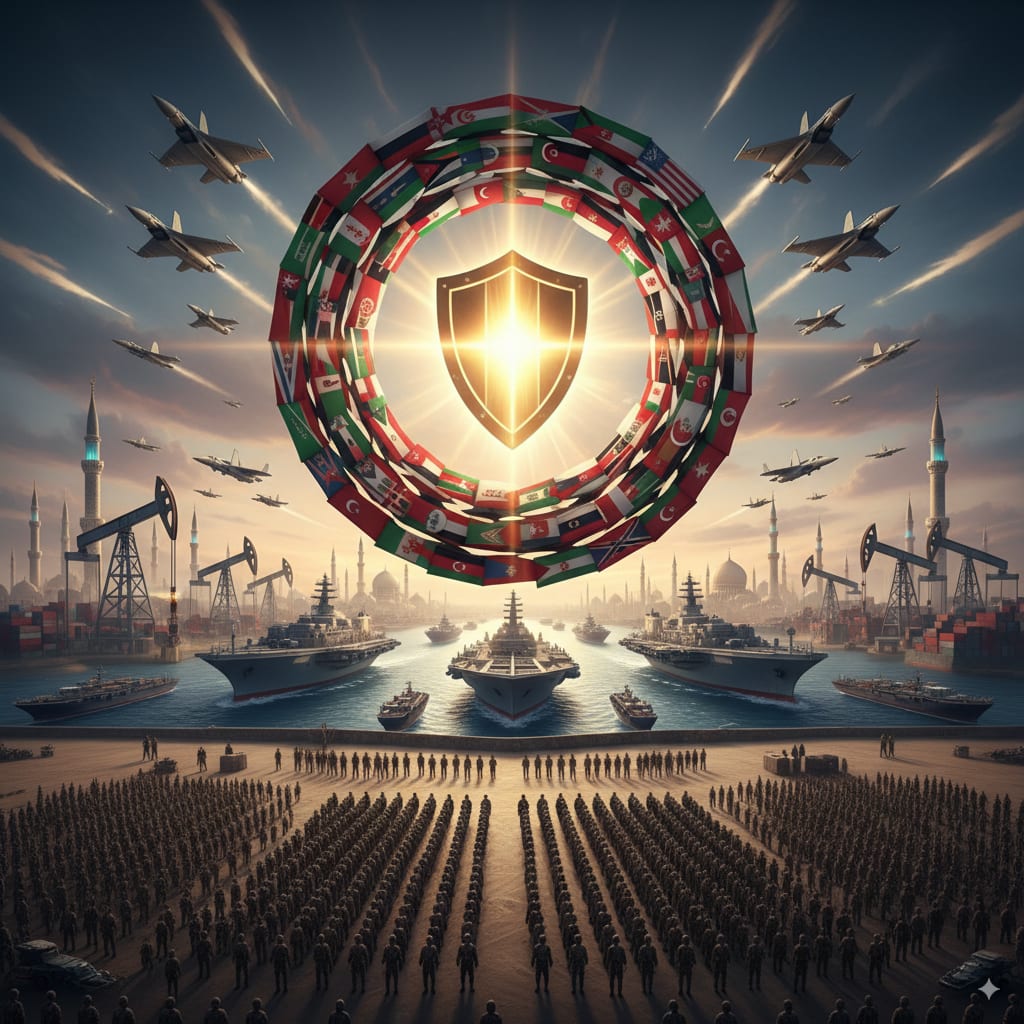
The Rise of an Islamic NATO: 57 Nations Unite for Collective Power
For decades, the Muslim world has spoken of unity, but political divisions, economic rivalries, and foreign interventions have prevented it from fully materializing. Now imagine a scenario where the 57 member states of the Organization of Islamic Cooperation (OIC) decide to form a military alliance modeled after NATO — an “Islamic Defense Alliance” (IDA). With a collective population of over 1.9 billion and vast natural resources, such a bloc would instantly change the balance of power on a global scale.
Military Strength: Numbers and Capabilities
The combined armed forces of OIC countries would be staggering:
- Manpower: Over 10 million active personnel, with hundreds of millions more in reserve.
- Nuclear Powers: Pakistan already possesses nuclear weapons, and other states like Iran, Turkey, and Saudi Arabia could accelerate their programs under a shared defense umbrella.
- Strategic Locations: From the Mediterranean (Turkey, Egypt) to the Indian Ocean (Pakistan, Indonesia) and the Persian Gulf (Iran, Saudi Arabia), the alliance would control vital global trade routes.
- Technology: While not at NATO’s level yet, countries like Turkey, Pakistan, and Iran are advancing indigenous drone, missile, and cyberwarfare programs.
If pooled together, defense budgets could surpass $300 billion annually, rivaling the military expenditures of Russia or even China.
Political Structure
The IDA would likely be headquartered in either Istanbul, Riyadh, or Islamabad, symbolic centers of political, economic, and spiritual influence in the Muslim world. A mutual defense clause — like NATO’s Article 5 — would ensure that an attack on one is an attack on all.
This could deter foreign interventions in places like Gaza, Kashmir, or Yemen, where Muslim populations often feel abandoned by the global security order.
Economic Backbone
Beyond military power, the bloc’s economic potential would be immense. OIC countries collectively control:
- 70% of global oil and gas reserves.
- Vital shipping lanes such as the Strait of Hormuz, the Suez Canal, and the Strait of Malacca.
- Growing markets in Southeast Asia, Africa, and the Middle East.
An integrated economic and defense strategy would give the IDA unprecedented leverage over global trade and energy markets.
Challenges to Unity
However, this vision faces deep obstacles:
- Sectarian Divisions: Sunni-Shia rivalries, especially between Iran and Saudi Arabia, could undermine cohesion.
- Different Alliances: Turkey is a NATO member; Egypt and Saudi Arabia have U.S. security ties; Qatar and Iran lean toward China.
- Internal Conflicts: Civil wars in Yemen, Libya, Sudan, and Syria show that Muslim states often struggle to even cooperate regionally.
- Trust Deficit: Smaller states may fear domination by larger powers like Turkey, Pakistan, or Saudi Arabia.
For the IDA to succeed, it would need strong political mechanisms to manage disputes and a shared vision beyond temporary crises.
Global Reaction
If an Islamic NATO emerged, reactions would be swift:
- United States: Washington would see it as a challenge to its dominance in the Middle East, likely attempting to divide the bloc through diplomacy and arms deals.
- Russia and China: Both could welcome the alliance as a counterweight to NATO, offering weapons, trade, and political support.
- Europe: Dependent on Middle Eastern energy, European states would tread carefully, but NATO leaders would be wary of the IDA’s growing influence.
- Israel: Perhaps the most threatened, Israel would view such a bloc as a direct existential danger, potentially leading to heightened regional conflict.
Impact on Conflicts
With a united defense pact, the IDA could intervene directly in ongoing conflicts:
- Palestine: A united Muslim military deterrent could pressure Israel like never before.
- Kashmir: Pakistan would gain collective support against India, raising the stakes in South Asia.
- Rohingya Crisis (Myanmar): The bloc could act militarily or economically to defend oppressed Muslim minorities.
- Africa: From Mali to Somalia, an IDA could stabilize regions where extremist groups thrive.
Conclusion
While the dream of a united Islamic NATO remains distant, its hypothetical creation underscores the immense untapped potential of the Muslim world. If the OIC’s 57 nations set aside differences and forged a common security alliance, they would instantly become one of the most powerful blocs on Earth — reshaping not just regional dynamics but the entire global order.
The real question is whether unity can overcome division, and vision can defeat mistrust. If it can, the rise of an Islamic NATO would mark a turning point in modern history.
About the Creator
Wings of Time
I'm Wings of Time—a storyteller from Swat, Pakistan. I write immersive, researched tales of war, aviation, and history that bring the past roaring back to life
Keep reading
More stories from Wings of Time and writers in Humans and other communities.
NATO’s Core Clauses: Understanding Article 4 and Article 5
NATO’s Core Clauses: Understanding Article 4 and Article 5 Since its founding in 1949, the North Atlantic Treaty Organization (NATO) has been the backbone of Western security. Its strength lies not only in the military power of its member states but also in the legal framework that binds them together. Two clauses of the NATO Treaty—Article 4 and Article 5—stand at the heart of this framework. They are the cornerstones of collective security, ensuring that no member stands alone in times of crisis or attack.
By Wings of Time 4 months ago in Humans
How to Succeed at the Benson Directory®
Congratulations and welcome to the Benson Directory® employee #22391! As our newest call handler, you will have the privilege of speaking with dozens of unique and interesting people on a daily basis as well as the opportunity to earn bonuses for high performance. Contained within this handbook you will find a set of ease to follow instructions designed to help you settle in to your new role and begin paving the way to success.
By S. A. Crawford2 days ago in Fiction



Comments
There are no comments for this story
Be the first to respond and start the conversation.