
The Prisoner Who Never Tried to Escape
He could walk out anytime. But he chose to stay locked in… for love.

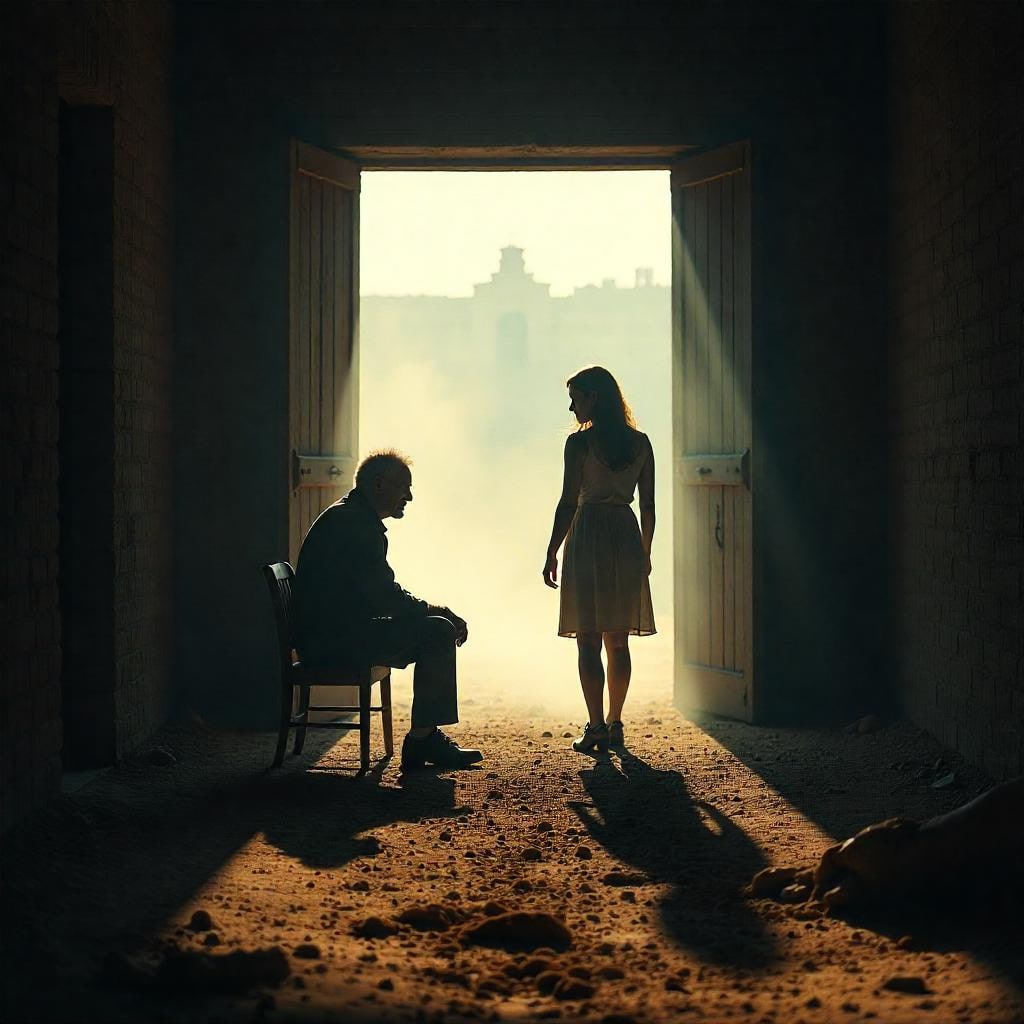
Emily walked quietly through the ruined gates of the abandoned prison, her camera slung carefully over her shoulder, the weight of the equipment grounding her in the silence. Each step of her worn leather boots crunched sharply against the gravel path, sending small stones skittering in every direction. The prison, a colossal structure of broken concrete and rusted iron bars, had been closed for over a decade now, swallowed slowly by the relentless desert and largely forgotten by the world outside. To most people, this place would be considered haunted—whispers of lost souls lingering between crumbling walls, shadows moving just beyond sight. But Emily didn’t see ghosts; she saw a story waiting to be told, a perfect location for her final shoot on a documentary she had spent nearly a year crafting—“Forgotten Prisons.” The film was about places where justice had once been served, but where time had grown weeds over truth and silence had settled thick like dust.
What she did not expect to find on this day, in this forsaken place, was a man already there.
He sat quietly on a broken bench in the central courtyard, his posture relaxed yet somehow purposeful. In one hand, he cradled a chipped enamel mug, sipping slowly as if savoring each swallow. The harsh sunlight caught on the silver threads woven through his beard, making him look like a relic himself—weathered but enduring. He didn’t look like a squatter or a ghost. Instead, he looked as though he belonged, a living part of the prison’s forgotten history. And that realization unsettled Emily far more than the peeling paint and crumbling stone around her.

She raised her voice just enough to cut through the heavy stillness. “Are you the caretaker?”
The man looked up, squinting against the sun, a faint smile pulling at the corners of his mouth. “Caretaker?” he echoed, chuckling quietly. “No, nothing like that.” Emily hesitated, then pressed further, “Then… do you live here?” He shrugged, as if the question was both simple and complicated all at once. “I stay,” he said, his voice calm, steady.
“For how long?”
He glanced toward the ruins of the nearest cellblock, its roof collapsed like the pages of a forgotten book. “Seventeen years, give or take.” Emily blinked in disbelief. “You’ve been here since it closed?”
“No,” he replied quietly. “I’ve been here since it broke me.”
His words hung in the air like a fragile glass orb about to shatter. Emily wasn’t sure if she should keep filming or quietly turn away, but something about the stillness in his voice held her rooted to the spot. “I’m Emily,” she said finally, offering her name. “I’m making a film about forgotten prisons.”
He nodded slowly, a flicker of recognition in his eyes. “Then I suppose I’m one of your ghosts.”
Over the following days, Emily returned to the prison again and again. Daniel Hayes, as he revealed his name, was a man of few words at first, speaking only when asked, often retreating into long stretches of silence that seemed to stretch endlessly between the cracked walls. But gradually, he began to share fragments of his story—not about crime or justice, but about memory, love, and the unbearable weight of staying still while the world moved on without him.
One afternoon, he took her to the cell where he slept. It was small and bare, but it wasn’t locked; he had removed the door years ago, a silent protest against the prison that had trapped him in more ways than one. The mattress was old and stained but surprisingly clean. Against the wall, leaning carefully on the floor, was a faded photograph—a woman with bright, laughing eyes. Her name was Lily.
“She was my wife,” Daniel said quietly, almost as if speaking the words aloud gave them new life. Emily, filming from a respectful distance, watched the sadness pool in his eyes.
“We were on a road trip when they took us in,” he continued. “They said we matched the description of suspects in a robbery. We thought it would be sorted out in a day.” But it didn’t.
He shook his head slowly, the memory weighing on him. “It never did.” His voice dropped lower, steady and steady like a slow-burning ache. Two young lovers, arrested wrongly, ripped apart before anyone could prove their innocence. Lily was pregnant. Daniel wasn’t allowed to see her or even speak with her.
“She died in custody,” he said simply. “They said dehydration. Panic. She never understood what was happening. And she never got to say goodbye.” Emily sat on a cracked concrete step nearby, the camera forgotten in her lap, the story hitting her harder than she expected. “I was released two weeks later,” Daniel said, his eyes hollow. “An apology, some legal nonsense. They called it a mistake. But they buried her without telling me.”
“When I found out, I came back here,” he said, his voice breaking ever so slightly. “And I’ve stayed ever since.” Emily swallowed hard. “Why?" He didn’t look at her when he answered. “Because this is the last place she was alive. If I leave… it’s like she dies all over again.” She didn’t ask more. Instead, she captured the broken walls, the fading light, and Daniel’s silent shadow.
That night, back at her motel, Emily couldn’t sleep. The story haunted her mind. She opened her laptop and started digging through the scattered digital archives she had gathered during her research. Prison records, court documents, old memos, medical reports—the pieces were faint but there. One document caught her eye—a medical note stating that Lily had gone into premature labor. The baby had been taken to a hospital. Another file. The child had survived.
Her heart raced as she dug deeper, tracing confidential adoption records she could access through journalistic connections developed over years. After hours of searching, she found what she needed. The girl—Grace—was alive. Seventeen years old. Living with a foster family in Oregon. The records mentioned her growing curiosity about her biological parents and a fascination with abandoned places. She had recently applied to film school.
Emily closed her laptop and stared at the ceiling, the weight of the discovery pressing down on her. She knew she had to tell Daniel. The next morning, Daniel was sweeping dust from the courtyard with a battered old broom when Emily arrived.
“There’s something I need to tell you,” she said carefully. He looked up, wary. “She didn’t die alone,” Emily said, stepping closer. “She gave birth. To a baby girl.” Daniel froze. The broom slipped from his hand and clattered onto the ground. Emily reached into her bag and pulled out a photo she had printed the night before—a young girl with deep brown eyes, a camera slung over her shoulder, standing in a film school auditorium.
“Her name is Grace,” Emily said softly. “She’s alive. She’s safe. And she’s been asking about you.” Daniel’s face didn’t move at first. Then slowly, the knees that had held him up gave way, and he sank to the ground as if the world had shifted beneath him. “She’s real?” he whispered, voice cracking.
“Yes,” Emily said gently.
He looked up at the sky, blinking through tears he didn’t bother to hide. “I don’t know how to be a father.” “You don’t have to know,” Emily said, kneeling beside him. “You just have to show up.” “She’ll hate me.”
“She doesn’t even know you yet. But she’s waiting.” He stared at the photo, trembling with a mixture of hope and fear. “I thought I’d lost everything.” “You didn’t,” Emily said. “You just stopped looking.” That evening, Daniel packed his few belongings—a handful of clothes, Lily’s photo, a worn-out notebook filled with memories and regrets. Emily bought the bus tickets. He didn’t protest. The bus ride was quiet. Daniel asked no questions. He simply stared out the window as the desert gradually gave way to cities, then trees, then the soft, persistent rain of Oregon.
Grace waited at the edge of a small community park, pacing nervously. She had agreed to meet Daniel after Emily had explained everything. In her hands, she clutched the only photograph she had ever had of Lily, the woman she’d never known. When Daniel stepped off the bus, he didn’t speak. He simply walked toward her, slow and unsure. Grace turned, saw him, and paused. Then she walked. Then she ran.
And he opened his arms. She crashed into him, holding on as though she would never let go. “I’m sorry,” he whispered, his voice thick with emotion. “I didn’t know. I didn’t know.” “You’re here,” she sobbed, “and that’s enough.” Emily watched from a distance, tears running silently down her cheeks. She would still finish the documentary.
But this story had changed. No longer about ghosts or forgotten ruins. This was a story about return. About broken timelines finding their way back to one another.
About a man who thought he had lost everything—and in the end, found everything.
About the Creator
Mian Nazir Shah
Storyteller fueling smiles and action with humor, heart, and fresh insights—exploring life’s quirks, AI wonders, and eco-awakenings in bite-size inspiration.
Keep reading
More stories from Mian Nazir Shah and writers in Humans and other communities.
The Girl Who Lived in a Graveyard
Graveyards are for the dead, they say. But in the heart of one—where silence clung like moss to stone and the wind wept over forgotten names—there lived a girl. She wasn’t a ghost. She wasn’t a figment of sorrow. She was real. Her name was Amara.
By Mian Nazir Shah9 months ago in Humans
We Are Not Fighting Demons; We Are Walking Our Shadows Home
Flower InBloom writes at the threshold where healing, truth, and self-return meet. This piece is an offering for anyone learning that wholeness does not come through inner war, but through walking the abandoned parts of the self back home.
By Flower InBloom2 days ago in Humans


Comments
There are no comments for this story
Be the first to respond and start the conversation.