
The Prison Without Bars: How Norway’s "Insane" Experiment Cut Crime in Half
A new experiment on human

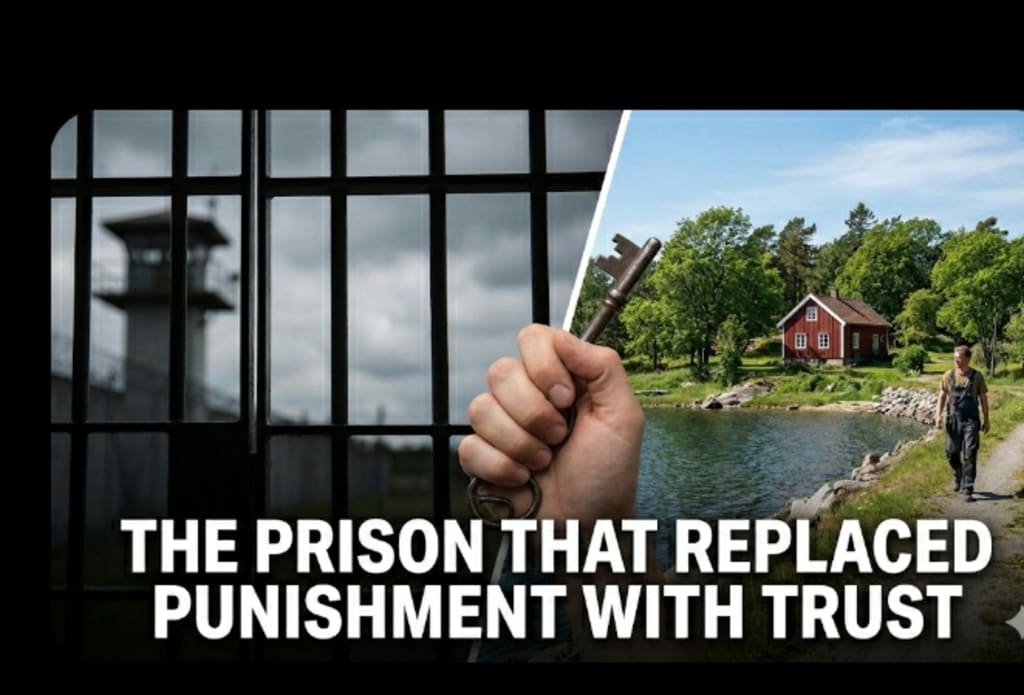
Imagine a prison with no walls, no guards, and no cells. It sounds like a recipe for disaster, but in Norway, it became the most successful correctional facility in the world. Here is the true story of how trust replaced punishment on Bastøy Island.
Introduction: The Ferry to Nowhere
If you stand on the shores of the Oslofjord in Norway and look out across the grey, freezing water, you might see a ferry approaching a small, pine-covered island.
On the deck, a man is smoking a cigarette, watching the waves. He isn’t wearing handcuffs. He isn’t wearing a bright orange jumpsuit. He is wearing jeans and a heavy wool sweater. He carries his own bag. When the ferry docks, no armed guards are waiting to seize him. He walks off the boat, breathes in the salt air, and walks toward a cluster of red wooden cottages that look more like a summer camp than a penitentiary.
This man is not a tourist. He is a convicted violent offender. And he has just arrived at Bastøy Prison.
For most of the world, the concept of prison is synonymous with concrete, steel, isolation, and fear. We are taught that justice requires suffering. If someone breaks the law, society must break them in return. But on this small island in Scandinavia, the Norwegian government decided to test a radical hypothesis that flies in the face of centuries of penal history.
They asked a dangerous question: What happens if we treat prisoners like neighbors instead of monsters?
The answer didn’t just change the lives of the men on the island. It produced statistics so shocking that criminologists around the world initially refused to believe them. This is the story of the prison that replaced punishment with trust—and why it works.
Part I: The Island of Paradox
Bastøy Island is a paradox. It houses some of Norway’s most serious offenders—men convicted of murder, rape, and large-scale drug trafficking. Yet, there are no electric fences. There are no watchtowers. There are no armed guards patrolling the perimeter.
In fact, there is no perimeter.
If a prisoner wanted to escape, they could. The distance to the mainland is swimmable for a strong athlete, or easily crossed if one were to steal one of the island's boats. And yet, almost no one tries.
When a new inmate arrives, usually transferred from a high-security facility after showing good behavior, they are expecting a trap. They are waiting for the other shoe to drop. They are used to being told when to wake up, when to eat, when to shower, and when to speak. They are institutionalized, stripped of autonomy, and conditioned to survive through aggression.
At Bastøy, the Governor (the warden) doesn't greet them with a threat. There is no "break you down" speech. Instead, there is a handshake. The new arrival is given a key—not to a cell, but to a wooden cottage they will share with a few other men.
The Governor’s message is simple but terrifying to a man used to cages:
"You are responsible for yourself here. Don't prove me wrong."
Part II: The Architecture of Trust
To understand why Bastøy works, you have to understand the philosophy of "Normalcy."
The Norwegian Correctional Service operates on a principle that the punishment is the restriction of liberty—not the conditions inside the prison. The loss of freedom is the penalty. Once inside, the goal shifts immediately from punishment to rehabilitation.
In a standard American or British prison, the environment is designed to dehumanize. Inmates wear uniforms that strip their identity. They live in cages that strip their privacy. They face constant threats of violence, which forces them to become harder, colder, and more violent to survive. It is a masterclass in creating better criminals.
Bastøy flips the script.
The Daily Life of an Inmate
At Bastøy, the day starts at 7:30 AM. But there is no blaring siren. The men have alarm clocks. They are responsible for waking themselves up.
They don’t line up in a cafeteria for prison slop. They are given a monthly stipend (earned through work) to buy groceries at the island’s mini-supermarket. They cook their own breakfast in their cottages. They have to budget, plan meals, and clean up after themselves.
From 8:30 AM to 3:30 PM, everyone works. This isn’t "breaking rocks" busy work. It is essential labor required to keep the island running.
* Some men work as farmers, tending to sheep, cows, and chickens.
* Others work in forestry, managing the dense woods of the island.
* Some are mechanics, fixing the island's vehicles and ferries.
* Others work in the laundry or the kitchen.
They are paid for this work. It’s not much, but it mimics the real world. If you don't show up, you don't get paid. If you don't get paid, you can't buy the good food at the shop.
The Guard Dynamic
Perhaps the most jarring difference is the guards. In most prisons, the relationship between guard and inmate is adversarial. It is a war zone.
At Bastøy, half the staff are women. None of them carry guns. They don’t even carry batons. Their primary role is not security, but social work. During lunch, guards and inmates eat together. They sit at the same tables, eat the same food, and talk about sports, politics, and their families.
This interaction is the "secret sauce" of the Bastøy experiment. It is impossible to demonize someone you share a meal with. When a guard treats a prisoner with dignity, the prisoner feels a sudden, crushing weight of social responsibility. It is easy to hate a guard who beats you. It is very difficult to disappoint a guard who treats you like a human being.
Part III: The "Soft" Prison vs. The Hard Facts
Critics often look at Bastøy and call it a "holiday camp." They see the horseback riding, the sunbathing in the summer, and the lack of bars, and they scream that it is an insult to the victims of these crimes.
“Why should a murderer get to live on a beautiful island?” they ask.
It is a valid emotional response. But justice isn’t just about emotional satisfaction; it’s about public safety. And this is where the hard facts destroy the argument for harsh punishment.
The Recidivism Rate
The ultimate measure of a prison's success is the Recidivism Rate: the percentage of prisoners who are released, commit a new crime, and end up back in jail within two years.
* In the United States, the recidivism rate hovers around 60% to 70%.
* In the UK, it is roughly 50%.
* In Norway’s general prison system, it is around 20%.
* At Bastøy Prison, the recidivism rate is approximately 16%.
Let that sink in.
In the US, nearly 7 out of 10 prisoners will create new victims. At Bastøy, fewer than 2 out of 10 will.
If the goal of the justice system is to ensure fewer people are raped, murdered, or robbed in the future, Bastøy is statistically the most effective prison model on Earth. The "harsh" prisons are arguably failing society by releasing men who are more dangerous than when they went in. Bastøy releases neighbors.
The Economic Reality
"But surely," critics argue, "this resort-style prison must cost a fortune."
Surprisingly, Bastøy is actually cheaper to run per inmate than a high-security closed prison.
* Staffing: You need fewer guards because there is less violence and tension.
* Infrastructure: You don’t need high-tech surveillance systems, electronic doors, or massive concrete walls.
* Self-Sufficiency: The prisoners grow a significant portion of their own food and maintain the island's buildings themselves.
Furthermore, the long-term savings are astronomical. Every time a prisoner is rehabilitated and doesn't return to jail, the state saves hundreds of thousands of dollars in future court costs, police time, and incarceration fees.
Part IV: The Psychology of the "Monster"
Why does trust work better than fear? To understand this, we must look at the psychological concept of the Self-Fulfilling Prophecy.
If you take a man and tell him he is an animal—if you cage him, chain him, and watch him constantly—he will eventually act like an animal. He loses his agency. He loses his moral compass because his entire existence is controlled by external forces. He behaves only to avoid pain, not because he wants to do good.
Bastøy operates on Cognitive Dissonance.
When a violent man is handed a knife to chop vegetables for dinner, his brain stutters.
Script A: "I am a dangerous criminal. I hurt people."
Script B: "This guard just gave me a knife and turned his back. He trusts me."
These two scripts cannot coexist. To resolve the tension, the prisoner has to change his internal narrative. He has to rise to meet the expectation of trust.
The Story of the Chainsaw
There is a famous anecdote from the island regarding the forestry team. Inmates use chainsaws, axes, and heavy knives to clear trees. These are lethal weapons.
In the history of the prison, there has never been an incident where a chainsaw was used as a weapon against a guard or another inmate. Not once.
Why? because the chainsaw represents a trade. It represents a job. It represents the fact that someone trusted them with a dangerous tool. To use it as a weapon would be to admit that they are merely animals, confirming the world's worst suspicions about them. By using it for work, they prove their humanity to themselves.
Part V: A Lesson for the World
The story of Bastøy is not really about criminals. It is a mirror held up to society.
It challenges our deepest instincts about justice. We naturally want revenge. When we are hurt, we want the perpetrator to hurt. It feels "right." But Bastøy forces us to ask a difficult question:
Do we want revenge, or do we want a safer society?
We cannot have both. The data shows that revenge—locking people in boxes and treating them like dirt—creates a cycle of violence that never ends. It creates angry, broken men who return to society with a grudge.
Bastøy proves that the opposite is true.
* Trust creates responsibility.
* Dignity creates self-control.
* Community creates empathy.
The Final Key
There is a moment that every inmate at Bastøy eventually faces. It is the moment they are released.
In a traditional system, a released prisoner walks out with $50 and a bus ticket, traumatized by years of violence, with no skills and a criminal record that ensures no one will hire them. They are set up to fail.
A Bastøy graduate walks onto that ferry to the mainland differently. He has spent the last few years waking himself up, going to work, managing his money, and living in a community. He is a trained mechanic, or a chef, or a carpenter. He has looked authority figures in the eye and been treated with respect.
He isn't just "free." He is ready.
As the ferry pulls away from the island, leaving the red cottages and the pine trees behind, the former prisoner looks back. He sees the place where he was imprisoned, but he doesn't see a cage. He sees the place where he was finally given permission to be human.
And because he was treated like a human, he will live like one.
Why This Story Matters Today
In an era of mass incarceration and rising crime debates, the "Bastøy Model" offers a blueprint that is hard to ignore. It suggests that the strongest bars aren't made of iron—they are made of shared humanity.
If you enjoyed this deep dive into the psychology of justice, please consider liking this story and subscribing for more explorations into the human condition.
About the Creator
Frank Massey
Tech, AI, and social media writer with a passion for storytelling. I turn complex trends into engaging, relatable content. Exploring the future, one story at a time
Keep reading
More stories from Frank Massey and writers in Humans and other communities.



Comments
There are no comments for this story
Be the first to respond and start the conversation.