
The Station of the Lost: The Ten-Year Vigil of Hiroshi Tanaka
On March 11, 2011, the ocean swallowed the coast of Japan. In the silence that followed, one man decided that death was not a good enough reason to break a date. For a decade, he stood on a platform, proving that patience is the loudest form of love

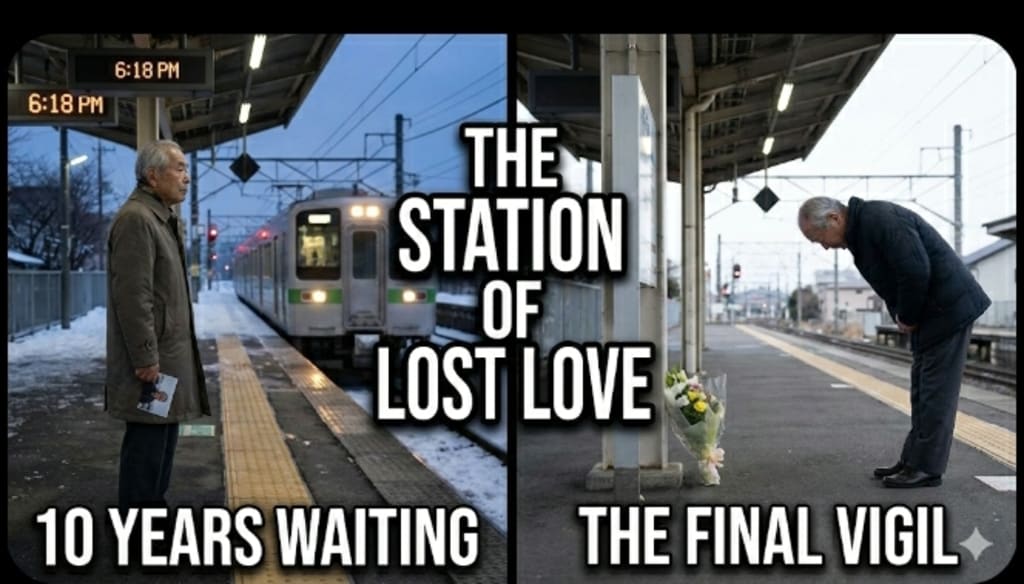
The heartbreaking and inspiring true story of a Japanese man who waited at a train station every single evening for ten years, hoping his missing wife would return after the 2011 tsunami.
Introduction: The Precision of Happiness
In Japan, time is not a suggestion; it is an architecture. Trains arrive at 6:18, not 6:19. Seasons change on the calendar. Life has a rhythm, a predictable cadence that offers comfort in a chaotic world.
Hiroshi and Yuko Tanaka lived inside this rhythm.
They were a couple in their late fifties, living in a coastal town in the Iwate Prefecture. They had been married for thirty years. Their love wasn't the fiery, dramatic kind found in cinema. It was the quiet, structural kind found in architecture. It was the tea poured without asking. It was the socks folded in the drawer. It was the silent agreement on who locked the door at night.
Yuko worked in the city. Hiroshi worked locally. Every evening, Yuko took the commuter train home. She would arrive at the small coastal station at 6:18 PM.
Hiroshi would often drive to pick her up, or sometimes, just be home preparing dinner when she walked through the door at 6:30.
They had plans. Retirement was coming. They talked about visiting the hot springs in hazy blue mountains. They talked about grandchildren.
But the calendar on the wall, which promised a future, did not know about the tectonic plates shifting deep beneath the Pacific Ocean.
Part I: The Day the World Broke
March 11, 2011. 2:46 PM.
The Great East Japan Earthquake did not just shake the ground; it rearranged the geography of the nation. It was a magnitude 9.0 tremor that lasted for six terrifying minutes.
Hiroshi was at his workplace, crouching under a desk while the ceiling tiles rained down like chalk. The sound was deafening—the groaning of steel, the shattering of glass.
When the shaking finally stopped, the silence was worse. The air was filled with dust and the siren wail of the tsunami warning system.
Evacuate. Seek high ground.
Hiroshi ran. He scrambled up the hillside behind his office, watching in horror as the ocean receded from the shore, sucking the harbor dry, only to return as a black, churning wall of water.
It wasn't a wave. It was a deluge. It consumed the town. It took the houses. It took the cars. It took the train tracks.
Hiroshi stood on the hill, shivering in the snow that had begun to fall, and tried to call Yuko.
Beep. Beep. Beep. Connection failed.
The networks were down.
He told himself she was safe. She was at work. She was inland. The train hadn't left yet. She was fine.
He wrapped his arms around himself and watched his town disappear under the black water.
Part II: The Void
The water receded, leaving behind a landscape that looked like the surface of a darker planet. Mud. Debris. Ships sitting on top of buildings.
For weeks, Hiroshi walked through the wreckage. He went to the emergency shelters in school gymnasiums. He scanned the handwritten lists of survivors taped to the walls.
Tanaka... Tanaka... Tanaka...
He found neighbors. He found cousins.
He did not find Yuko.
He went to the morgues, which were just converted warehouses filled with white bags. He looked at faces that were swollen and gray.
He did not find Yuko.
She was simply... gone.
In the bureaucracy of disaster, there are two categories: "Confirmed Dead" and "Missing."
"Confirmed Dead" is a tragedy, but it is a period at the end of a sentence. It allows you to grieve. It allows you to bury.
"Missing" is a question mark that hooks into your heart and pulls. It is a state of suspended animation.
Weeks turned into months. The debris was cleared. The roads were patched. The train tracks were repaired. The station, which had been damaged, was rebuilt.
The officials told Hiroshi the truth he didn't want to hear. "The ocean took thousands, Tanaka-san. Many will never be found. You must accept this."
Hiroshi nodded politely. He was a Japanese man; he understood duty and acceptance.
But his heart was a rebel.
Part III: The Ritual Begins
It started in the summer of 2011.
The train lines were running again. The rhythm of the country was restarting.
One evening, Hiroshi looked at the clock. It was 5:50 PM.
In his old life, this was when he would check the rice cooker. This was when he would anticipate the sound of the front door.
But the house was empty. The silence was loud.
He couldn't sit there.
He put on his jacket. He took his car keys. And he drove to the station.
He parked in the spot he used to park in. He walked to the platform.
He stood near the ticket gate.
At 6:18 PM, the train arrived. The brakes squealed. The doors hissed open.
Commuters poured out. Tired businessmen. Students in uniforms. Mothers with bags.
Hiroshi scanned every face. He looked for the familiar grey coat. He looked for the way she walked, favoring her left knee.
The crowd thinned. The platform emptied.
Yuko was not there.
Hiroshi stood for a moment longer. He breathed in the smell of ozone and sea salt.
Then, he turned around and went home.
The next day, at 6:18 PM, he was back.
Part IV: The Sentinel of the Railway
It wasn't a conscious decision to do it for ten years. It was a decision to do it today. And then tomorrow.
Seasons began to cycle.
Autumn came. The leaves turned red. The wind off the ocean grew sharp. Hiroshi wore a scarf Yuko had knitted him years ago. He stood on the platform, hands in his pockets, watching the doors open.
Winter came. The snow piled up on the tracks. The trains were delayed. Hiroshi waited in the small heated waiting room, wiping the condensation off the glass so he wouldn't miss the arrival. When the train finally pulled in, he stepped out into the blizzard to check the faces.
People started to notice.
The station master, a young man named Kenji, watched him. At first, Kenji thought Hiroshi was confused—perhaps suffering from dementia or trauma-induced amnesia.
One night, Kenji approached him.
"Sir," Kenji said gently. "Are you lost? Can I help you find someone?"
Hiroshi smiled. It was a sad, gentle smile.
"I am not lost," Hiroshi said. "I am waiting for my wife."
"Is she on this train?"
"I don't know," Hiroshi said. "But if she comes back, if she walked out of that ocean and found her way to a hospital, and now she is coming home... I want the first face she sees to be mine. I don't want her to step off the train and see an empty platform."
Kenji bowed low. He never asked again. He simply made sure the vending machine had warm coffee.
Part V: The Ghost of the Living
Years three, four, and five passed.
Hiroshi became a fixture of the town. He was the "Clock of the Station." If Hiroshi was standing by the pillar, you knew it was 6:15.
The community’s reaction shifted. At first, there was pity. Poor Tanaka-san. He has lost his mind with grief.
Then, there was annoyance. Why doesn't he move on? It's been years.
But eventually, it turned into reverence.
They realized that Hiroshi wasn't crazy. He was fully aware. He knew the odds. He read the newspapers. He knew about the DNA databases and the mass graves.
He wasn't standing there because he thought she would come.
He was standing there in case she came.
It was an act of service.
He kept his life in order. He kept the house clean. He went to work. He didn't become a recluse.
But every evening, he punched the clock on his grief.
Sometimes, teenagers would snicker. Sometimes, tourists would stare.
But Hiroshi didn't see them. He only saw the doors.
Open. Scan. Close.
Open. Scan. Close.
He held a small photo of her in his wallet. Sometimes, when the platform was empty and the train had gone, he would take it out.
"Not today, Yuko," he would whisper. "Maybe tomorrow."
Part VI: The Definition of Strength
We often think of strength as force. We think of it as moving mountains, fighting battles, or screaming at the heavens.
But Hiroshi taught his town a different definition.
Strength is standing still when the world wants you to move.
Strength is keeping a candle lit in a hurricane.
One evening, a woman approached him. She had lost her son in the tsunami. She had spent years drinking to numb the pain, angry at the universe.
"How do you do it?" she asked Hiroshi. "How do you stand here and not scream?"
Hiroshi looked at the tracks.
"Love is not measured by how quickly you give up," he said. "If I go home and sit on the couch, I am accepting that she is gone forever. But here... here there is a chance. Even if it is 0.0001%. And as long as I am standing here, I am keeping her place in the world open. I am holding the door for her."
"But it hurts," the woman said.
"Yes," Hiroshi said. "It hurts. But the pain is proof that she existed. I would rather feel the pain of missing her than the emptiness of forgetting her."
Part VII: The Call
* Ten years since the wave.
New technologies had emerged. Advanced DNA sequencing. Dental matching algorithms. The police were making a final push to identify the thousands of unidentified remains stored in vaults across the region.
One afternoon, Hiroshi’s phone rang.
It was the local police prefecture.
"Tanaka-san?"
"Yes."
"We have a match."
They had found a partial bone fragment near the breakwater, miles from where Yuko’s office had been. It had been found years ago, but the technology to match it hadn't existed then.
"It is Yuko," the officer said. "We are 99.9% certain."
Hiroshi sat down in his kitchen. The silence of the house rushed in.
For ten years, she had been "missing."
Now, she was dead.
The hope—that tiny, irrational, beautiful flame he had Cupped his hands around for a decade—was blown out.
He cried. He cried for the wife he lost ten years ago, and he cried for the ghost he was losing today.
Part VIII: The Final Vigil
That evening, the clock struck 5:50 PM.
Hiroshi looked at the phone. He looked at the urn the police said he could collect tomorrow.
He knew she wasn't coming on the train. He knew it with scientific certainty.
But he put on his coat anyway.
He drove to the station.
He walked to the platform.
The station master, Kenji, saw him. Kenji had heard the news—in a small town, news travels fast. He expected Hiroshi to stay home.
When he saw the old man standing by the pillar, Kenji felt a lump in his throat.
The 6:18 arrived.
The brakes squealed. The doors hissed open.
Hiroshi didn't scan the faces this time. He didn't look for the grey coat. He didn't look for the limp.
He looked at the empty space where she would have stepped off.
He imagined her there. He imagined her smiling, carrying her bag, complaining about the air conditioning on the train.
He imagined her saying, “Tadaima” (I’m home).
And in his heart, he answered, “Okaeri” (Welcome back).
The doors closed. The train pulled away, disappearing into the twilight.
The platform was silent.
Hiroshi took the photo out of his wallet. He looked at it one last time in this setting.
He didn't speak to the air. He didn't speak to the train.
He bowed.
A deep, slow, respectful Japanese bow. Bending at the waist, holding the pose.
He bowed to the station that had sheltered his hope. He bowed to the tracks that had carried his dreams. And he bowed to the wife who was never coming back.
"Now I know," he whispered. "Now I can rest."
He straightened his coat. He turned around.
And for the first time in ten years, Hiroshi Tanaka walked away from the station without looking back.
Conclusion: The Architecture of Love
The story of Hiroshi Tanaka is not a tragedy.
A tragedy is when love dies. Hiroshi’s love never died. It just changed forms.
For ten years, his love was a wait.
Now, his love was a memory.
Most people run from pain. We distract ourselves with screens, with work, with anger. We try to "move on" because we are terrified of being stuck.
But Hiroshi showed us that "moving on" is a myth. You don't move on from the people you love. You move with them. You carry them.
Sometimes, you carry them in your heart. And sometimes, you carry them by standing on a concrete platform in the freezing wind, refusing to let the world forget that they mattered.
Hiroshi didn't waste ten years.
He spent ten years building a monument. It wasn't made of stone or bronze. It was made of minutes, hours, and days.
It was a monument that said to the universe:
You can take her body. You can take her future. You can break the world.
But you cannot break my promise to be here when she arrives.
And in the end, that loyalty is stronger than any tsunami.
About the Creator
Frank Massey
Tech, AI, and social media writer with a passion for storytelling. I turn complex trends into engaging, relatable content. Exploring the future, one story at a time
Keep reading
More stories from Frank Massey and writers in Humans and other communities.
The Bus Driver Who Refused to Turn Back: A Story of Survival in the Colombian Andes
Date: May 16, 2017. Location: The rural mountains of Antioquia, Colombia. Weather: Relentless. In the mountains of Colombia, rain is not just weather; it is a living entity. It doesn’t just fall; it hammers. When the wet season arrives in the department of Antioquia, the lush green peaks that look like paradise can turn into a death trap within minutes.
By Frank Massey 2 days ago in Humans
Whiskey At Dusk
Guess the whiskey was more important to you in the end, wasn’t it? It was more than the well-being of your friends; more vital than showing up to the places you promised you would and could come to; more critical of a matter than fulfilling your damn responsibilities and getting the press off your back.
By Snarky Lisa5 days ago in Humans
My Old Friend
My Friend (Chinese Folktale) This is a traditional Chinese folktale. Long ago, animals resembling today’s black-and-white pandas did not exist. Instead, deep in China’s bamboo forests lived white bears with soft, shining fur, as bright as freshly fallen snow. These bears were called Bai Xiang, meaning “white bears.”
By Sudais Zakwan3 days ago in Humans
One Unchecked Box
"Republished" because it was the only way to add the embed for the newly recorded audio version of this story due to the Top Story badge. Plus it serves as a nice, informal announcement of the podcast's revival for another season (go subscribe!):
By Stephen A. Roddewig2 days ago in Fiction


Comments
There are no comments for this story
Be the first to respond and start the conversation.