
The Price of Arrogance
How a Simple Market Dispute Unveiled the Weight of True Justice
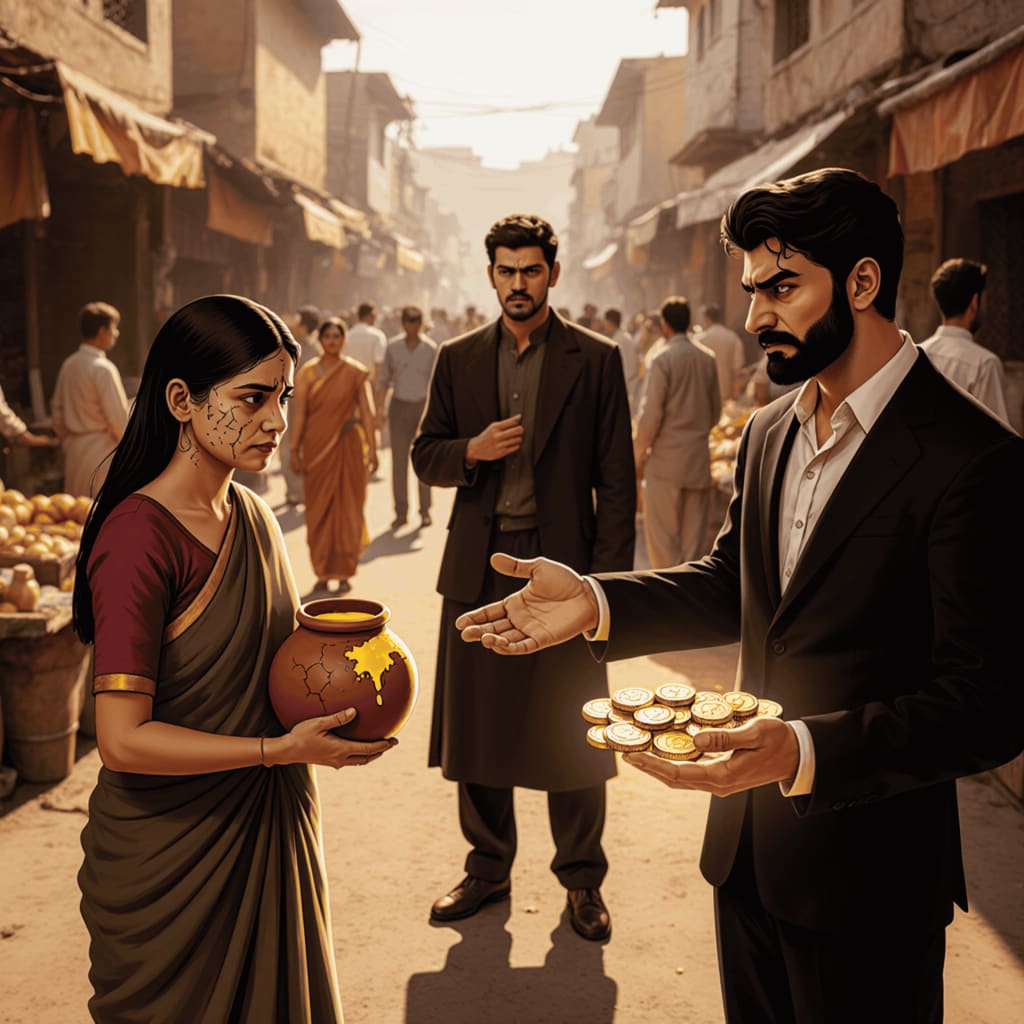
The market was filled with its familiar symphony of sounds—merchants shouting their goods, children dodging stalls, and the constant buzz of haggling hanging in the air. Through the crowd passed a man well-known in the town for his conceit. He dressed in fine attire, held his head high with a haughty tilt to the chin, and spoke as if each sentence he articulated contained the force of law.
As he walked along the bazaar, his gaze rested on a woman carrying on her head a large clay doll full of ghee. She wore simple clothes, her face creased with lines of toil, but she moved with dignified calm. The man sneered, addressed her, and asked facetiously,
"O Mai, what are you carrying on your head?"
The woman shifted the weight and responded simply, "Yes, I sell ghee."
Maybe looking for a joke, or maybe just arrogant, the man persisted, "And how are you?"
The tired woman carefully shifted the clay doll from her head onto her arms. In doing so, a little trickle of ghee escaped from the container and splashed onto the man's shirt. His eyes grew wide.
You stupid woman!" he bellowed. "Don't you see what you've done? You've destroyed my good shirt! Until I get payback, I will not allow you to leave here."
The woman began to cry. "I am a poor woman, sir. I did not do that on purpose. Have pity on me, let me go.
But pride does not allow much for mercy. "No," the man snarled. "Not until you pay me. And understand this—this shirt cost me a thousand dirhams."
The poor woman folded her hands. "A thousand? Sir, I barely earn that in many months. Where am I supposed to get such money? Please, don't shame me like this in front of everyone."
But the man continued to shout, threatening and taunting her, attracting the onlookers. The mob observed in silence, compassion in their eyes but fear constraining them.
It was at this moment that a young man, appearing simple in his attire but radiating poise, intervened. He glanced at the shaking woman, then at the rude man looming over her. "What is going on here?" he inquired.
The woman told her bad luck between tears. The young man didn't hesitate. He opened his pocket, took out a bag of coins, and said, "Here, sir. A thousand dirhams—the cost of your shirt."
The haughty man grabbed the money with greedy hands and was about to turn and walk away victorious. But before he could move one step, the voice of the young man halted him.
"Where are you going?"
The man spun around. "What else do you want from me? You have your money."
The young man's face was tranquil but resolute. "We paid for your shirt, did we not? So now, hand over your shirt and leave."
The crowd burst into grumblings. The man's face turned red. "Are you crazy? How am I to walk naked in the marketplace?"
The young man shrugged. "We do not care. You said the shirt was worth a thousand dirhams, and we have paid you. Now the shirt is ours."
The conceited man balled his fists. "And if I say no?"
"Then pay us the value of the shirt," the young man responded flatly.
"And how much is that?" the man asked, voice shaking with rage.
"Two thousand dirhams," the young man stated.
The man was taken aback. "But you offered me only one thousand!"
The young man's voice grew more acerbic. "Just as you insisted from this poor woman. Now it is we who determine the price."
The self-important man spluttered. "This is too high—it is unfair!"
The young man's gaze met his. "Injustice? You felt no injustice in humiliating this poor woman for a minor mishap. But now that the balance has shifted, you howl cruelty? Marvelous how swift you learn fairness when the lash is on your own back."
The market became silent. Everyone stared at the conceited man, whose ego now was shattered at the feet of the crowd. In an attempt to escape further embarrassment, he took two thousand dirhams from his bag and pushed them at the young man.
The young man accepted the money, turned to the woman and put it into her hands gently. "This," he said, so that everyone could hear, "is yours. Not out of pity, but justice. Today, arrogance has cost itself something."
The woman wept openly now—not tears of despair, but thanks. The crowd murmured in applause. The obnoxious man crept away, shorn not of his shirt, but of his pride.
The young man spoke to the crowd and said, "Remember this: we are hasty to claim justice for ourselves when we are done wrong, but blind when others are done wrong. Unless we can feel another's pain as our own, we will never emerge a just people. But if we learn to uphold the dignity of the weak, we can become a nation of honor.
The words hung in the air long after he departed, a subtle reminder that real justice is not tallied in coins or fabric, but in empathy.


Comments
There are no comments for this story
Be the first to respond and start the conversation.