
The Power of Good Craft -- Reid Anrod for the "Create Your Happiness" Challenge
How freeing painting can be
Reid Anrod // Vocal “Create Your Happiness” Essay
This pair of opposing forces, I have found in the past year -- expectation rushing up from behind, and uncertainty crushing in from the front -- can be almost oppressive.
“Reid, when will you..”
“Reid, how will you…”
“Reid, what will you…”
Questions coming in at a critical time when I’m not sure what the next step in my life should or will be, when I don’t have any answers. At 21 years old, I’ve just graduated college, and have spent what seems like far too many nights awake in my bed, worrying. Over the span of many serious, hard-worded conversations and lines of questioning with & from the people closest to me, I have become impressed with this heavy sense that my future has to be decided now. It is time to step off of the path I have followed up until this point -- the normal course of schooling, predetermined and definite -- into the ‘real world,’ young man. And, since I still do not feel capable of making that decision, resolving my life, here and now, the whole situation feels overwhelming. If it was just that stress all the time, I might be paralyzed. But I am very lucky. I have always had art.
I think I’ve known since the beginning that the space in which I make art -- the hours spent at a table, with a pen, or marker, or these days, a paintbrush -- is somewhere else. Somewhere separate from this world of cares, and expectations, and hard realities, a place where I am like a bankrobber who has escaped into some sunny country with no extradition treaty: immune from it all. These days, I paint and paint.
I may not have the cash for actual canvases, and I may use paints from the hardware store -- stinky stuff, intended more for fences and walls than for art -- but those details do not seem to matter. If you care about art, you will find a way, whatever you have; materials are to me, basically incidental -- immaterial. The will to create is far more important in an artist than his or her means of creating. That is why I believe art is so fundamentally egalitarian. For my painting surface, case in point, I reclaim a supply that virtually anyone can get their hands on for next to nothing: brown paper grocery bags. I think I can fairly call it a paper choice for the people!
The preparation of that painting surface is almost like a ritual to me -- it has to be handled with diligence, and done right, because the life & character of the painting necessarily depends on a good support of the right size. My first tool in the whole art making process is, without fail, scissors. No joke, the same pair of orange-handled Fiskars scissors that has been used in my home since before I can remember. I carefully cut the bag apart, being careful to preserve all the uncreased faces, bring the rectangle of paper to the intended dimensions, then flatten it out and prime it.
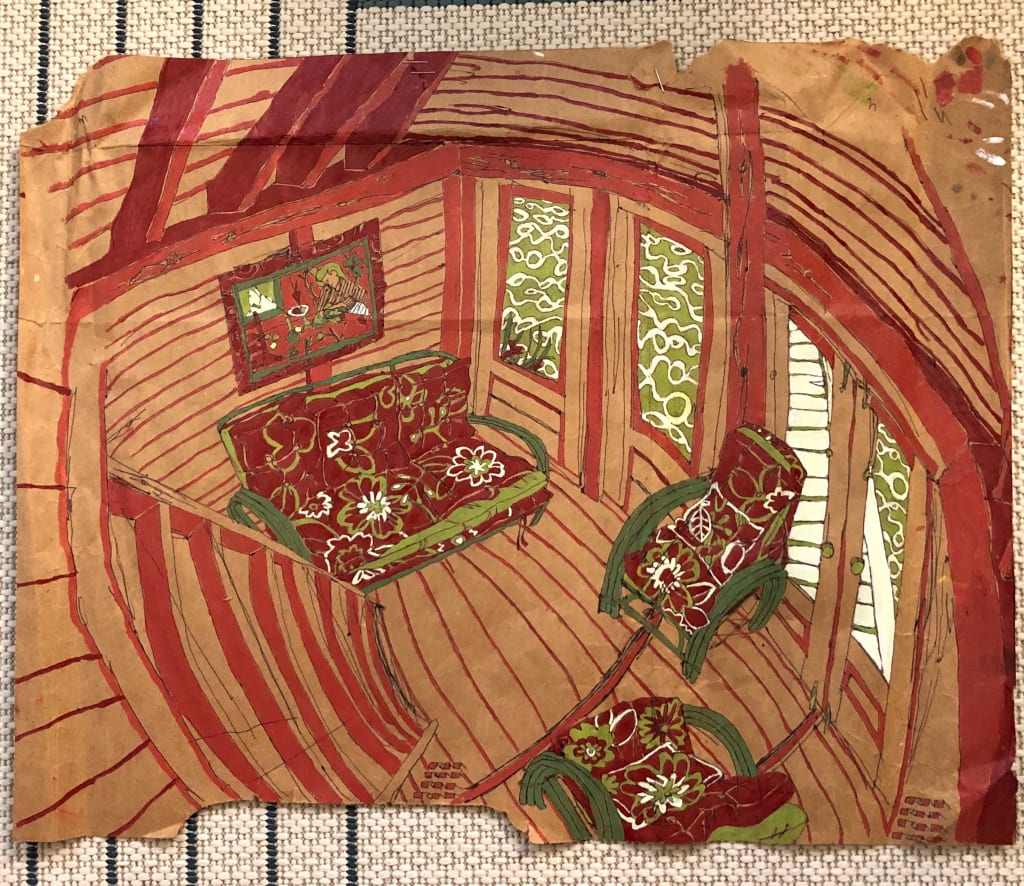
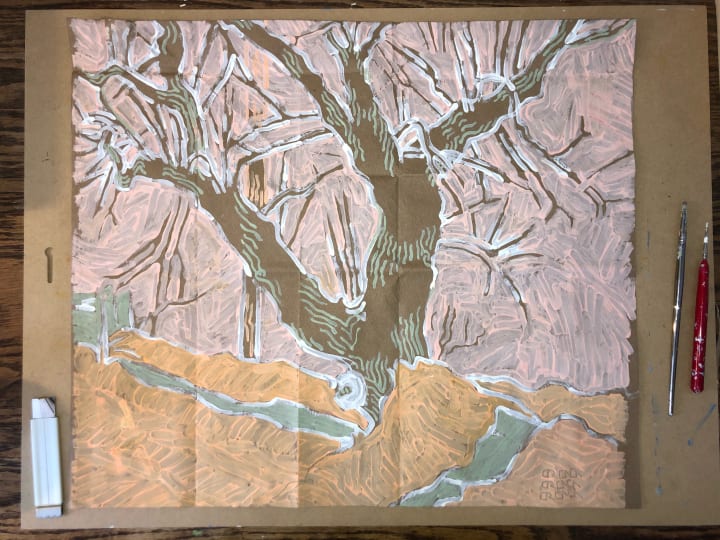
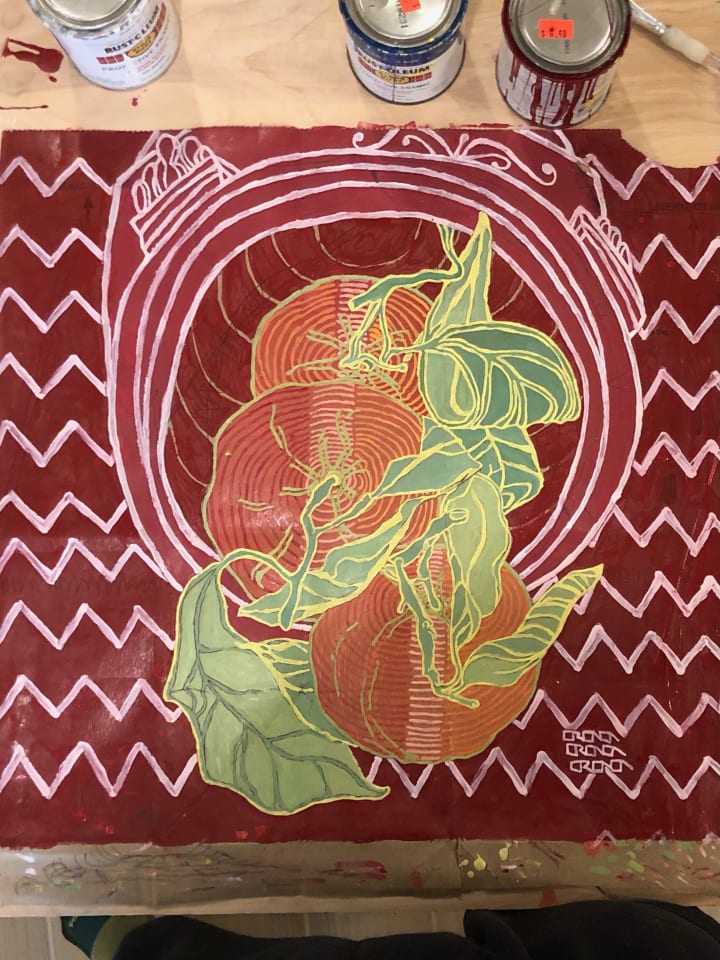
Only after this can painting start. If I have to settle on just one painting to talk about, I think I will choose one which best retains the truth of the surface -- the brown paper -- in the image. (Two more paintings are attached, though, just to show some of my subject variety). I generally like to paint familiar things over people, since they are such patient subjects, and are not prone to move. Especially things & structures & scenes that bring me joy; I like pictures that carry me back to high times, not low ones.
In the case of the first attached image, I climbed into a boathouse loft with my salvaged sheet of paper, and spent several hours sketching and painting the wooden beam-and-plank room I saw below. To grasp as much of the room as possible, I tried to force a kind of fish-eye perspective on the space. It remains, to date, one of my favorite paintings I’ve done. And the act itself, of making that picture, remains one of my favorite memories.
Sitting up there, in that boathouse loft, with the sound of the lake before me, and sunlight on my back, I was essentially free. No stress, no pressure, no expectation or decision about my future was on me. They were left behind somewhere. All there was in that moment was me, alone in a loft with my art. I didn’t have to worry about anything but the next line I was going to put down on the paper, or the right color for the water out the window. If any thought about my future did cross my mind, it was only, ‘why can’t this be it. Why can’t I just paint.’
When I climbed down from that loft, as is often the case when I feel I have been productive with my art, the lightness of soul lingered for the rest of the day. I returned to a table, got out my best scissors, and cut off the unused border -- brought the picture to its final size. Those scissors are at the start and end of every painting I make. I am so ecstatic when I feel I have executed a good picture, and yet at the same time, in that success, I’m at such sound internal peace. Painting seems to be the absolute best thing I ever do for my mental and spiritual health. I believe that very rare, curative power of art can do its work on anyone. It certainly did on my artistic hero, Van Gogh, who made his most famous pictures not when suffering, but when recovering from his severe mental illness. We all have troubles, and we all occasionally need sanctuary from them. For me, and I know for many, passion for a craft is that safe haven. I am so grateful, in the face of grave and sometimes oppressive circumstances, that I will always have this creative hope. It doesn’t just shelter. For a bright second, it liberates.
About the Creator
Reid Anrod
Painter!!
Keep reading
More stories from writers in Humans and other communities.
Lost and Alone in the French Alps
Looking back, I can trace some of my life’s biggest adventures to a simple action from my sister. She’d introduced me to Tommy (a very long time ago), a colleague of hers, who had overshared his penchant for Italian-looking women, and I ticked that box.
By Chantal Christie Weiss20 days ago in Humans
Seven Socially Acceptable Behaviors That Secretly Kill Your Potential.
You follow rules taught as polite and mature. Society rewards these behaviors with approval. Praise feels safe. Progress slows. The danger hides in habits nobody questions. These habits look responsible. They drain growth over time.
By Wilson Igbasi6 days ago in Humans


Comments
There are no comments for this story
Be the first to respond and start the conversation.