
The Path to Sand
a personal essay on a childhood best friend
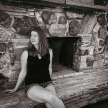


Through the screen door and past the red wooden one that is, to your memory, always open, go straight for three paces and twist right. Stand at the top of the stairs. The banisters mark an indent of a large living room, but you aren’t bothering with the living space just ahead, the hallway of bedrooms behind you, or the kitchen over to your right. You’re at the top of the stairs. A large mirror hangs on the orange-red wall behind you. (Go nearly eighteen years ago when you tried to see the back of your head as you turned in all directions.) It’s a foyer that belongs to a ranch-style home, or more specifically, a front hall; nothing about it distances you. That’s who you were when you were with this family: utterly embraced.
As you trek down the beige carpeted steps, the bottom of the upstairs floor begins to create a new ceiling. It tricks you into believing your head will hit it now that you’ve grown to be tall enough to notice. The memories of being a tall child possess you during this process but don’t duck as you go under it like your nine-year-old instincts demand.
Once at the bottom, you’ll see a framed oil painting of a girl on a swing. It makes you think of that summer you, your sister, and your neighborhood friends played “Survivor” in the backyard of this house. Your sister began on the swing, dropping with it from the treehouse like a skydiver without a chute. But don’t get distracted! Look to your right at a rickety piano with genuine ivory keys. There’s still tape residue where you and your best friend labeled them. Remember that time you both laid down and played them from underneath? Even here, now, the haunted appearance of the keys echo.
Beside the instrument and through a doorway is your best friend’s bedroom. The black sand you collected from an Italian beach still sits in a blue container on her dresser. You can barely conjure her old room upstairs, the one she used to share with her sister. But this one was better, anyway. Her two pillows make you think of the endless sleepovers and how it never seemed normal that she needed double that of a normal person in order to sleep.
Leaving now, turn left and go down that piano’s hallway. Straight ahead is a small bathroom with olive green walls and shower mats. Being in there always felt as though a room was swallowing you (probably because it was). Don’t look inside the shower; some spiders never die. Look and wonder at the visceral nature of your memories of this place. Then turn the corner and you’ll come to a marble counter with two sinks. You used to be so confused as to its presence, out in the open without any other feature of a bathroom, which, as you'll recall, has its own sink. (Later, you learned that this used to be a rental house for college students.)
You will come to a door that leads into a small room full of random boxes, objects, and furniture. This was the place you and your sister helped your best friend pack for a trip to California once. Don’t go in. That was the day she slipped between your fingers, the rock of her constant presence dissolving like sand. You suppose it was only right that it felt like that. You started it with the sand, after all.
With a ninety degree turn, you now greet the basement living room. Like the first floor, the basement fully encircles the staircase. To your left is another bedroom, one that eventually became her oldest younger brother's room. You have zero memories of this bedroom. In fact, did it even exist? One day, it seemed to appear out of mist.
Just in front of this room, though it must be offset out of logic, is a corner desk with many picture frames on and around it. This is where the parents worked. You used to find the constantly surrounding family beautiful in a way your house could never pull off. (No, your house was too crowded, too angry, too stair-stepped in its routines and sense of selves.) Further down the wall is a green-cushioned couch that faces the television. A pile of toys, games, and other miscellany for the youngest children is heaped all together opposite it. You, your sister, and your best friend would play with these items when you, too, were young enough, and then only with the dog once they got a puppy. (By that point, you had long since drifted apart, only seeing each other out of a deep-rooted love that just couldn’t quite die. Puppies are good for that.) The television resides inside its own cubicle and there were so many different photographs of the children within and atop this piece of furniture that you’re jealous of how few your own family has up of you and your sister, especially current ones. You're stuck in time.
There’s a small, old-looking clock in the top right corner of this far wall that you used to stare at when you slept over. Impossibly, the work desk is also here. When did it move? The clock holds feelings of transition, being in a strangely silent place, half-buried beneath a house that never felt as stable as yours, yet even more so. You were anxious of blackened window-wells, of phantom boys looming over you wearing grim-reaper masks. Your best friend’s brothers never did that, but they were masters of the in-person jump scare. (They replaced the brothers you always imagined having, kind-hearted pranksters who could validate the puddle of your anxious heart with unpredictable antics and allow you the confidence you wish you’d never had to learn via volcanoes and salty water.)
You don’t remember how it all started, but it had to have been during a sleepover. The “Sleeping Bag Game,” as it was named by the group, was effectively a more exciting and significantly more dangerous version of Blind Man’s Bluff. The neighborhood kids would come over and play with the six of you, which would often add up to ten kids trying to evade a shrouded “it” man in the dark. Sleeping bags became outlawed quickly, replaced, instead, by blankets. Depending on the blanket, you would unabashedly peek through the knit pattern to find your prey. Looking back on it, there's no way nobody else did too, but you liked the fantasy of being cleverer than the bunch.
If one of the older boys was “it,” the game sped up as you were forced to run away from his haphazard lurching and snatching. The more kids there were, the easier it was to break off and mess around until he tried to grab you. You used to race each other around the stairs or simply sprint at top speed on your own, your eventual burst into the crowded living room space causing the shrieks and chaos you hoped it would, while reeling away from the grabbing of unseen hands.
Although everyone experienced equal darkness during those games, the suffocation you felt under the blanket didn’t strike you as numinous at the time. The freedom of running without sight, being silly without shame, and shrieking past the false ceiling into the true one were all that a kid back then could have observed. It was a family without boundaries. Of course, 360 degree access means your blind spots tend to surprise you from the shadows, just like sand never ceases to be created.
About the Creator
Mackenzie Davis
“When you are describing a shape, or sound, or tint, don’t state the matter plainly, but put it in a hint. And learn to look at all things with a sort of mental squint.” Lewis Carroll
Boycott AI!
Copyright Mackenzie Davis.
Reader insights
Outstanding
Excellent work. Looking forward to reading more!
Top insights
Compelling and original writing
Creative use of language & vocab
Easy to read and follow
Well-structured & engaging content
Excellent storytelling
Original narrative & well developed characters
Expert insights and opinions
Arguments were carefully researched and presented
Eye opening
Niche topic & fresh perspectives
Heartfelt and relatable
The story invoked strong personal emotions
Masterful proofreading
Zero grammar & spelling mistakes
On-point and relevant
Writing reflected the title & theme
Keep reading
More stories from Mackenzie Davis and writers in Humans and other communities.
Who American People Meet While Traveling And Exploring New Places
As the American people go sightseeing and tour the countries, the journey that they take is defined not only by the nature and attractions, but by the people they meet on the way. Any destination becomes a melting pot where strangers are transformed into narrators, tutors, friends and even best friends. Travel makes the world not a group of places, but a kind of living network of human relations.
By Tiana Alexandra5 days ago in Humans


Comments (12)
Mackenzie!! Congrats on placing runner-up on the Maps of Self challenge!!
Wooohooooo congratulations on your win! 🎉💖🎊🎉💖🎊
Congrats on your win, Mackenzie!!
This essay is full of tenderness and reflection the kind of writing that reminds us how the simplest places can shape who we become. Absolutely beautiful.
Wonderful! You’ve really brought back memories of childhood houses I used to play in 🥰
What a beautifully vivid walk-through of memory. You brought the whole house back to life.
Wow. This is fabulous. Well done.
This was superb, Mackenzie. I love how you took me with you through those memories, guiding me with simple language towards the rooms in the house. The last paragraph made me quite emotional. Thank you! Thank you!
I returned to reread this piece and to leave a comment. "Go nearly eighteen years ago when you tried to see the back of your head as you turned in all directions." Yes! This was nostalgic for me too! We had a large trifold mirror in our living room. And I loved goofing around with it, creating multiple 'copies' of myself in the reflections within the reflections, reaching for the back of my head. It's interesting that you give so many details about the house: the colors, the room layout, but talk so little (at least explicitly) about your childhood friend. Hmm, are you hiding something? :D
I've lost touch with all of my childhood friends. I enjoyed reading this wonderful piece!
This wonderful. You made me think about childhood friends that are no longer with us.
Childhood memories are so strange you remember somethings being better then they were.Growing apart is part of growing pains and you nailed that feeling