
The Parking Lot Vigil: The Woman Who Slept in Her Car for Three Years So Her Son Wouldn’t Die Alone
In the shadows of a Cleveland hospital garage, a mother redefined the meaning of survival, proving that policy dictates visiting hours, but love knows no clock

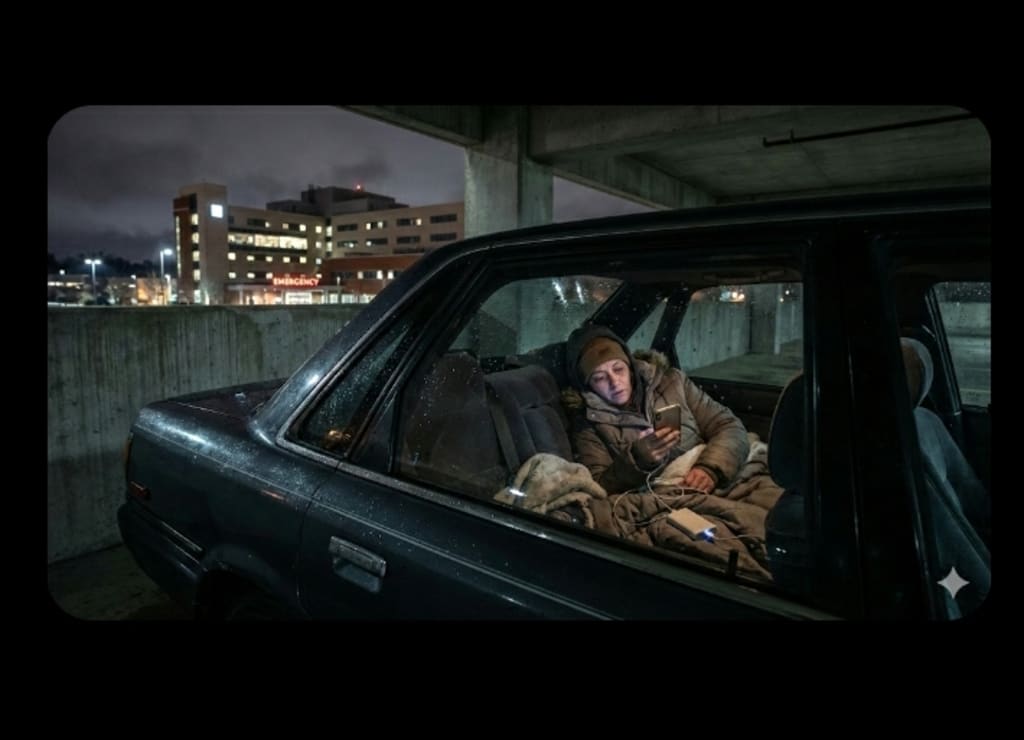
The concrete of a parking garage holds a specific kind of cold. It is a damp, industrial chill that settles into the bones and refuses to leave, regardless of how many layers of wool or polyester you pile on top of yourself. It smells of exhaust fumes, stale oil, and the metallic tang of winter. For most people, a parking garage is a transient space—a place to leave a vehicle while living life elsewhere.
For Linda Perez, in the early 2010s, the third level of a Cleveland hospital parking structure wasn't a place to park. It was a bedroom. It was a living room. It was the staging ground for a war she was fighting against death itself.
Linda was not homeless in the traditional sense. She wasn't battling addiction or running from the law. She was a mother. And inside the sterile, fluorescent-lit building attached to that garage, her 19-year-old son, Miguel, was fighting a rare autoimmune disorder that was methodically trying to shut down his body.
The insurance company had a ledger that covered the hospital bed, the IV drips, and the monitors. But the ledger had no line item for a mother who refused to leave. So, Linda made a choice. She traded her comfort for proximity, her address for a parking spot, and her sleep for a three-year vigil that remains one of the most quietly devastating stories of American resilience rarely told.
The Call That Changed Everything
Before the garage, life was loud, busy, and normal. Linda was the archetype of the hardworking single mother. She worked two jobs—retail during the daylight hours, cleaning offices when the city went dark. She had an apartment. She had furniture. She had a lease. She had the simple, underappreciated luxury of a mattress and a hot shower.
Then came the diagnosis. Miguel’s condition was not a sudden accident or a predictable illness. It was a biological betrayal. His immune system began attacking his lungs and heart simultaneously. It was a condition defined by its volatility. One moment, he was stable, breathing on his own. The next, his oxygen levels would plummet, his heart rhythm would scatter, and he would be minutes away from a fatal crash.
The doctors classified him in a gray area of the medical system. He wasn't critical enough for the Intensive Care Unit (ICU) every single day, but he was far too fragile for hospice or a standard nursing facility. He needed "long-term observation."
The hospital was forty minutes away from Linda’s apartment. In the beginning, she tried to do what normal people do. She went home to sleep. She tried to maintain the veneer of her old life.
That illusion shattered on a Tuesday night.
Linda had just arrived home, exhausted, kicking off her shoes, when her phone rang. It was the floor nurse. Miguel had suffered a sudden pulmonary collapse. By the time Linda sped back to the hospital, running red lights and praying to a God she wasn't sure was listening, Miguel was stabilized, but barely.
The doctor, looking tired and grave, met her in the hallway. "If you had arrived ten minutes later," he told her softly, "we would have lost him."
Ten minutes.
Ten minutes was the difference between her son and a memory. Ten minutes was the time it took to brew a pot of coffee or fold a load of laundry. The distance between her apartment and the hospital was forty minutes. The math didn't work.
Linda realized then that distance was the enemy. If she couldn't shorten the drive, she had to eliminate it.
She never went home again.
The Architecture of Survival
The transition was swift and brutal. Linda quit her jobs. The logic was cold and undeniable: she could not work while monitoring a son who could die between shifts. Without income, the apartment had to go. She sold the furniture, broke the lease, and moved the sum total of her existence into the trunk of her Toyota Corolla.
There was no GoFundMe campaign. There was no viral tweet. There was no local news crew filming a tearful segment. It was just a woman, a car, and a parking pass.
She established a routine that was military in its precision. She chose the corner spots, away from the sweeping headlights of incoming traffic. She learned the blind spots of the security cameras.
Her bed was the back seat, folded flat. It wasn't flat enough to be comfortable, but it was horizontal. She had two blankets—one heavy wool for warmth, one softer fleece for comfort—and a small pillow from her old sofa.
Hygiene became a game of strategy. She washed up in the hospital public restrooms on the ground floor, timing her visits for when foot traffic was low. She brushed her teeth in sinks designed for strangers. She kept her clothes in garbage bags in the trunk, rotating them to keep them smelling as fresh as possible.
But the most critical tool in her arsenal was her phone charger. She found a hallway outlet near the vending machines on the second floor. That phone was her lifeline. It was her connection to the nurses' station three floors up.
She set an alarm on her phone for every 90 minutes.
She didn't set it to wake up for work. She set it to walk up the stairs, slip into Miguel’s room, and watch his chest rise and fall. She needed to see the monitors with her own eyes. She needed to know that the ten-minute window wasn't closing while she slept.
The Seasons of the Garage
Living in a car in Ohio is a lesson in atmospheric violence.
The first winter was the hardest. Cleveland winters are unforgiving, with winds that whip off Lake Erie and cut through steel and glass. Inside the Corolla, the temperature dropped rapidly once the engine was off. Linda couldn't afford to keep the car running all night—gas cost money, and she had none coming in.
She learned to layer. T-shirts, sweaters, a coat, then the blankets. She wore a beanie pulled low over her ears. On the coldest nights, when the temperature dipped below zero, the condensation from her breath would freeze on the inside of the windows, creating a delicate, icy lace that blocked out the world. She would shiver violently for the first hour until her body heat created a small, trapped pocket of warmth under the blankets.
Summer brought a different kind of torture. The concrete garage acted as an oven, absorbing the heat of the day and radiating it back at night. The car became a sauna. She had to crack the windows for air, but that invited risk. A woman sleeping alone in a car with the windows down is vulnerable. Every footstep echoing on the concrete made her heart hammer against her ribs. Was it security? Was it a predator? Was it just a doctor going home?
She lay still, sweat pooling at the base of her neck, praying for invisibility.
Security guards were the constant variable. Technically, sleeping in the garage was against hospital policy. It was a liability. It was loitering.
"Ma'am, you can't stay here," a guard would tap on her glass, his flashlight beam cutting through the dark.
Linda never argued. She never screamed about the injustice of it. She simply nodded, turned the key in the ignition, and drove the car up one level. Or down one level. She played a game of cat and mouse, moving her mobile home from floor to floor, staying one step ahead of eviction.
The Conspiracy of Kindness
While the hospital administration had its rules, the people inside the building had their eyes. The doctors and nurses on Miguel’s floor began to notice.
They noticed that Linda was always there. At 2:00 AM. At 5:00 AM. At shift change. They noticed the wrinkles in her clothes and the dark circles under her eyes that no amount of coffee could erase. They knew she wasn't going home because they knew she had nowhere to go.
An unspoken conspiracy formed.
They never officially gave her permission to live there. To do so would be to break protocol. Instead, they operated in the gray areas of human decency.
A night nurse would "accidentally" leave the side door to the waiting room unlocked, allowing Linda to sit on a cushioned chair for a few hours.
"I brought too much soup today," a resident doctor said once, placing a steaming styrofoam cup on the table next to her. "It’s going to go to waste if you don't take it."
Another nurse began bringing her travel-sized toiletries—shampoo, soap, toothpaste. Small indignities erased by small kindnesses.
They knew the policy said Visiting Hours End at 8:00 PM. But they also knew that love doesn't wear a watch. They understood that Linda was part of Miguel’s life support system just as much as the ventilator was.
The Night the World Stopped
Two years into the vigil, the moment Linda feared most finally arrived.
It was a Tuesday, eerily similar to the day she decided to move into the car. She was in the stairwell, taking a brief moment to stretch her legs, when the Code Blue alarms began to blare. The sound is unmistakable in a hospital—a rhythmic, urgent electronic shriek that signals a heart has stopped.
Linda didn't run. She froze. She knew, with a mother’s terrifying intuition, that the alarm was for Room 314.
Miguel had gone into full cardiac arrest.
She rushed to the hallway, but the crash team was already swarming the room. A wall of blue scrubs blocked the door. The crash cart was wheeled in. She heard the commands—"Charge to 200! Clear!"—followed by the sickening thud of the body convulsing on the bed.
She couldn't go in. She would only be in the way.
Linda retreated to the cold concrete of the stairwell. She slid down the wall until she hit the floor. She didn't scream. She didn't weep hysterically. She simply folded her hands and spoke into the silence.
"Please," she whispered, her voice cracking. "Please don't make me go back to an empty car. Please don't let that car be all I have left."
For twenty minutes, Miguel hovered between worlds.
Then, the rhythm returned. Faint, thready, but there.
He survived. Barely. But "barely" was enough.
The Ending That Wasn't a Movie
If this were a Hollywood movie, Miguel would have made a miraculous recovery. He would have run a marathon a year later, and Linda would have won the lottery.
But this was Cleveland, and this was real life.
Miguel did not get "better" in the traditional sense. He didn't run out of the hospital. But after three years—three winters, three summers, over a thousand nights in a Toyota Corolla—he stabilized enough to be discharged for home care.
He wasn't cured. He was alive.
The day Linda drove out of that parking structure for the last time, there was no fanfare. The security guard at the booth took her ticket, the gate arm lifted, and she drove out into the sunlight.
She had to rebuild everything from scratch. She had to find a new apartment, new furniture, a new job. She was starting over in middle age, with a credit score battered by unemployment and a résumé with a three-year gap.
She never sought publicity. She never wrote a blog about her experience. She never called herself a hero.
Years later, a social worker who learned of the case asked Linda how she managed it. How did she endure the freezing nights, the back pain, the fear, the isolation? How did she keep her sanity in a parking garage for three years?
Linda looked at her, confused by the question.
"You don’t manage it," she said simply. "You just refuse to leave."
Why This Story Matters
We live in a culture that fetishizes a specific kind of strength. We celebrate the entrepreneur who grinds for 18 hours a day. We celebrate the "self-made" success stories. We talk about hustle and independence as the ultimate American virtues.
But we rarely talk about the strength that exists in the shadows. We don't have magazine covers for the strength of a mother in a layered coat, shaking the snow off her boots in a hospital lobby at 3:00 AM.
Linda Perez’s story forces us to look at the gaps in our society. It forces us to ask why a mother had to become homeless to save her son. It highlights a healthcare system that will pay for a machine but ignore the human needed to operate the heart behind it.
Yet, beyond the systemic failure, there is a triumph of the human spirit that is almost blinding in its purity.
Linda Perez reminds us that the most powerful force on earth isn't success, or money, or status. It is the simple, stubborn, immovable refusal to abandon the people we love.
It looks like a tired woman.
It looks like a phone charger plugged into a hallway wall.
It looks like a blanket in the back seat of a car.
And it is the strongest thing in the world.
If you were moved by this story of unconditional love and resilience, please consider sharing it. Let’s bring stories of hidden strength out of the shadows.
About the Creator
Frank Massey
Tech, AI, and social media writer with a passion for storytelling. I turn complex trends into engaging, relatable content. Exploring the future, one story at a time
Keep reading
More stories from Frank Massey and writers in Humans and other communities.
The Man Who Listened to the Pipes: John Lowry and the Disaster That Didn’t Happen
The gripping story of John Lowry, the refinery mechanic who risked his job to expose critical safety failures at a Texas City oil plant, preventing a second massive explosion through sheer persistence.
By Frank Massey a day ago in Humans
Why American Lifestyle Now Prioritizes Travel Over Possessions
Travel in the present day America is not simply a visit to new places or an escape out of routine. It has come to become a kind of guide on the way individuals perceive purpose, fulfillment, and how they structure their lives. More Americans are making travel their guide, letting experience and not anticipation tell what is important. The changes in movement and exposure make people start doubting the over-inspired notions of success and finding out which values are more natural to them.
By Tiana Alexandra6 days ago in Humans



Comments
There are no comments for this story
Be the first to respond and start the conversation.