
The Pale Blue Eye - A Movie Review
All the Poe References, Explained

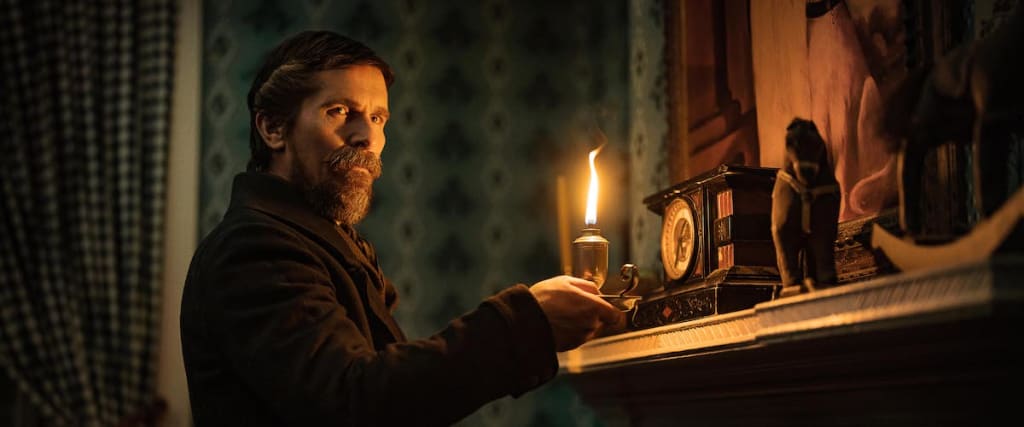
As the winter months set in, movie watchers may not be looking for more bleakness on the screen. However, "The Pale Blue Eye," directed and written by Scott Cooper and starring Christian Bale, may surprise audiences with its suffocating atmosphere of a bleak mid-winter. The story takes place in the rugged Hudson Valley of New York in 1830, with Masanobu Takayanagi’s cinematography capturing the gorgeous grayscale of the winter landscape, interrupted only by flashes of blue water and the uniforms of cadets at the West Point Military Academy, where the story is set.
The plot revolves around the discovery of the cadet Fry's body, with his heart removed, which sends shockwaves through the Academy. The overseers of the school are afraid of scandal, and to avoid it, they enlist a retired lawman named Augustus Landor to investigate. Landor, played by Bale, is a solitary widower who likes to drink and is prone to melancholy despite his dry wit. He is reputed to have once gotten a confession from a criminal using only a "piercing look."
The murder of Fry is only the beginning, and soon Landor discovers another body with its heart cut out, which leads him to suspect devil worship. One of the cadets, Edgar Allan Poe, who is sensitive and an outcast among militaristic braggarts, insists that the killer is a poet. Poe is uncannily played by Harry Melling, who was similarly haunting in "The Ballad of Buster Scruggs." Landor takes Poe under his wing, and they both take a particular interest in the academy's doctor, Daniel Marquis, and his family. The Marquis family could give the Addams Family a run for their money, with Mrs. Marquis breaking household china at a moment's notice, and daughter Lea playing the piano beautifully while suffering from "the falling sickness." Edgar falls in love with her, and she observes that his morbidity suits him well. He recites to her his poetic meditations on "Lenore," which is where the movie's title is derived.
Adapted from a novel by Louis Bayard, "The Pale Blue Eye" is a mystery with a limited cast of characters and suspects, leading the audience to believe that the central mystery is just a feint. Christian Bale's character, Landor, solves a couple of murders and contributes to the development of a great American literary figure, but not much else. Bale's characterization is subtle and enigmatic throughout, but eventually blooms and sears as the movie progresses. The movie honors the real-life figure who became the arguable creator of the American detective story, while also shedding light on the darker recesses of the human heart.
As the story unfolds, audiences may be surprised by the movie's depth, as it delves into themes of loss and wrong-headed resolution. "The Pale Blue Eye" is more than just a murder mystery, and it offers viewers a unique and compelling look at a particular moment in history. Scott Cooper and Christian Bale deliver a haunting and suspenseful movie that is sure to captivate audiences.
As Landor and Poe dig deeper into the case, they begin to unravel a web of secrets, lies, and deceit that extends beyond the walls of the academy. The doctor's family, in particular, is found to be harboring dark secrets and gruesome desires. Mrs. Marquis is revealed to be a fanatic who dabbles in occult rituals and whose madness is threatening to tear the family apart. Meanwhile, Lea's condition, which is initially thought to be epilepsy, is revealed to be a symptom of a deeper psychological trauma. As Landor and Poe get closer to the truth, they realize that the killer may still be among them, and that they themselves may be in grave danger.
The Pale Blue Eye is a masterful work of suspense, driven by a gripping mystery and an unforgettable cast of characters. Christian Bale delivers a powerhouse performance as Augustus Landor, a man haunted by his own demons and driven by a relentless pursuit of the truth. Harry Melling shines as Edgar Allan Poe, capturing both the poet's brilliance and his tortured soul. The supporting cast is equally impressive, with standout performances by Toby Jones, Lucy Boynton, and Charlotte Gainsbourg.
Director Scott Cooper brings the bleak midwinter setting to life with stunning visuals and a haunting score. The film's cinematography, by Masanobu Takayanagi, is breathtaking, capturing the beauty and terror of the Hudson Valley in equal measure. The score, by composer Max Richter, is equally impressive, heightening the tension and emotion of each scene.
In the end, The Pale Blue Eye is much more than a murder mystery or a period piece. It is a meditation on the nature of truth, justice, and human frailty. It is a story about the cost of obsession, the power of art, and the darkness that lies within us all. It is a film that will leave you breathless, haunted, and deeply moved.
About the Creator
ZaZa Stories
Story Reader
Movie Reviewer
Keep reading
More stories from ZaZa Stories and writers in Humans and other communities.
You People - A Movie Review
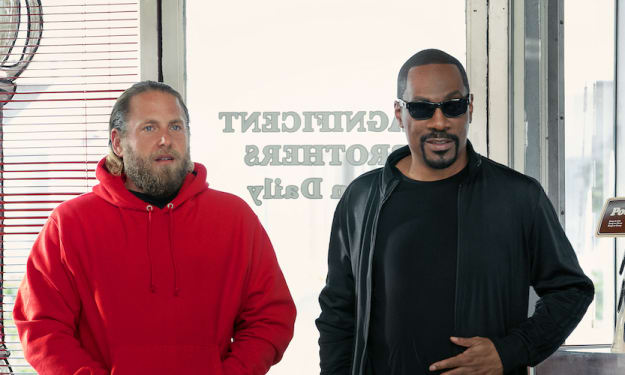
From the mind behind the hit series "Black-ish" and co-written by Jonah Hill, comes "You People," a modern take on "Guess Who's Coming to Dinner" that fails to impress. Despite assembling a cast of talented actors, the movie falls short of being an actual movie and is one step away from being a "Naked Gun"-esque parody of comedies that traffic in racial stereotypes.
By ZaZa Stories3 years ago in Humans
I am not alone.
Billu Bhai’s Realization Category: Human Interest / Life Lessons His real name was Bilal, but everyone in the village called him Billu Bhai. He was the eldest child in a large family, with parents, siblings, and relatives all living together. Growing up, Bilal had been quite weak, both physically and mentally. His childhood was marked by illness, which affected his ability to concentrate in school. Learning was a constant struggle, and he barely managed to complete his education up to the tenth grade. Now, at twenty-five, Bilal was hardworking, reliable, and always willing to help others. His father had given him a rickshaw, which became his source of daily income.
By Sudais Zakwan3 days ago in Humans



Comments
There are no comments for this story
Be the first to respond and start the conversation.