
The Next Name
One young student finds gets thrown into a century-long legacy with no answers.

The wood grain of my desk was smooth under my fingertips. I had been tracing it for the last hour, trying to keep my eyes cast down. Despite my efforts to avoid his gaze, I knew my Civil War professor could not take his eyes off me in class. I wasn’t processing the subject matter as I took my notes, and if I were to have guessed, I would have said Dr. Harlow was just as committed to the material as I.
I had half a mind to skip lecture entirely, but Dr. Harlow was notorious for his midterms, and just the thought of losing my 4.0 was enough to make me go. Missing even a single class was risking a low grade; not hearing Dr. Harlow’s ephemeral side-notes, made only out loud, never written on the lecture slides, were what most often caused students to slip up. This fear kept me from avoiding what was turning out to be an agonizing class period. Dr. Harlow’s eyebrows, usually raised with astonishment, as though he, too, was hearing about the death toll at Antietam for the first time, sat at a consistent pinch. Grandfatherly concern. His mouth kept pursed, lips set firmly together whenever he would stop to change the slide, pausing to make sure he was pressing the correct button on the remote this time.
Dr. Harlow was remembering. Each pause, each look.
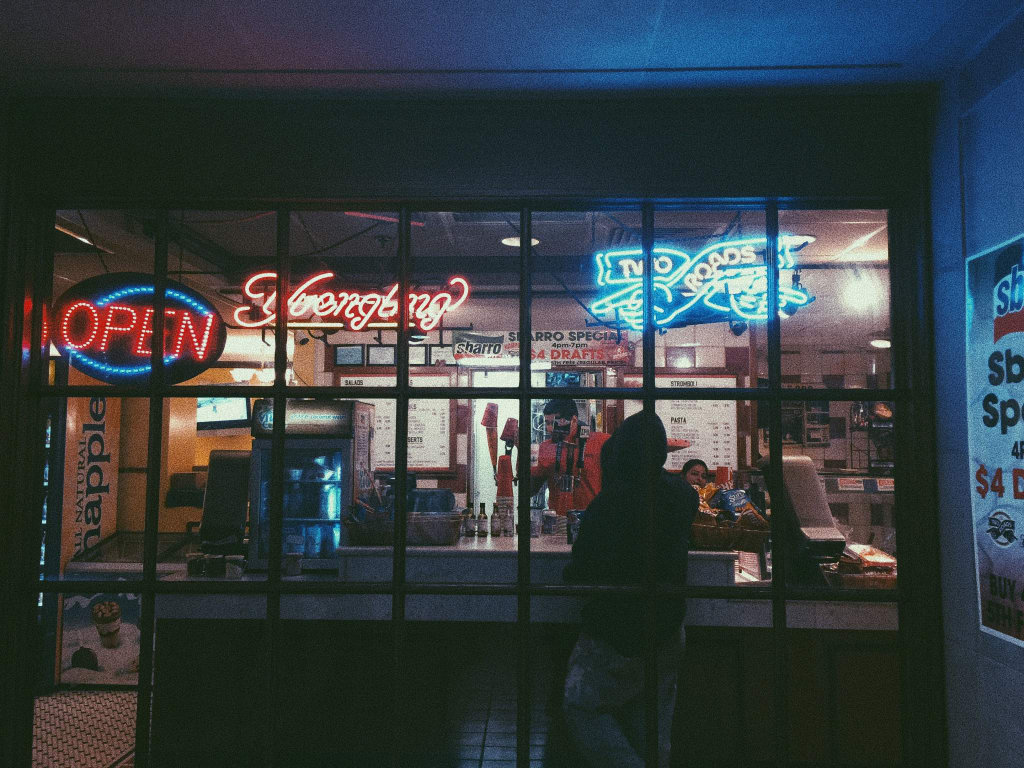
He wasn’t even a regular at Greco’s, was the curious thing-- I had really only seen him come in once before, at the very beginning of the semester. Pickup order. He came in with exact change in hand, plus tip for Ariana, our hostess of twenty years. Owner’s daughter; you know the type. Big hair, big smile, knows all the customers by their first names.
I ran to the back when I first recognized his 1980’s-style glasses and shock of white hair. I chatted with the kitchen boys until he left-- I didn’t need Dr. Harlow to know I spent my nights serving already-drunk frat guys pizza, wearing extra eyeliner in the hopes they would leave a good tip.
The night before, however, Dr. Harlow had caught me by surprise, coming in at the end of an absolutely dead night. Tuesdays never usually brought much profit; only one or two waitresses ever had to work. That night, I had been the only waitress scheduled. A snowstorm was about to hit campus, and Sergio, the owner, wasn’t going to pay a single person more than he had to. If it were up to him, he would wait tables himself every night in between yelling at the cooks and making the busboys cry in the bathroom.
Sergio was not a stranger to making lewd comments the waitresses would whisper about outside on their cigarette breaks. I was warned on my first shift to get used to them, lest I wanted to get fired. Anything less than a polite smile in response could result in someone immediately being sent home, even if they still had tables to close. Shifts at Greco’s were a delicate balancing act between looking nice enough to get tips and inconspicuous enough to avoid Sergio’s gaze. Nights alone with him at the front, when even Ariana was home, were enough to make me consider forgoing the pay. Especially on nights when, say, campus was expected to be hit by a snowstorm, and there would certainly be no customers to keep him in line.
Each time Sergio would say something to me-- things he thought of as harmless compliments-- my anxiety grew. After a shift full of such moments, I was cleaning a booth after my only table had left. Sergio crept up behind me, and I froze as razor-sharp panic began to spill from my chest into my hands. What I had been dreading, what seemed inevitable from my first shift, was finally happening, and I had no way to stop it.
As Sergio placed his hands on my hips, slowly circling them towards the front of my thighs, none other than Dr. Harlow entered the restaurant, tinkling the entry bell. He was wrapped up in an old scarf: hand-knit, dropped stitches everywhere. His eyes widened as he first saw what Sergio was doing. His face hardened with anger when he recognized me.
Dr. Harlow, who usually had the composure of a strict but loving grandfather, cursed at Sergio like I had never heard before. I stood frozen, still crouched in the booth. Threats were made to call for a lawyer, to close Greco’s for good. In one final act of defiance, Dr. Harlow ripped his pizza off the counter without paying and threw the door shut behind him.
I had made myself scarce immediately after. I ran to the kitchen to grab my purse, ignored the kitchen boys’ questions of what had happened, and slipped out the employee entrance undetected.
Instead of just worrying about the consequences of the night before-- had I effectively lost my job? If so, how would I pay for the coming months’ rent?-- I also had to process the shame of Dr. Harlow witnessing Sergio’s hands creep around my thighs.
I could still feel the pressure of his touch. My stomach turned at the memory, and for a second I was gripped with fear of being sick in front of my classmates. I breathed slowly, deeply, and tried to focus once more on tracing the wood grain of my desk. As much as I needed to pay rent, the fear of seeing Sergio again was overwhelming.
When class ended, Dr. Harlow called my name, clipped and businesslike, just as I was about to leave.
Can I have a word with you, please?
I did not respond, only stepped to the side, waiting for my classmates to file out of the room.
Once the final student left, Dr. Harlow closed the door shut behind them, locking it. He turned out the lights, leaving the classroom to be illuminated only by the weak, winter sun leaking in. Finally, he turned back to the door, which was half made up of glass. He looked out the window portion and, after a moment’s thought, drew the blind down over it.
We were standing apart in the quiet darkness, the room faintly smelling of dry-erase markers and mint gum.
Please, take a seat. Dr. Harlow’s voice was deeper, gruffer, when he wasn’t straining it to lecture. I found the desk nearest to me and sat down, putting my bag down next to me.
I’m going to make this short. Dr. Harlow pressed his lips together in thought. He breathed sharply in and out through his nose and began to roll up his shirtsleeves to the elbow. His forearms were littered with faded, circular scars. As my eyes adjusted to the darkness, I recognized them for what they were: cigarette burns.
When I was in high school, I still lived with my old man. Dr. Harlow spoke slowly. He, for the first time that afternoon, was not looking at me. My heart raced. Was he really speaking to me-- me-- about this?
One day during my senior year, my statistics teacher-- Ms. Carter, her name was-- saw a glimpse of these. She told me to stay back from lunch. Scared the hell out of me. Dr. Harlow chuckled, and I smiled sympathetically. I was too shocked to say anything substantial out loud.
She asked me what caused them, and I told her the truth. She asked, genuinely, how I was doing. If I was safe. I told her I was okay, but something I said must have clued her otherwise. Ms. Carter was smart like that.
He smiled down at his hands.
The next day, she pulled me aside again, and handed me two things.
Dr. Harlow stopped to clear his throat.
The first was an envelope. She said to take it down to the bank, deposit it, and to pay for college with it. To leave as soon as I graduated and not look back.
He crossed his arms, looked at me, and gave a slight nod of his head.
And that’s exactly what I did.
What was the second thing? I asked softly, curiosity getting the best of me. I shifted slightly in my seat, attempting to rid some of my nervous energy.
The second thing, Dr. Harlow said, reaching into his briefcase, was this.
He put down something on my desk with one large, aged hand. It was a small notebook, around the size of my own hand. The notebook was covered in worn, black leather and held together with a ribbon so delicate I feared it would fall apart if touched. The leather was sun-bleached in patches, the pages mouse-bitten.
Open it. Dr. Harlow said, gently.
Hesitantly, I unraveled the ribbon. The pages of the notebook smelled sweet and musty with age. Inside, each page had a list of neatly scripted names and dates. The first date listed was from 1883. The name across from it: Noah Becker.
I gasped quietly at the realization of how old the notebook was. How it had never been lost, greatly damaged, stolen, I did not know.
It used to keep me up at night, He said. Who started this, why. I couldn’t find the answers anywhere.
I turned through until I found the most recent name. Oscar Harlow, 1970. Just above his: Ida Carter, 1955.
I looked up at Dr. Harlow, incredulous. He met my gaze again, this time with a smile, blue shimmering out between years worth of deep-set wrinkles.
Dr. Harlow reached into his briefcase once more and pulled out a single, white envelope, so fully stuffed with cash I couldn’t have estimated how much was in it if I tried.
$20,000, Dr. Harlow said, as if he knew I was wondering.
I opened my mouth in protest, beginning to stutter a refusal, but Dr. Harlow put up one finger to silence me.
Ms. Carter told me how, when she was younger, she was given this same gift-- adjusted for inflation, of course. He chuckled again.
It came at a time when she desperately needed it, but never would have asked for help. She was told what she told me: the gift could not be refused, and the only condition it came with was that, when I one day found someone in need of it, I would pass it on to them. I don’t want to talk about what I saw yesterday. I don’t know how long he’s been treating you like that, and I don’t need to know.
He took in a shaky breath.
What I do know is this: you cannot continue to work with that terrible man anymore. I’ll tell you what I was once told: take this to the bank. Deposit it. Use it to pay rent. Do not go back into that restaurant.
He shifted back to rest on his hands. When you inevitably meet someone who needs this gift as much as you do now, you must pass it on. Until then--
Dr. Harlow tapped one finger firmly on the old, leather cover of the notebook.
Keep this safe. And I don’t ever want to see you in Greco’s again.
Kind Dr. Harlow, who I had met just in August, giving me so much? I became overcome with guilt.
Surely there’s someone who needs this more than me.
There’s no perfect recipient. He said without hesitation. If I waited to find the person most in need, I would be waiting forever.
I swallowed my guilt and finally managed to say: I can’t think of a way to thank you.
Dr. Harlow did not respond; instead, he smiled at me and began to gather his things. He pulled his old, wool overcoat on before taking his homemade scarf out of his briefcase and wrapping it around his neck.
There simply isn’t one, he said, knowingly. But that is no longer my burden to bear.
About the Creator
Keep reading
More stories from writers in Humans and other communities.
Time to change your life.
Is it even possible for you to change your life? A lot of people, more than there should be, are unhappy with their lives. But what are they doing about it? Usually nothing. People talk about how shitty their lives are and want change, but are they not taking the actions to change?
By Jen Phillipsabout 12 hours ago in Humans
Himalayan Salt Tiles: A Timeless Design Trend for Modern Interiors
Wall salt bricks and Himalayan salt tiles are gaining a lot of popularity in residential and business places. Individuals are desiring natural and simple designs rather than artificial walls. These salt products are entirely natural and provide everyone with serenity and tranquility to any room.
By Emily Rosie6 days ago in Humans
The Duelist
The rays of a dying red sun flashed against the onrushing blade. The grey beards say the key to dueling lies in size, speed, reach, righteous fury, whatever the person in front of them pays them to say. Matteo knew better than any it was none of these and had an undefeated record on these sands to prove it.
By Matthew J. Fromm6 days ago in Fiction


Comments
There are no comments for this story
Be the first to respond and start the conversation.