
The Mysterious Hundun in "Shanhaijing"
Record of Strange Beasts in the Classic of Mountains and Seas
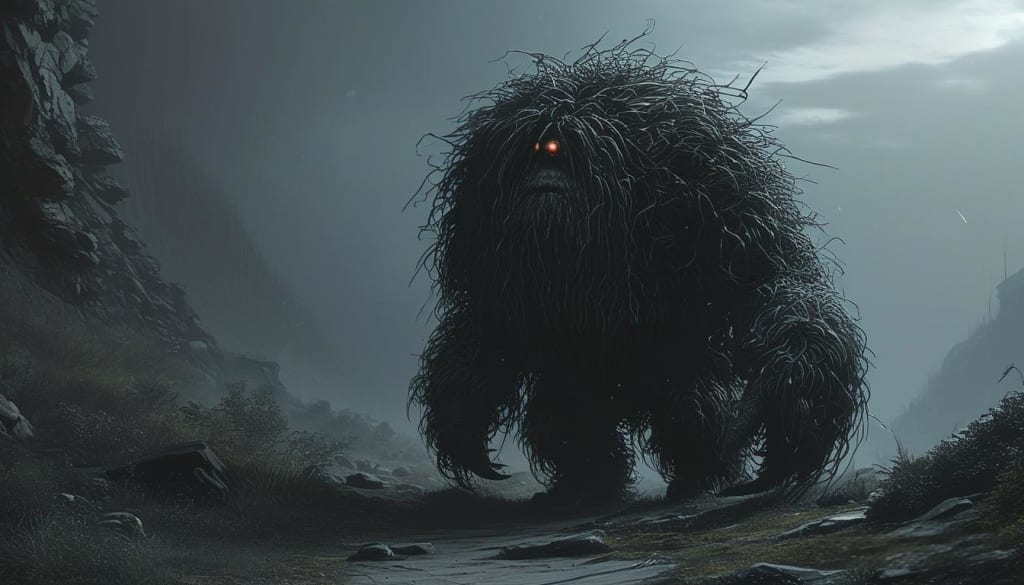
Within the pages of the "Shanhaijing," a rich repository of ancient Chinese mythology, Hundun emerges as an enigmatically fascinating and somewhat confounding creature. Representing primordial chaos, Hundun has long intrigued scholars and enthusiasts alike with its unique characteristics and the profound symbolism it embodies.
Appearance and Physical Attributes
Describing Hundun's appearance is no easy feat, as it defies the typical forms of known creatures. It is often depicted as a shapeless, amorphous mass, a swirling and roiling entity that lacks distinct features such as eyes, a mouth, or limbs. This lack of defined form is a key aspect of its identity, mirroring the concept of chaos from which it hails. In some interpretations, Hundun is envisioned as a large, roundish being, its surface in a constant state of flux, as if it were a living manifestation of the swirling chaos that preceded the creation of the world.
Peculiar Behaviors and Habits
Hundun's behavior is as mysterious as its appearance. It exists in a state of perpetual motion, constantly swirling and churning, without a clear sense of direction or purpose. Lacking eyes, it cannot see in the traditional sense, and without a mouth, it cannot communicate through speech. Instead, it moves through the world in a seemingly random manner, its movements creating a sense of disarray and confusion wherever it goes. This chaotic movement is not just aimless; it is a reflection of the fundamental nature of chaos itself, a force that disrupts order and challenges the established norms.
Mythological Accounts
One of the most well - known mythological stories involving Hundun is related to its interaction with the gods Shu and Hu. In this tale, Shu and Hu, who represent order and structure, decide to show their gratitude to Hundun, who has been kind to them. They observe that Hundun has no facial features and, believing that giving it the ability to see, hear, eat, and breathe will enhance its existence, they decide to drill seven holes in Hundun's body, corresponding to the eyes, ears, nose, and mouth. However, as soon as the seventh hole is made, Hundun dies. This story serves as a poignant reminder of the delicate balance between chaos and order. It suggests that attempting to impose too much order on chaos can lead to its destruction, and that chaos, in its natural state, has its own integrity and value.
Cultural Significance
In Chinese culture, Hundun represents the primordial state of the universe before the separation of heaven and earth and the creation of all things. It is a symbol of the unformed, the potential, and the chaos that precedes the emergence of order. The concept of Hundun is deeply ingrained in Chinese philosophy, particularly in Taoism, where the idea of returning to the state of chaos or the "uncarved block" is seen as a way to achieve harmony with the natural world. It also serves as a reminder that chaos is not necessarily a negative force but rather an essential part of the creative process. Just as the world emerged from chaos, so too can new ideas, innovations, and transformations arise from a state of disorder.
Influence on Art and Literature
Hundun's unique and mysterious nature has had a significant impact on Chinese art and literature. In traditional Chinese paintings, Hundun is often depicted as a nebulous, swirling mass, using soft, flowing brushstrokes to convey its ever - changing and formless nature. Artists may use dark, muted colors to suggest the mysterious and chaotic essence of Hundun, or incorporate elements of light and shadow to create a sense of movement and depth within the shapeless form.
In literature, Hundun appears in many ancient texts, where it is used to explore themes of creation, chaos, and the nature of the universe. Poets and storytellers have drawn on the concept of Hundun to create vivid and imaginative narratives that delve into the mysteries of existence. In modern literature, especially in works of fantasy and science fiction, Hundun continues to inspire authors, who may reimagine it in new and innovative ways, using it as a symbol of the unknown, the uncharted, and the potential for transformation.
In conclusion, Hundun in the "Shanhaijing" is a creature that encapsulates the rich and complex mythology of ancient China. Its appearance, behaviors, and the stories associated with it have made it an enduring symbol of chaos, creativity, and the fundamental nature of the universe. Whether in art, literature, or cultural philosophy, Hundun continues to fascinate and challenge us, inviting us to explore the depths of our imagination and the mysteries of the world around us.
About the Creator
hello-word
As a Chinese person, love for the culture of my own country. Nowadays, the global exchange of information is becoming increasingly rapid. I also hope that more people can gain a deeper and more detailed understanding of Chinese culture.
Keep reading
More stories from hello-word and writers in Humans and other communities.
The Sinister Qiongqi in "Shanhaijing"
Amidst the rich tapestry of mythical creatures in the "Shanhaijing," Qiongqi stands out as a symbol of malevolence and chaos. This fearsome being has intrigued and horrified people for centuries with its unique characteristics and dark deeds.
By hello-wordabout a year ago in Art
If Your Partner Has These 15 Qualities, Never Let Them Go
Choosing the right partner is one of the most important decisions a person can make. The person you build a life with will influence your happiness, your growth, your confidence, and even the direction your future takes.
By Navigating the Worldabout 5 hours ago in Humans
Author’s Advice
If you would’ve asked me 20 years ago did I know I’d become a writer and an author, I would’ve said “nope, ain’t happening”. As fate would have it I did become an author and I can honestly say I’m loving it so far. It really does feel good to be a writer. I’ve learned a lot on this journey and I feel like with even me being as new to this world as I am, there’s some wisdom I need to share with every other aspiring author.
By Joe Patterson2 days ago in Journal



Comments (1)
Hundun Is cool, do me next! Write A story in the third person! Wonderful work! Great research!