
The Misalignment of America’s Foundational Systems
A History of Structural Racism


Systems are meant to organize to provide predictability, fairness, and governance. In the United States, however, the very architecture of its social, political, economic, and legal systems was built on a hierarchy that placed whiteness at the center. This hierarchical system was not simply discriminatory in isolated instances; it was systemic, stitched into the law, enforced through policy, and embedded in culture, producing outcomes that shape every facet of life for people of color, especially African Americans. The fault in this system is not in isolated acts of prejudice, but in the deep structural design that has historically concentrated power and wealth in white hands while marginalizing others. This is not a matter of individual ill will; it is the story of how the nation’s systems were constructed and perpetuated over centuries.
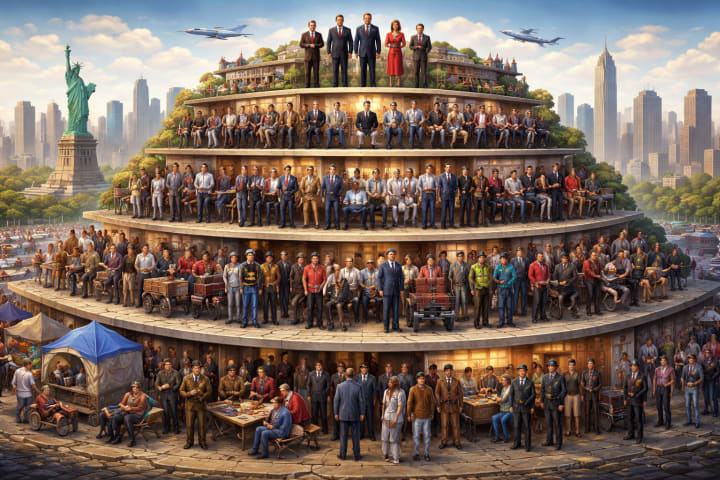
The Nation’s Birth and the Foundational System of Racial Hierarchy
From its earliest years, what we now call the United States was premised on white supremacy the belief that people of European descent were superior and inherently worthy and filled with capability. Slavery was not a marginal institution; it was central to the colonial economy and later to the U.S. economy, particularly through the production of cotton, tobacco, and other cash crops that generated immense wealth for white landowners and merchants. The law codified these racial hierarchies in ways that would shape future generations.
Reconstruction’s Promise and the Backlash of White Supremacy
Here’s your timeline:
- American Revolution ended in 1783 and the U.S. was operating under the Articles of Confederation; this created a weak federal government. Congress was unable to tax effectively, regulate trade or enforce laws; with states acting semi-independent countries bickering with each other. The 1787 Convention in Philadelphia was supposed to fix this issue but the idea became to replace the constitution; but the North and South were not on the same page. Slavery was declining and in Northern states the economies were based on small farms, trade and manufacturing; so of course they wanted representation in government based on free population only. Southern states depended on enslaved labor for their wealth because enslaved people were property not citizens.
Representation determines the number of seats in the house which influence the laws or the electoral college but if enslaved people were counted then it would give the South more political power; and the 3/5 Compromise was born which meant each enslaved person could count as 3/5th (60%) of a person for representation and direct taxation. This was the compromise to have a constitution; they believed a flawed union was better than no union. What this did was strengthen slaveholding states, provided disproportionate power for decades, helped entrench slavery rather than weaken it and heavily influence the election of presidents and the passage of pro-slavery laws. Count the bodies for power while denying rights simultaneously.
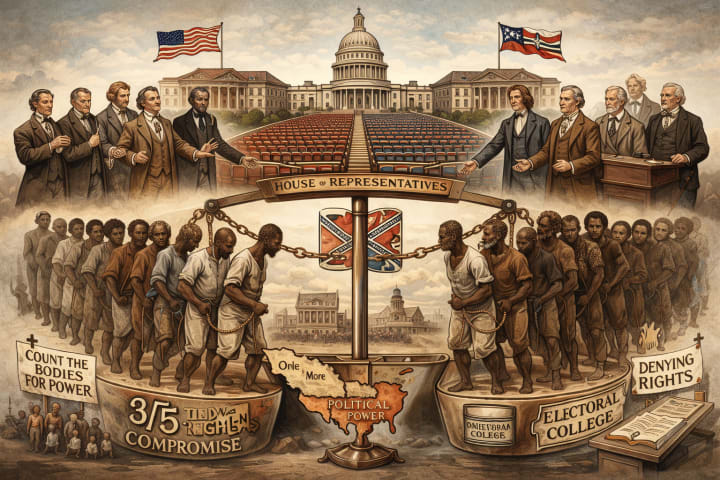
- March 6th 1857 the infamous Dred Scott v. Sandford, the Supreme Court explicitly declared that Black people, whether enslaved or free, could not be citizens and had no rights that white people were bound to respect. This judgment reflected and reinforced the view that the legal system was not neutral, but an active participant in enforcing racial hierarchy.
- January 1st, 1863 the Emancipation Proclamation changed the legal status of over 3 million enslaved people; was that enough? No because they were not seen or treated as human.
- December 18th, 1865 with the 13th Amendment ratified abolishing slavery and involuntary servitude.
- July 9th 1868 the 14th Amendment granting citizenship and guaranteeing equal protection under the laws.
- February 3rd 1870 the 15th Amendment prohibited states from denying a citizen the right to vote based on race. (https://www.archives.gov/milestone-documents/15th-amendment)
- July 14th 1870 the Naturalization Act of 1870 because the law granted formal citizenship without enforcing or protecting the rights that citizenship was supposed to guarantee. While the Act allowed people of African descent to be legally recognized as citizens, white supremacist violence, state resistance, and weak federal enforcement prevented Black Americans from voting, holding office, or accessing justice. Southern states rapidly implemented poll taxes, literacy tests, and other “race-neutral” laws to disenfranchise Black citizens, while economic systems like sharecropping, debt peonage, and convict leasing trapped them in exploitative conditions. At the same time, Supreme Court decisions weakened federal authority to intervene, allowing discrimination and racial terror to persist. As a result, citizenship existed largely on paper, while real political, economic, and social power remained inaccessible.
- April 15th, 1947 with Jackie Robinson becoming the first black player in Major League Baseball; a win is a win 🤷♀️
- June 26th, 1948 when President Truman signed the executive order abolishing racial discrimination in the US armed forces; wonder what was happening at the time they were needed. Were they respected and treated fairly for serving while in service or off duty? What do you think?
- May 17th, 1954, Brown v. Board of Education ruled that racial segregation in public schools was unconstitutional overturning the separate but equal doctrine.
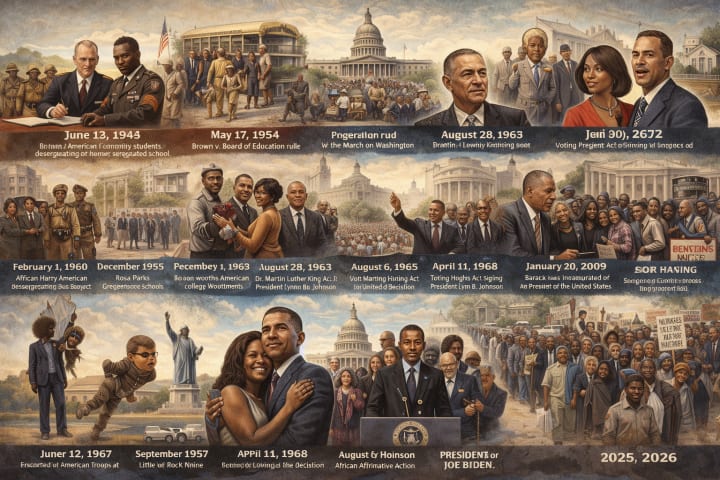
- December of 1955 with the Montgomery bus boycott sparked by Rosa Parks and Claudette Colvin's arrest and the year-long protest that led to the Supreme Court ruling that segregated bus seating was unconstitutional.
- September 1957 Little Rock Arkansas, The Little Rock Nine about nine black students integrated Central High School in Arkansas protected by federal troops ordered by the president; all that just to attend school.
- February 1st, 1960 with the Greensboro sit-ins when four black college students staged a sit-in at a segregated Woolworth's lunch counter triggering a nationwide movement to desegregate all public facilities.
- August 28th, 1963 with the March on Washington 250,000 people gathered to hear Dr. King's I have a dream Speech.
- Finally! August 6th, 1965 with the Voting Rights Act designed to overcome endless legal barriers at local levels that states started putting in place to prevent black citizens from voting.
- June 12th, 1967 when the Supreme Court struck down all state laws that were still banning interracial marriage; for someone as mixed as I am this coincides with my grandmother’s stories.
- April 11th, 1968 the Fair Housing Act prohibiting the rampant discrimination in the sale, rental, and financing of housing.
- An unbelievably shocking day January 20th, 2009 Barack Obama was inaugurated as the 44th president of the United States; where White supremacist would protest the president with lynched dolls wherever he spoke.
- During Obama’s second term in 2013, the Supreme Court’s decision in Shelby County v. Holder effectively dismantled the Voting Rights Act by striking down Section 4(b), the formula that determined which states with histories of racial discrimination had to obtain federal approval before changing voting laws. Without this formula, Section 5’s pre-clearance requirement became unenforceable, shifting the system from preventing voter suppression before it happened to forcing voters to challenge discriminatory laws only after they were already in effect. The Court argued the formula was outdated and that conditions had improved, despite Congress having reauthorized the Act in 2006 based on extensive evidence of ongoing discrimination. The immediate result was that several states quickly enacted voting restrictions previously blocked, weakening federal protections and placing a heavier burden on marginalized voters to defend their rights through lengthy and costly litigation. Obama publicly criticized the decision, stating that it undermined the Voting Rights Act and would make it harder for millions of Americans to vote, and he called on Congress to take action to restore its protections; but I guess it was a way to get at him before his last year.

- June 29, 2023, the Supreme Court ruled in Students for Fair Admissions v. Harvard and v. University of North Carolina that race-conscious admissions violate the Equal Protection Clause, effectively ending affirmative action in college admissions nationwide. The 6–3 conservative majority overturned decades of precedent, arguing that using race as a specific factor even to promote diversity amounted to unconstitutional discrimination and lacked a clear endpoint. The decision sharply limited how universities can consider race, though it left a narrow opening for applicants to discuss how race affected their personal life experiences.
President Joe Biden strongly opposed the ruling. He said he was “deeply disappointed”, calling the decision a setback for equality and warning it ignored the reality of systemic discrimination. Biden emphasized that diversity strengthens education and democracy, and he rejected the idea that America is already a level playing field. In response, he directed federal agencies and the Department of Education to explore lawful alternatives for promoting diversity such as considering socioeconomic disadvantage, first-generation status, and life experience while staying within the Court’s constraints; but I guess its another shot before he left office.
Do I really have to go over 2025 and 2026 and how equality looks like oppression to others; so they say that Voting Rights of 65 was discriminatory towards White people? No? Ok great lets carry on
Reconstruction’s Promise and the Backlash of White Supremacy
The Reconstruction (1865–1877) was a historic moment when Black Americans briefly experienced political representation and meaningful protection under federal law. Federal troops were stationed in Southern states to enforce these new rights, Black men held political office, and public institutions for all races began to emerge. However, once Reconstruction ended, white supremacists engaged in a ruthless campaign to dismantle these changes. (https://njsbf.org/wp-content/uploads/2021/02/Theme_Two_Background_Info.pdf)
Southern states swiftly enacted Black Codes, laws intended to restrict the freedoms of Black people and re-establish control over their labor, essentially a legal restoration of slavery under a new name. Local white militias like the Ku Klux Klan terrorized African Americans and those who supported their empowerment. The Supreme Court systematically weakened the Reconstruction Amendments or declined to enforce them decisions that gutted protections and allowed discriminatory state laws to flourish.
Examples of Black Codes:
- Labor Control: Mandated that Black laborers sign yearly contracts with white employers, penalizing them (often by forfeiting wages) for leaving before the contract ended, as seen in Texas's labor regulations.
- Restrictions on Property & Mobility: Prohibited Black people from owning certain types of property or moving into towns without posting a bond, like in South Carolina.
- Legal Discrimination: Forbade African Americans from testifying in court against whites or serving on juries.
- Firearms & Weapons: Banned Black people from possessing firearms or other weapons without a license.
- Occupational Limitations: Required licenses for Black people to work in jobs other than farming or domestic service, often at high costs, as in South Carolina.
- Vagrancy Laws: Made being unemployed a crime, leading to arrest, fines, and being "bound out" to labor to pay off fines, as seen with "Pig Laws" for minor theft like stealing livestock.
By the 1890s, so-called “Jim Crow” laws mandated racial segregation across public and private life from schools to parks, transportation, restrooms, and more. These were not merely social practices but codified legal requirements enforcing second-class citizenship. The term “Separate but Equal,” established in Plessy v. Ferguson (1896), became the legal doctrine that justified discrimination for decades.
In this period known as the Nadir of American race relations (1877 – early 1900s), extralegal violence such as lynchings and race riots also served as systemic enforcement mechanisms of white supremacy. Black economic and social mobility was met with hostility, with consequences still visible in disparities today.
https://www.themarshallproject.org/2025/11/04/delta-state-university-mississippi-hanging https://mainecampus.com/category/opinion/2025/09/lynchings-are-being-prominently-marked-as-suicides-and-swept-under-the-rug/ https://thegrio.com/2025/12/02/a-family-fights-for-answers-after-a-black-man-was-found-hanging-from-a-tree-in-wisconsin/ https://msmagazine.com/2025/10/21/trey-reed-lynching-suicide-black-racism/
I digress…
The Systemic Reinforcement of Inequality: Housing, Lending, and the GI Bill
The mid-20th century is often remembered as the era of progress, legislation, and civil rights victories. It was also an era where structural racism evolved to adapt, persist, and manifest in new ways. One of the most crucial areas was housing an area where opportunity, wealth creation, and generational stability are rooted.
The federal government’s role in housing especially through agencies like the Federal Housing Administration (FHA) and the Home Owners’ Loan Corporation (HOLC) institutionalized discriminatory practices such as redlining. These were maps and policies that intentionally withheld mortgage credit from neighborhoods based on racial composition, regardless of residents’ actual income or creditworthiness. Neighborhoods with Black residents were deemed high risk and colored red on maps, which resulted in decades of disinvestment and exclusion from wealth-building opportunities.
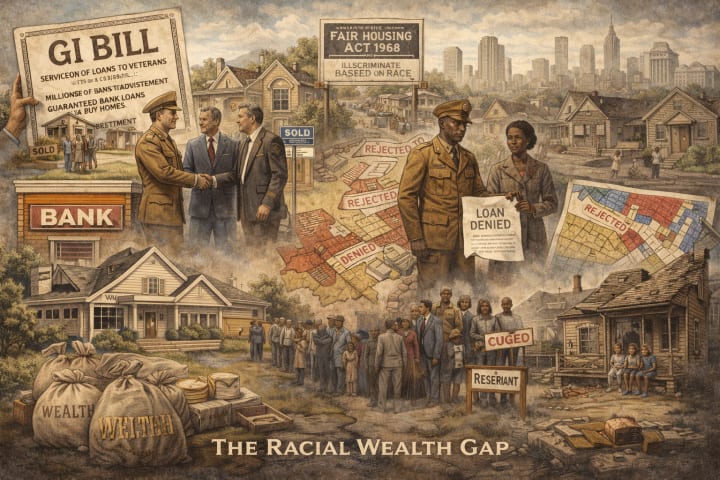
At the same time, the Servicemen’s Readjustment Act known as the GI Bill offered benefits to millions of World War II veterans, including guaranteed home loans. But local banks and authorities often denied these benefits to Black veterans, effectively closing the door that had been opened to white veterans. This exclusion had abiding consequences for the racial wealth gap, as homeownership has long been a primary vehicle for intergenerational wealth.
Although the Fair Housing Act of 1968 legally prohibited housing discrimination based on race, color, religion, or national origin, the legacy of decades of segregation did not vanish with the stroke of a pen. Discriminatory patterns embedded in zoning laws, restrictive covenants, and financial systems continued to shape communities creating racialized patterns of wealth, education, and access to opportunity that persist.
Structural Racism Today: Persistent Patterns of Inequality
Contemporary research shows that the consequences of these historic systems are not relics of the past, but active components of present inequality. Structural racism defined as the totality of ways in which societies foster discrimination via mutually reinforcing systems continues to shape outcomes in health, wealth, education, and justice.
For example:
- Studies link historic redlining and current health outcomes such as infant mortality, hypertension, and chronic diseases in segregated neighborhoods. This discrimination was not incidental but a systemic pattern that limited economic opportunity and access to resources.
- Residential segregation born from discriminatory policies has been shown to undervalue homes in Black neighborhoods by tens of thousands of dollars, contributing to the racial wealth gap in massive cumulative losses.
- Housing discrimination continues in more subtle forms such as differential treatment in rental and home buying markets by race long after the legal barriers were dismantled.
When systems like housing, education, labor markets, and criminal justice operate in ways that produce distinct racial disparities even without overtly racial language; the outcomes still reflect the historical legacies of structural racism.
Misalignment and the Human Toll
The misalignment of America’s systems rarely announces itself through sudden collapse. Instead, it operates through a persistent, low-grade pressure embedded in everyday life manifesting as disproportionate incarceration rates, unequal school funding, enduring wealth gaps, and restricted access to health care and political power. These outcomes are not the product of individual failure or deficient motivation. Rather, they reflect what sociologist Robert K. Merton described as structural strain: a condition in which socially endorsed goals economic stability, educational attainment, safety, and upward mobility are held out as universally attainable, while the legitimate means to achieve them are systematically obstructed for certain populations. When access to the foundational levels of Maslow’s hierarchy security, stability, and belonging is persistently denied, the strain is not aberrational; it is manufactured by design.
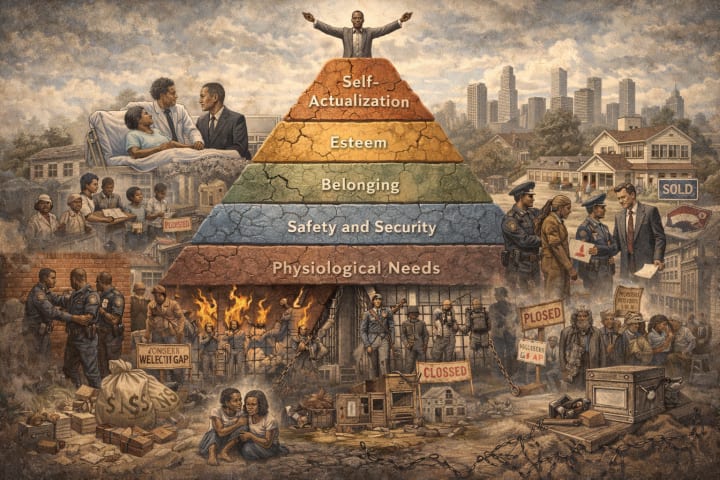
Within this framework, the celebration of milestones constitutional amendments, civil rights legislation, landmark court decisions, or even the election of a Black president cannot be mistaken for systemic resolution. While laws may formally expand rights, they do not automatically dismantle the unequal distribution of resources, surveillance, and constraint that shape daily life. Merton’s theory helps explain why inequality reproduces itself even after legal barriers fall; when structural conditions continue to restrict legitimate pathways to socially valued outcomes, individuals and communities are blamed for adaptive responses to strain rather than the systems that generate it. Persistent racial disparities, then, are not evidence of cultural deficiency or personal failure, but of entrenched power arrangements that remain largely intact beneath the surface of legal progress.
Conclusion… Attention as Accountability
The system is not broken in isolated spots; it was built this way and reinforced at every turn. Recognizing this is neither pessimism nor blame; it is clarity about how policies interact with lived experience. Systems define who gets opportunities, whose lives are valued, and whose voices are heard. When they consistently disadvantage a group of people based on race, that is not incidental friction it is structural oppression.
Understanding this history and its impacts is not just a matter of intellectual curiosity; it is an act of attention that acknowledges realities long ignored or minimized. Attention is the first step toward reimagining systems that uphold justice, equality, and dignity for all.
**Side note: I went to school for criminal law**
References
Merton, R. K. (1938). Social structure and anomie. American Sociological Review
Maslow, A. H. (1954). Motivation and personality. Harper & Row.
Maslow, A. H. (1962). Toward a psychology of being. D. Van Nostrand Company.
Alexander, M. (2012). The new Jim Crow: Mass incarceration in the age of colorblindness. The New Press.
American Civil Liberties Union. (2014). The war on marijuana in black and white. https://www.aclu.org
American Progress. (2019). Systemic inequality: How America’s structural racism helped create the Black–White wealth gap. Center for American Progress. https://www.americanprogress.org
Bertrand, M., & Mullainathan, S. (2004). Are Emily and Greg more employable than Lakisha and Jamal? A field experiment on labor market discrimination. American Economic Review, 94(4), 991–1013. https://doi.org/10.1257/0002828042002561
Brown v. Board of Education of Topeka, 347 U.S. 483 (1954).
Coates, T.-N. (2014). The case for reparations. The Atlantic.
Dred Scott v. Sandford, 60 U.S. 393 (1857).
Du Bois, W. E. B. (1935). Black reconstruction in America, 1860–1880. Free Press.
Equal Justice Initiative. (2017). From slavery to mass incarceration. https://eji.org
Federal Housing Administration. (1938). Underwriting manual. U.S. Government Printing Office.
Feagin, J. R. (2014). Racist America: Roots, current realities, and future reparations (3rd ed.). Routledge.
Hannah-Jones, N. (2015). Segregation now. The New York Times Magazine.
Katznelson, I. (2005). When affirmative action was white: An untold history of racial inequality in twentieth-century America. W. W. Norton & Company.
Lipsitz, G. (1998). The possessive investment in whiteness: How white people profit from identity politics. Temple University Press.
National Academies of Sciences, Engineering, and Medicine. (2023). Structural racism and health inequities in the United States. National Academies Press. https://doi.org/10.17226/26803
Oliver, M. L., & Shapiro, T. M. (2019). Black wealth / white wealth: A new perspective on racial inequality (2nd ed.). Routledge.
Pager, D., & Shepherd, H. (2008). The sociology of discrimination: Racial discrimination in employment, housing, credit, and consumer markets. Annual Review of Sociology, 34, 181–209. https://doi.org/10.1146/annurev.soc.33.040406.131740
Plessy v. Ferguson, 163 U.S. 537 (1896).
Rothstein, R. (2017). The color of law: A forgotten history of how our government segregated America. Liveright Publishing.
Shelby County v. Holder, 570 U.S. 529 (2013).
Thirteenth Amendment to the United States Constitution, ratified December 6, 1865.
United States Census Bureau. (2022). Wealth inequality by race. https://www.census.gov
United States Department of Housing and Urban Development. (2021). Housing discrimination study. https://www.huduser.gov
Voting Rights Act of 1965, Pub. L. No. 89-110, 79 Stat. 437.
About the Creator
Cadma
A sweetie pie with fire in her eyes
Instagram @CurlyCadma
TikTok @Cadmania
Www.YouTube.com/bittenappletv
Whiskey At Dusk
Guess the whiskey was more important to you in the end, wasn’t it? It was more than the well-being of your friends; more vital than showing up to the places you promised you would and could come to; more critical of a matter than fulfilling your damn responsibilities and getting the press off your back.
By Snarky Lisa4 days ago in Humans
The Fear Of Commitment Is Destroying Genuine Romantic Connections
The fear to be committed is now one of the greatest problems of the contemporary relations. Most individuals desire intimate emotional attachment, but fail when relationships start getting serious. This fear is conditioned by the previous heartbreak, emotional trauma, social pressure, and the fantasy of unlimited choices generated by modern dating sites.
By Hayley Kiyoko2 days ago in Humans



Comments
There are no comments for this story
Be the first to respond and start the conversation.