
The Market of Shared Hands
How Cooperation Healed a Town

THE STORY
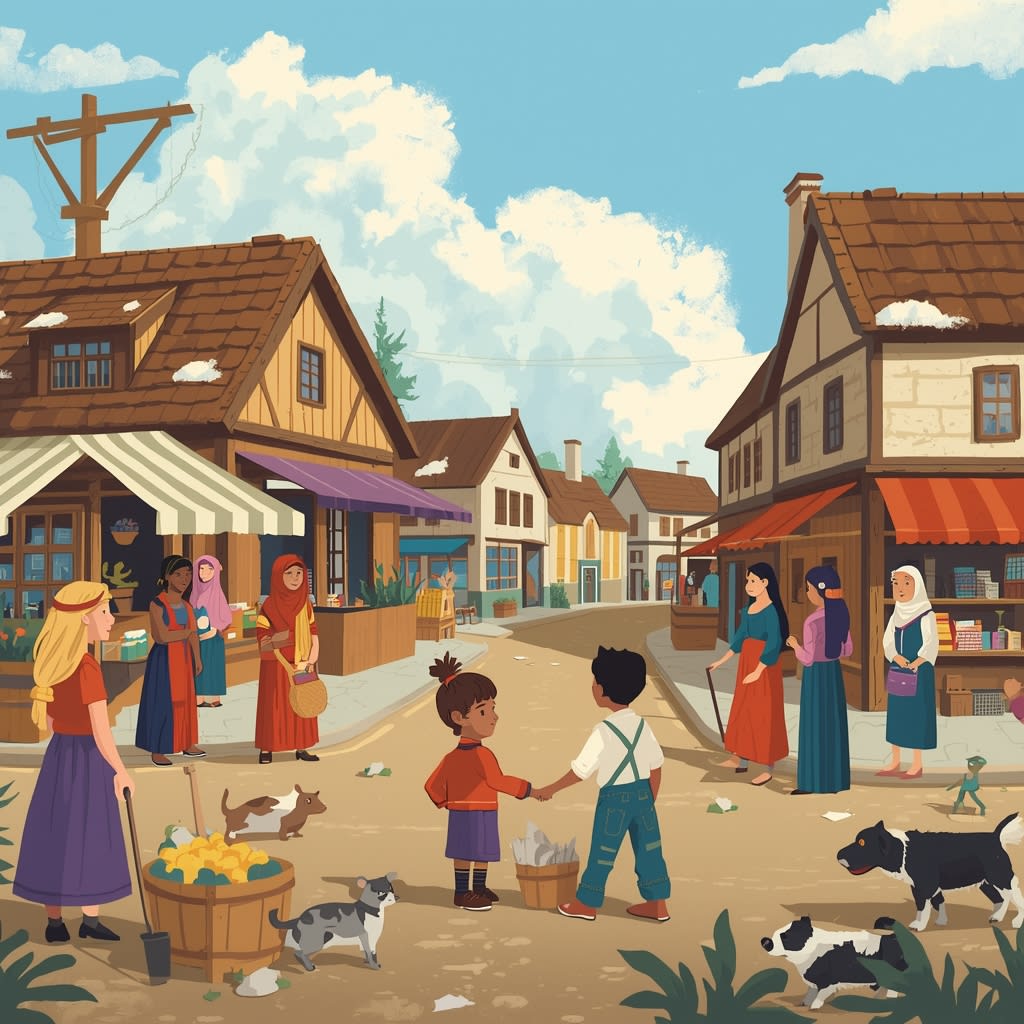
The town of Karvanpur had long been famous for its vibrant market, a place where life flowed like a river between stalls of colorful spices, woven fabrics, clay pots, and hand-carved trinkets. Merchants greeted each other in the morning, families exchanged news, and children ran through the aisles playing games between the rows of goods.
But in recent years, tension had grown. A few misunderstandings had spiraled into grudges:
Traders accused each other of taking advantage of deals
Artisans blamed competitors for copied designs
Customers overheard arguments and stopped coming as often
Slowly, the market that had once united the town became fragmented, quiet in corners, tense in alleys, and divided by invisible walls. The laughter that once echoed in the air was replaced by whispers, suspicion, and silence.
RINA, THE YOUNG MEDIATOR
Seventeen-year-old Rina, daughter of the town’s spice merchant, remembered when the market had been alive. She recalled the sweet scent of cardamom and cinnamon mixing with freshly baked bread, the music of street performers, and neighbors helping each other without hesitation.
Walking through the empty square one morning, she sighed:
"How did it all fall apart?"
She decided to act. Rina began small. She wrote notes of peace and encouragement and left them at different stalls:
“A smile shared brings more customers than a complaint.”
“Trade together, grow together.”
“Small kindnesses can make the biggest profits.”
At first, most ignored the notes. Some laughed. Others threw them aside. But one young artisan, Javed, picked up a note and read it aloud to his friends.
“This… makes sense,” he said, smiling. “We’ve been so focused on arguing that we forgot why we do this work.”
THE FIRST SIGNS OF COOPERATION
Rina proposed a shared stall day, where merchants could combine efforts and display their goods together. Many were skeptical.
“Won’t we lose profits?” asked the fabric seller, Mrs. Noor.
“What if people take advantage?” grumbled a pottery vendor.
But Rina convinced a group of young helpers to assist. Slowly, curiosity turned into participation. On the day of the shared stall:
Spice sellers blended their best mixes, attracting customers with new flavors
Fabric merchants created patterns by combining their cloth, producing designs no one had seen before
Children handed out flyers and small gifts to encourage conversation
For the first time in months, the market was buzzing again. Strangers smiled, families lingered, and the town’s heartbeat began to return.
THE FESTIVAL OF UNITY
Encouraged by the progress, Rina organized a Festival of Shared Hands. The festival included:
Music from local performers playing together across genres
Craft workshops where artisans taught children
Food stalls blending family recipes from previously rival groups
The festival began with hesitation. Elders whispered to each other: “Will this really work?”
But as the day progressed:
Children ran freely between stalls, laughing and sharing
Families shared meals and exchanged recipes
The marketplace glowed with colorful lanterns and smiling faces
By sunset, even the most stubborn traders admitted that cooperation was stronger than conflict.
THE HEALING OF KARVANPUR
The festival marked the beginning of a new era. The town learned:
Peace is built slowly, through small acts of courage and kindness
Cooperation fosters trust, understanding, and shared growth
Symbols and traditions, like the marketplace and its festivals, heal divisions
Even young visionaries can lead a community to unity
Rina stood in the square, watching the families and children celebrate. She realized that it had only taken one determined heart, a few small actions, and the courage to invite others to join, to restore life and joy to the town.
The Market of Shared Hands was no longer just a place to sell goods—it had become a symbol of hope, collaboration, and enduring peace.
About the Creator
M.Farooq
Through every word, seeks to build bridges — one story, one voice, one moment of peace at a time.
Bruce Lee and The God of War: Kuan Ti
It starts with love.. The Power to the God Of War and Wealth Walk into a Chinese restaurant (even in Oklahoma, USA), a Chinese police station, a kung fu martial arts studio or even a Chinese temple and you often see a red faced warrior holding a heavy quan-do (spear like weapon).
By WILD WAYNE : The Dragon King6 days ago in Chapters


Comments
There are no comments for this story
Be the first to respond and start the conversation.