
The Man Who Lived the Longest in Space
Russian cosmonaut Gennady Padalka safely returns to Earth after spending a record-breaking 879 days in space across five missions.

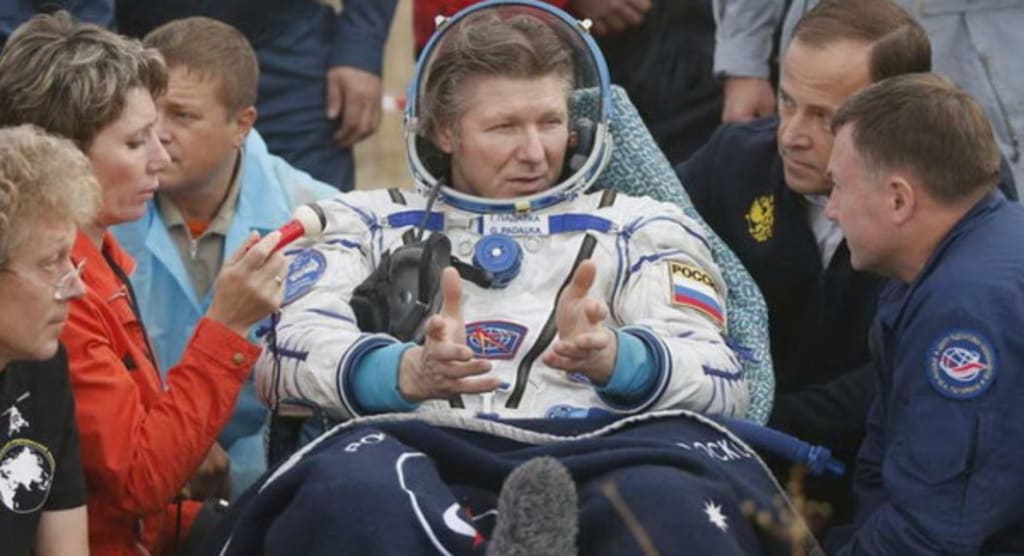
On September 12, 2015, as the early morning light brushed the vast steppes of Kazakhstan, a Soyuz spacecraft touched down gently on Earth’s surface. Emerging from it was a man who had just broken one of humanity’s most awe-inspiring records: Gennady Padalka, the Russian cosmonaut who had spent a total of 879 days in space—more than any other human in history.
Padalka, then 57 years old, had just completed his fifth spaceflight, safely returning alongside two fellow astronauts: Aidyn Aimbetov of Kazakhstan and Andreas Mogensen of Denmark. Their journey had ended, but Padalka’s legacy had only just begun to orbit the halls of history.
A Lifetime Among the Stars
Padalka’s extraordinary journey to this record began nearly two decades earlier, in 1998, when he first flew to space aboard the Russian space station Mir. Since then, he returned to the cosmos four more times, each trip longer and more commanding than the last.
What sets Padalka apart isn’t just the number of missions—though five is impressive in itself—it’s his repeated leadership in space. He is the only person in the world to have commanded the International Space Station (ISS) four times. Each time, he led with precision, resilience, and a calm demeanor that made him both a hero in Russia and a respected figure among the global astronaut community.
Returning to Earth: A Historic Moment
The return on September 12 was flawless. At exactly 7:51 AM, the Soyuz capsule, charred from reentry, deployed its parachutes and glided to a gentle landing in the remote Kazakh grasslands. Medical teams rushed in immediately. Within minutes, all three astronauts were extracted, smiling and waving.
"I'm feeling great," Padalka said simply, a quiet understatement from a man who had spent nearly two and a half years floating hundreds of kilometers above Earth.
From there, the crew was flown to Astana, Kazakhstan's capital, where they were to meet President Nursultan Nazarbayev in a formal ceremony honoring their achievements.
Breaking the Record
Before Padalka, the longest time spent in space by a human belonged to another Russian cosmonaut: Sergei Krikalev, who accumulated 803 days across six missions. Krikalev’s record stood as a symbol of human endurance and Soviet-Russian space supremacy.
But Padalka not only broke it—he shattered it by 76 days.
To grasp the enormity of this accomplishment, consider this: the average astronaut spends about six months aboard the ISS. Padalka’s combined missions amount to over 29 months in microgravity. That’s nearly two and a half years without the comfort of gravity, fresh air, or the blue skies of Earth.
What It Takes to Stay in Space
Life in orbit is not just thrilling science fiction—it’s a daily test of human limits. Astronauts must contend with bone loss, muscle atrophy, psychological stress, and constant exposure to radiation. They work 12-hour days maintaining the station, conducting experiments, and preparing for emergencies that can occur at any time.
Padalka didn’t just survive these conditions—he thrived in them. His leadership and adaptability made him a trusted figure aboard the ISS, where cooperation among international crewmates is not just encouraged but necessary.
A Career Written in the Stars
Padalka was born in 1958, and by the time he joined Roscosmos—the Russian space agency—he had already been trained as a pilot and engineer. His first journey to space in 1998 lasted 198 days aboard Mir. After that, his missions increased in complexity and duration.
By 2009, Padalka was a seasoned commander, guiding astronauts from NASA, ESA, and JAXA through months of collaborative work in low Earth orbit. On each return, he would undergo a rigorous rehab process to regain muscle mass and relearn how to walk.
But his passion for space never dimmed.
The Science of Staying
Padalka's extended time in orbit provided researchers with valuable insights into long-duration spaceflight—knowledge that will be critical as humans plan missions to Mars and beyond. His data contributed to the understanding of how microgravity affects the body long-term and helped shape protocols for future explorers who may one day live off Earth for years at a time.
He became, in a sense, a living experiment—and a symbol of human adaptability.
The Quiet Hero
Despite his record-shattering feat, Padalka has remained humble. He rarely seeks the spotlight, instead choosing to speak about the importance of international cooperation in space exploration. For him, space is not a race to be won, but a frontier to be explored together.
“I am just doing my job,” he has said in interviews. “It’s a job that demands respect, focus, and love for discovery.”
What’s Next?
With his retirement from active spaceflight, Gennady Padalka now serves as an inspiration to future generations of explorers. He may no longer float among the stars, but his legacy continues to orbit our imaginations.
In a time when space travel is moving toward commercial flights, lunar bases, and Martian dreams, figures like Padalka remind us that courage, patience, and dedication remain the most essential tools for any traveler into the unknown.
Conclusion
Gennady Padalka’s name may not be as globally famous as Neil Armstrong or Yuri Gagarin, but his place in the annals of space exploration is no less monumental. To spend nearly 900 days in space is to challenge what it means to be human—to embrace discomfort, danger, and isolation in the pursuit of knowledge.
Padalka’s story is not just about numbers and records. It is about the relentless human spirit, the power of discipline, and the wonder of the universe that still awaits us all.
About the Creator
Eleanor Grace
"Dream big.Start small.Act now."
Keep reading
More stories from Eleanor Grace and writers in Humans and other communities.
The Genetics of Genius: Can Talent Be Inherited or Is It Built?
The Science Behind Genius: Is Talent Inherited or Developed? The question of whether genius is a product of natural talent or can be cultivated through education has been debated for centuries. Russian scientist Dr. Sergey Savelyev, a leading expert in brain morphology, has spent a lifetime studying the structure of the human brain in an attempt to uncover the origins of genius. Through his research, he has arrived at a conclusion that challenges popular belief: genius is not something that can be taught—it is inherently tied to the structure of the brain and is largely determined by genetics.
By Eleanor Grace10 months ago in Humans
Autonomy Is The Real Privilege
Good morning, freedom-seekers! Today we’re gonna be looking at autonomy. A strange word, I know; one many would probably look at blankly and run away from on sight. We’re gonna figure out what it actually means, consider how it’s achieved, and decipher just how deeply most of us are tangled up in dependence without realising it.
By That ‘Freedom’ Guyabout 12 hours ago in Humans
Marc Guéhi
Marc Guéhi is a professional football player who is known for his calm defending, strong leadership, and smart decision-making on the field. He plays as a central defender and represents both club football and the England national team. Over the years, Marc Guéhi has become one of the most trusted young defenders in modern football.
By Farhan Sayed4 days ago in Humans
Smart phones, Humans and Aliens.
WARNING. I will be tapping into one of your favorite creative tensions: The absurdity of humans worshipping their glowing rectangles as if they were tiny oracles. There’s something deliciously poetic about that contradiction, and it lends itself beautifully to an instructive proviso.
By Novel Allen4 days ago in Poets




Comments
There are no comments for this story
Be the first to respond and start the conversation.