
The Love Letter I Found in a Library Book
A forgotten note, a stranger’s heart, and the unexpected ways words can find us.

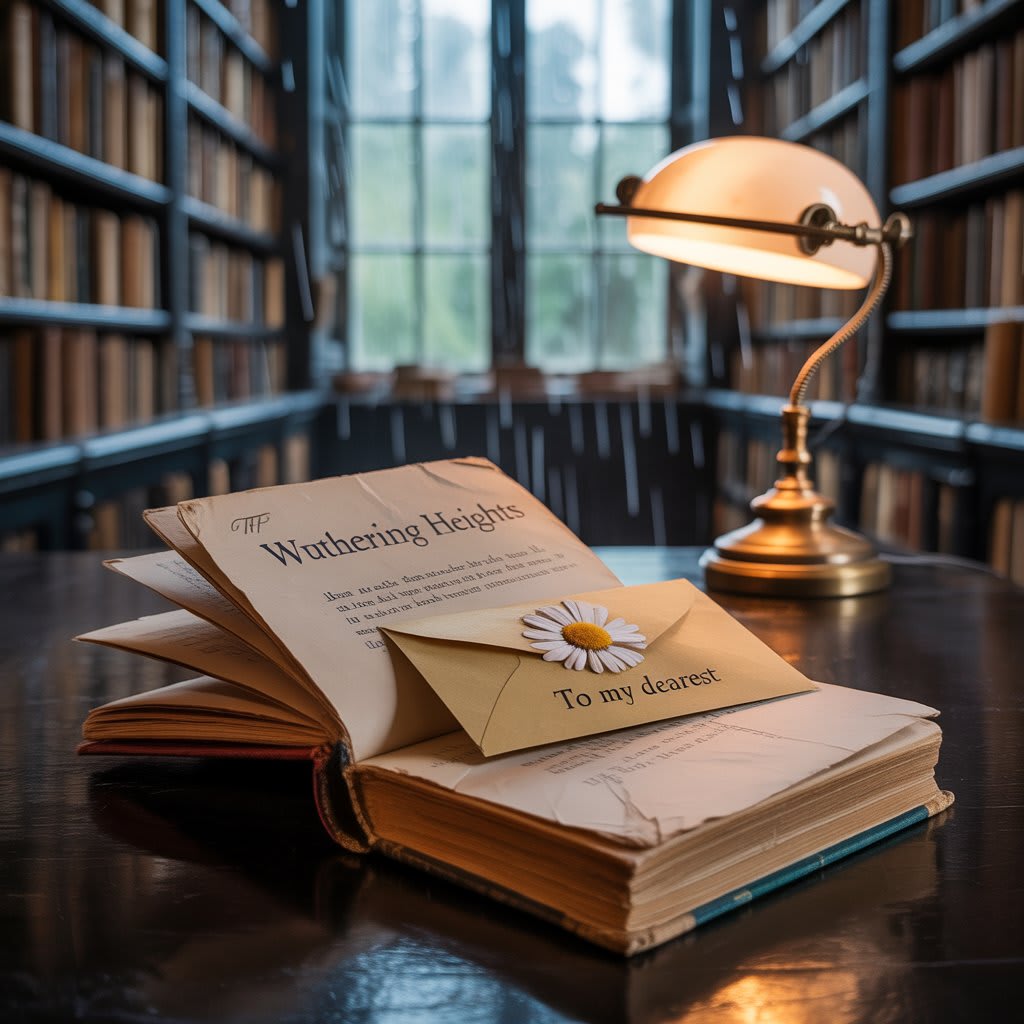
I wasn’t looking for romance when I went to the library that rainy Tuesday. I was looking for silence. The kind of quiet you can’t get in a coffee shop, the kind that isn’t broken by your own refrigerator humming. I wandered to the classics section, running my fingers along worn spines, until I pulled out a weathered copy of Wuthering Heights.
The book fell open in my hands, and there it was—folded neatly, tucked between pages 142 and 143. A small envelope, the paper yellowed at the edges, sealed with a sticker shaped like a daisy. My first thought was that it was a bookmark, but the slight bulge inside told me otherwise. I hesitated, looking around as if someone might stop me. No one did. So, I slid my finger under the flap.
Inside was a letter, handwritten in looping script. The ink was smudged in a few places, as if from tears—or maybe rain. It began simply: “If you’re reading this, then I couldn’t give it to her myself.” My breath caught. The writer never signed their name. They spoke about a woman named Claire, how her laughter “could tilt the whole world toward the sun,” and how they’d met on a bus one windy day in November. Every word hummed with longing.
Halfway through, the tone shifted. They wrote about mistakes—things unsaid, times they hadn’t shown up, fears that had kept them apart. “If I had another chance,” it read, “I’d tell you that you were the only thing I ever got right.” By the end, my eyes were blurring. The final line was the one that broke me: “Maybe love is just a letter we’re too afraid to send.”
I sat there for a long time, the book open in my lap, the letter resting on my fingers like something fragile. Who was the writer? Why had the letter ended up here, hidden away in an old novel? Was it left intentionally, a message for anyone who might need it? Or had it been forgotten by accident, never meant for eyes like mine?
As the rain tapped against the library windows, I considered my own life. I thought about the messages I’d never sent, the calls I hadn’t made, the moments I’d convinced myself would have another time. Something about holding that letter made me feel both an intruder and a confidant—like I’d been trusted with a stranger’s most vulnerable truth.
When I finished reading it again, I knew I couldn’t just put it back. But I also couldn’t take it away from the place where it had waited, possibly for years, for someone to find it. So I wrote my own note—just a short one—and tucked it behind the original. “Whoever you are, your words reached me. I hope you’ve found peace, and I hope Claire knew.” Then I closed the book, slid it back on the shelf, and walked away.
Weeks later, I returned to the library, curiosity pulling me to the same spot. The book was gone. I’ll never know who took it next or whether they read both letters. Maybe it found its way to someone else who needed it. Maybe it made them pick up the phone, or write their own confession.
Sometimes I think about the person who wrote that letter—whether they’re still alive, whether they ever told Claire. But mostly, I think about how words, once written, have a strange kind of immortality. They can outlive the moment, the writer, even the love they were meant for.
And maybe that’s the real magic of it: even the letters we’re too afraid to send still have a way of finding someone who needs to hear them.
About the Creator
Musawir Shah
Each story by Musawir Shah blends emotion and meaning—long-lost reunions, hidden truths, or personal rediscovery. His work invites readers into worlds of love, healing, and hope—where even the smallest moments can change everything.
Keep reading
More stories from Musawir Shah and writers in Humans and other communities.
The Website That Only Exists at 3:33 AM
It started with a post on a forgotten corner of a Reddit thread: “Ever seen the site that only loads at 3:33 AM? Don’t try it unless you’re ready to learn the truth.” I laughed at first, assuming it was just another urban legend meant to spook the chronically online. But my curiosity wouldn’t let it go. The strange timestamp, the cryptic warning—it lived in my thoughts longer than it should’ve. I bookmarked the comment, telling myself I’d check it out the next time I found myself wide awake in the middle of the night, restless and alone.
By Musawir Shah5 months ago in Humans
Today, Tomorrow
I had a moment recently where I contemplated what is even genuine anymore in the digital space. Humans were bound to be predictable in our unethical use of AI, I cannot think of any popular user generated platform online that has not been exploited or oversaturated in one way or another. Money, power and dominance are the pillars of society, so it is no surprise the rapid development of AI coincides with the human condition.
By Malachai Hougha day ago in Humans


Comments
There are no comments for this story
Be the first to respond and start the conversation.