
The Man Who Heard the Steel Scream: Tom Alvarez and the Paper Shield
In the summer of 2007, a foreman in Minneapolis refused to sign a safety release for a bridge that engineers said was fine. Weeks later, the I-35W bridge collapsed into the Mississippi River. His refusal didn't save the bridge, but it saved the truth.

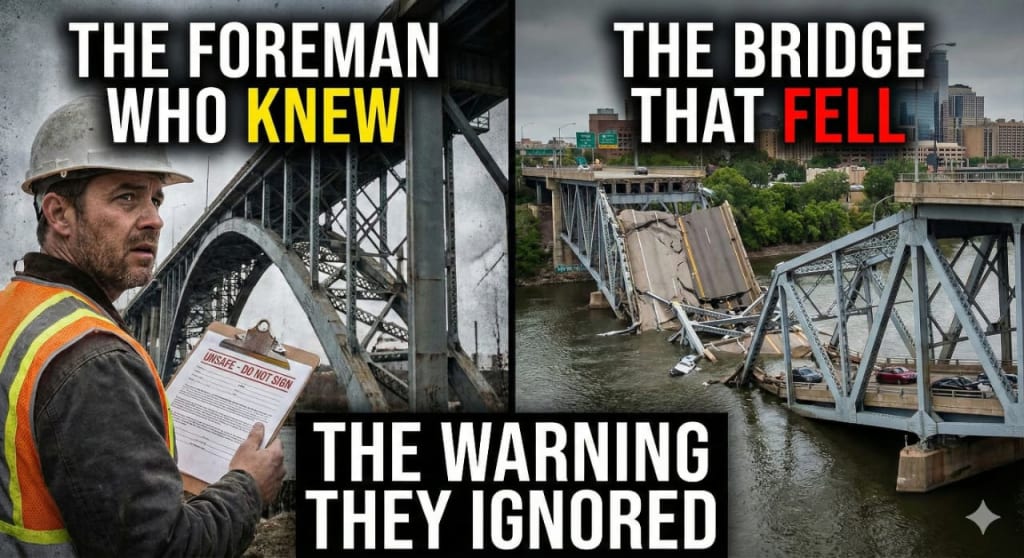
The untold story of Tom Alvarez, the construction foreman who documented the structural instability of the I-35W bridge weeks before its 2007 collapse, challenging the official engineering reports.
Introduction: The Living Structure
A bridge is not a static object. To the tourists driving over it, or the commuters stuck in traffic, it is just a strip of concrete suspended in the air. But to a man like Tom Alvarez, a bridge is a living, breathing organism.
It expands in the summer heat. It contracts in the winter freeze. It breathes. It stretches. And, when it is in pain, it speaks.
In the summer of 2007, Tom Alvarez was a foreman working on the I-35W Mississippi River bridge in Minneapolis. He was a man of the "old school." He didn't have a PhD in structural engineering. He didn't work in an air-conditioned office with CAD software and theoretical models.
He worked in the dust. He worked in the noise. For thirty years, his office had been the catwalks and underbellies of America’s infrastructure. He knew the difference between the rhythmic thrum of a healthy structure and the chaotic vibration of a dying one.
And in July of 2007, the I-35W bridge was dying.
The bridge was undergoing a massive resurfacing project. Tons of construction materials—sand, gravel, heavy machinery—were being staged on the deck. The traffic was bumper to bumper.
Tom spent his days walking the steel truss beneath the deck. It was hot, dirty, dangerous work. But as he walked the catwalks, putting his hand against the green-painted steel, he felt something that made the hair on the back of his neck stand up.
It was a hum. A low, grinding vibration that traveled too far.
In a healthy bridge, vibration dampens quickly. It is absorbed by the mass of the structure. But on I-35W, when a heavy semi-truck hit a pothole above, the steel beneath rang like a tuning fork.
The bridge was screaming. And Tom was the only one listening.
Part I: The Disconnect
The conflict began with a report.
It was a standard piece of bureaucracy—a "Condition Assessment" and safety clearance that needed to be signed off to allow the construction work to proceed to the next phase. This phase involved placing even more weight on the center span.
The report, generated by engineers looking at data sheets and previous inspection logs, concluded that the bridge was "Structurally Sufficient for Continued Service." It acknowledged some corrosion. It acknowledged some fatigue. But the math said it was safe. The "safety factor"—the margin for error—was deemed acceptable.
The report landed on Tom’s desk in the portable construction trailer.
Tom read it. He looked at the graphs. He looked at the stamps of approval.
Then he looked out the window at the bridge.
He knew what the engineers didn't see. He knew about the "gusset plates"—the sheets of steel that connect the beams of the truss together.
Tom had seen plates that were bowing. He had seen rust that was flaking off in chunks the size of dinner plates. He had seen bearings—the rollers that allow the bridge to expand and contract—that were frozen solid with rust and grime.
When a bridge can't move, it tears itself apart.
Tom walked into the project manager's office. He threw the report on the desk.
"I'm not signing this," he said.
Part II: The Math vs. The Metal
The project manager was a man under pressure. The schedule was tight. The city wanted the work done before winter. Every day of delay cost thousands of dollars.
"What do you mean you're not signing it?" the manager asked. "The engineers signed it. The state signed it. It’s a formality, Tom."
"It's not a formality if it's a lie," Tom said. His voice was gravelly, shaped by decades of shouting over jackhammers. "You're loading 500,000 pounds of gravel and equipment on the weakest point of the span. I’ve been down in the truss. The gussets are bowed. The bearings are seized. The vibration is wrong."
"The vibration?" The manager scoffed. "Show me the data on the vibration, Tom. Show me the sensor logs."
"I don't need a sensor," Tom said, tapping his chest. "I feel it in my boots. When the jackhammers run, the whole truss sings. It’s carrying more load than it was designed for. The math may pass, but the metal doesn't."
This is the eternal conflict of modern industry. The conflict between the Map and the Territory.
The engineers had the Map. They had the blueprints from the 1960s. They had the calculations of yield strength and shear force.
Tom lived in the Territory. He saw the reality of forty years of salt, snow, and neglect.
The manager leaned back. "Tom, you’re a foreman. You’re not a structural engineer. Your job is to manage the crew and the schedule. If you don't sign the safety clearance, we have to stop work. We have to bring in independent inspectors. That takes weeks. We don't have weeks."
"Then find the weeks," Tom said. "Because if you keep loading that deck, something is going to give."
Part III: The Ultimatum
The tension escalated over the next few days. Tom became a pariah.
He was the "problem." He was the "bottleneck."
He was called into a meeting with higher-ups. They used a tactic common in corporate structures: they tried to isolate him. They told him that he was the only one complaining. They told him that his refusal was an act of ego, not safety.
Then came the threat.
"Tom," a senior supervisor said, "if you are unwilling to perform the duties of your position, which includes signing off on site clearances, we will find someone who will. You are delaying a major municipal project based on a 'gut feeling.'"
It would have been easy to sign.
If Tom signed, and the bridge fell, he could say, "I just followed the engineers' report." He would be covered legally. He would keep his job. He would keep his pension.
But Tom Alvarez lived by a code that is older than OSHA. It is the code of the craftsman. You do not put your name on bad work. You do not verify a lie.
He looked at the men in the suits. He looked at the paperwork that was designed to shield the company from liability, not to protect the public from gravity.
"Then replace me," Tom said. "Fire me if you want. But don't make me lie to gravity. Gravity doesn't care about your schedule. It doesn't care about your budget. It only cares about the load."
He stood up.
"I am filing a formal dissent. I want it on the record that I believe the load on the deck exceeds the safe capacity of the compromised gusset plates."
He wrote it out. He signed it. He filed it with the site safety officer and kept a carbon copy for himself.
He went back to work, but the target was on his back. He was a dead man walking on the job site.
Part IV: August 1, 2007
The days turned into weeks. The construction continued. The piles of gravel on the bridge deck grew higher. The heavy equipment rumbled back and forth.
Tom watched it all with a sick feeling in his stomach. He checked the truss every day. The groaning was getting louder.
On August 1, 2007, at 6:05 PM, Minneapolis was in the throes of evening rush hour. The sun was still high. The heat was oppressive.
Traffic on the I-35W bridge was bumper to bumper. Cars were inching along, drivers listening to the radio, thinking about dinner, thinking about the Twins game.
Tom had just finished his shift. He was off the bridge, down in the staging area near the riverbank.
He heard a sound that he had been dreading for months.
It wasn't a crash. It was a pop.
It sounded like a gunshot, loud and sharp.
That was the sound of a gusset plate—a piece of steel half an inch thick—shearing off. The rivet heads popped like bullets.
Then came the rip. The sound of tearing metal is a screech that sounds like a dinosaur dying.
Tom looked up.
He saw the center span of the bridge—the part carrying the construction load and the rush hour traffic—simply let go.
It didn't wobble. It didn't sway. It fell.
1,000 feet of steel and concrete dropped 100 feet into the Mississippi River.
Dust exploded into the air. Water geysered up. Cars slid off the tilting deck like toys on a tilted table. A school bus full of children slammed against the guardrail, hanging over the edge of the broken slab.
The noise of the impact was deafening, but to Tom, the silence that followed was worse.
For a split second, before the sirens, before the screams, there was total, dusty silence.
The gravity that Tom had refused to lie to had finally collected its due.
Part V: The Artifact of Truth
The rescue effort was heroic. Divers went into the murky, swirling water. Firefighters climbed the tangled wreckage. Civilians rushed to help.
Thirteen people died. 145 were injured.
In the days that followed, the blame game began.
The politicians blamed the funding. The state blamed the federal government. The construction company blamed the design. The designers blamed the maintenance.
The National Transportation Safety Board (NTSB) arrived to conduct a forensic investigation. They needed to know why.
They looked at the steel. They found the gusset plates—specifically the U10 plates. They discovered that due to a design error from the 1960s, these plates were only half as thick as they should have been.
But they also looked at the load. They found that the construction materials placed on the deck—the gravel and sand—had been placed exactly over the weakest point of the bridge.
And then, they went through the paperwork.
They found the engineering reports that said "Safe." They found the inspection logs that said "Passed."
And buried in the file, they found Tom Alvarez’s dissent.
It was a single sheet of paper. It was handwritten in parts. It was blunt.
It documented the vibrations. It documented the fear of the load. It documented the refusal to sign the clearance.
That piece of paper changed the narrative.
Without it, the collapse might have been ruled an "Act of God" or a completely unforeseeable hidden flaw.
With it, the narrative became: Negligence.
It proved that the warning signs were visible. It proved that the vibrations were palpable. It proved that a human being, using nothing but his eyes and his experience, had correctly identified the danger that the computer models had missed.
Part VI: The Tombstone Mentality
Tom Alvarez was called to testify. He didn't wear a suit. He sat in the hearing room, uncomfortable in the glare of the lights.
They asked him how he knew.
"I didn't know the math of the gusset plates," Tom said. "I didn't know they were undersized on the blueprints. But I knew the bridge was tired. You can't keep asking a structure to do more than it was built for. It tells you when it's done. You just have to listen."
His testimony was devastating to the "system." It exposed the arrogance of thinking that a spreadsheet can override the physical reality of steel and rust.
Because of the I-35W collapse, and because of the evidence that the danger was knowable, the entire industry changed.
New regulations were passed regarding the placement of construction loads.
Every bridge in America of similar design was immediately re-inspected, specifically checking for gusset plate thickness.
The "Safety Factor" calculations were revised.
The concept of the "Tombstone Mentality"—the idea that safety regulations are only updated after people die—was laid bare.
Part VII: The Unwanted Oracle
Tom Alvarez didn't get a medal. In fact, his career in high-level construction was effectively over.
Nobody wants to hire the guy who was right about the disaster. He reminds them of their own liability. He is a walking "I told you so."
He went back to smaller jobs. He poured driveways. He framed houses. He stayed close to the ground.
He never bragged about the bridge. To him, it wasn't a victory. It was a failure.
"I didn't stop it," he told a friend years later. "I just predicted it. That’s not worth a damn thing to the thirteen families who lost someone."
But he was wrong. It was worth something.
It was worth the truth.
If Tom had signed that paper, the company might have successfully argued that the collapse was a total mystery. They might have avoided accountability. The design flaws might have remained hidden in other bridges, waiting to kill more people.
By refusing to sign, Tom Alvarez placed a marker in history. He proved that the system isn't always right.
Conclusion: The Man in the Boots
We live in a world of data. We trust the algorithm. We trust the sensor. We trust the report.
But infrastructure is physical. It is real. It ages, it rusts, and it breaks.
The story of the I-35W bridge collapse is a tragedy of engineering. But the story of the foreman is a triumph of conscience.
It reminds us that the most important safety device in any machine is a human being with the courage to say "Stop."
Tom Alvarez is a reminder that there is a wisdom that comes from the boots, not the boardroom.
There are thousands of Toms out there right now. They are walking the tracks of the subway system. They are climbing the towers of the power grid. They are inspecting the dams holding back the rivers.
They are the ones who hear the hum.
And when they refuse to sign the paper, when they refuse to "lie to gravity," we should not silence them. We should not threaten them.
We should listen.
Because gravity always wins in the end. The only variable is whether we are standing under it when it does.
About the Creator
Frank Massey
Tech, AI, and social media writer with a passion for storytelling. I turn complex trends into engaging, relatable content. Exploring the future, one story at a time
Keep reading
More stories from Frank Massey and writers in Humans and other communities.
The Girl Who Blinked: How a Sixteen-Year-Old Stopped a Massacre by Trusting the Knot in Her Stomach
The true story of Emily Carson, the Colorado high school student who prevented a school shooting by noticing a subtle detail and reporting it, highlighting the power of situational awareness.
By Frank Massey 4 days ago in Humans


Comments
There are no comments for this story
Be the first to respond and start the conversation.