
The Lighthouse & the Little Black Book
A light within the void.
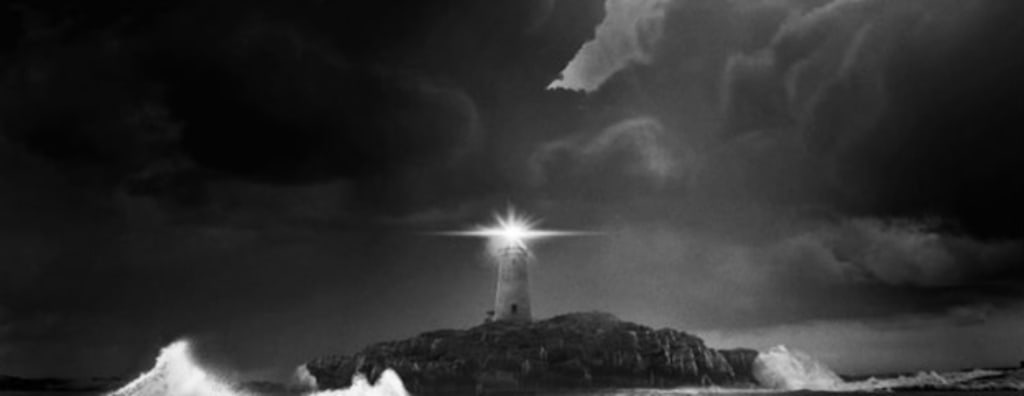
Torrential rain and howling wind were no strange thing to the man who lived all by his lonesome in a small, run-down shack near the base of the great lighthouse on an island north of the town. He was used to the stormy sea winds, the deafening sound of raindrops the size of cannonballs crashing into the window and onto the roof, and the smashing of wrathful waves against the rocks.
When he first arrived to maintain the lighthouse grounds all those years ago, he was terrified of the storms, terrified that the artillery of the clouds would decimate his modest home, but such fears eluded him now. In his current state of mind, he would find himself at a strange peace at the very thought of his shack somehow coming into irreparable ruin, but to him, that was only a dream. And a nightmare. The man feared nothing for such is the habit of those unfortunate enough to have nothing.
The man, a relatively young, lengthy, slender man with a dark shade of stubble and a head of untamed black hair, would wait out the stormy shelling by watching the beacon of the great lighthouse turn and turn, each revolution of its powerful beam sending him into an easy trance like a soundless siren song. He longed for nothing more than to feel its warmth, feel its light, its tender embrace that meant home. Maybe he didn’t even long for the light’s warmth, but just wanted to feel that which the light offered with its shining brilliance to those weary sailors upon the open waters. But, alas, the man was forbidden by the keeper of the lighthouse to set foot inside the tower unless upon dire need. To the man’s great dismay every day, there was never any dire need. The man wasn’t even sure if the keeper was still alive for he never left the comfort of the lighthouse, not even to fish or gather clean water. He just sat inside and kept light burning when he needed to, and left the man isolated in his shack, forced to endure the gnawing cold, the ceaseless solitude, the neverending nothingness, and the slow devouring entropy of time.
As the man stared out of his cracked, yet not yet completely leaky, window towards his lighthouse, his throat began to grow parched. Such is the way of waiting for that which is unattainable. He leaned over the table to grab the whiskey and simultaneously slid his hand underneath the table in search of something. Seemingly having mastered this dual hand movement, the man grabbed both the bottle and whatever he was reaching for under the table simultaneously. He pulled his hand back from under the table and placed an old flintlock pistol on the cold stone table he sat before. He stared at the pistol long and hard, thinking of pitting his own luck against the aged weapon.
“Who will win this time?” he wondered, “Who will win this time?”
After a pull from his whiskey, he pulled back the hammer past the lock of no return, he slammed the cold steel barrel to his temple, and pulldc the heavy trigger. A loud click. Then silence.
The gun had won once more. It seemed that the man had once again forgotten if he had loaded the gun or not during one of his many nightly, and sometimes daily, drunken stupors. This game he played with the gun was becoming more and more frequent, almost habitual. At first the game had been played twice monthly, then biweekly, but he began to play his luck with this demented, somewhat liberating, game every week. The man was never truly sure if he ever had the intention to load the ball into the pistol, but he was never truly sure.
The man slid his lonely friend back into its leather holster underneath the table, but as he was pulling his hand back, he felt something strange, something unfamiliar to him, yet not so for the texture of the strange item was quite similar to that of the leather holster, but much, much smoother. With a mind of doubt, he slowly pulled the mysterious thing from the table and placed it upon the table.
Before him was a little black book, blemish-free, spotless, with a luminescent black face of genuine leather shining in the dim candlelight just as brightly as the moon on the ocean’s face. The man stared, dumbfounded, trying to recall if he had ever felt such a thing before. He thought that he must have but was probably too many demijohns of whiskey deep to realize. With a steady, slow-moving hand, the man opened the front cover, holding the perfectly straight, creaseless spine delicately in his left hand.
There was nothing on the first page of the little black book. He rubbed his cracked fingertips across its surface; the pages were of old golden parchment, ancient yet as bright as yellow stars, coarse to touch but translucent when held in the light. The man noticed a faint black marking on the lower corner of the first page. Standing up, he held the page above the low burning candle. Revealed in the hot light was a beautifully written “M” in a font unknown to the man.
He had never seen this signature before, not anywhere in his small shack and nowhere else on the lighthouse island as a matter of fact. He also could not think of anyone with a name that had begun with the letter, “M,” and couldn’t fathom a single possible reason for someone to just write a letter on a blank page in a little black book. It could’ve been the lighthouse keeper’s that he forgot to claim once he had moved into the lighthouse itself, but if it had been of any importance, he would’ve remembered, so that man did not feel anything when he decided to pilfer through its pages.
He flipped through each page, thoroughly and slowly, taking each blank page as though they were filled with such words that can create worlds, each golden page brighter than the last.
“Golden pages,” he thought, “Golden pages. Gold. Gold. Gold. Gold is money. And I could use some money. I could finally get out of here, maybe I could finally afford to move someplace far away to find my own lighthouse. Perhaps someone in town might think this little black book is worth something. Enough for just a ferry ticket”
The man stopped flipping when something serendipitous, nay miraculous, occurred. Out of one of the golden parchment pages fell a small, folded piece of paper, and not like the paper of the book. No, this paper was thin as the warm spring air and just as light. The man snatched the paper up from the stone table and unfolded the delicate thing slowly to see what secrets might be written on the surface.
A check. The thin paper was a check much to the man’s astonishment, and not just any meaningless check. This was a check written to no one yet endorsed with a signature, the very same “M,” and for twenty thousand dollars.
“Jesus,” gasped the man, barely able to keep his head right up. “Jesus Christ!”
He roared with laughter, the kind of laughter that can only be experienced a few times in one’s life; the deep, genuine laughter that swirls and builds in the gut then fills every part the body with such a feeling of bliss that all ailments and problems disappear altogether, even if but a moment. His episode of mania was interrupted when he realized that the sound of laughter, his own laughter to be more specific, was more foreign to his ears than the sound of melancholy songs the whales would sing in the late hours of the night in the darkest parts of the sea that only those listening with empathy could hear.
No longer laughing, but still electric with excitement, the man went to gather his coat and hat hanging on the rack, and walked out the rotten wooden door, little black book in the pocket of his coat. In his excitement, the man didn’t even care to notice that the torrential rain had stopped pouring and the cloudy artillery had come to a cease fire. The clouds were still lingering up above, covering the sky in a deep swath of gray. Even so, the man wouldn’t let any bad weather stop him from reaching the bank.
Outside, the air was frigid and the rocky earth below him was slippery with fresh rain. Wearing nothing but old worn boots and forgetting that his shack laid upon a hill with a sharp decline, the man ran out the door, slipped on the wet stony ground and began to tumble down the hill.
Down he tumbled through the freshly made mud and muck, splintering every dead branch and twig on the way down. At the bottom, the man staggered to his feet, but when he tried to fully extend his right leg, a devilishly sharp pain shot first through his leg then his entire body. He looked down to see a small fragment of a branch sticking out from his right calf.
“Jesus H,” he exclaimed as he hobbled closer to the old dock thirty feet from the bottom of the hill. Easing himself down on a rock and looking out ahead of him, he saw there was only one dock on the whole island and tied to the rotten wooden planks was a small, equally as rotten and wooden, dinghy no bigger than six feet long and one foot wide. Quite possibly, the meek vessel might have been a sailboat at one point, a time long ago before a great storm destroyed the little mast, a mast so tiny and fragile that it had no business being upon the open water in the first place. The man wondered what flag they might have flown, if a flag was flown at all. The dingy had begun to rot, the combination of entropy and moist saline air having weaved its way into the fabrics of the wood, a horde of barnacles who had found the rot welcoming having colonized the hull. The boat was not a sight for sore eyes, but it was the only method of transportation the man had since the lighthouse keeper did not believe in any motorized boat.
The lighthouse keeper said to the man, on the one day he had ever spoken to him when he first arrived on the little island, that the only way a true vessel of the sea could sail her majestic beauty was by the power of wind, but when the man made the mistake of questioning his thought process when he noticed the little boat had no sail, the lighthouse keeper grew angry and stormed off, but not before shouting his piece.
“Damn ye, ye blasted fool,” he bellowed. “I was going to repair her mast and fit a sail when I had the chance, which I haven’t. How about ye be the one to do it, huh, if ye so goddamn smart. Begone!” It was the only conversation the man could recall having with the keeper, and he never had another chance to remedy the relationship though he wasn’t sure he wanted to.
So it was that whenever the man desired to head inland, which was seldom, he would have to row. But this boat, this dinghy, this former sailboat, was the only way to town, and the man would let nothing stop him from reaching town.
Before the man could go anywhere, though, he had to deal with the jagged branch that stuck in his leg. He was no stranger to pain, and fortunately the branch hadn’t jammed itself too deep into the flesh. He pulled his cap off and bit down hard on the brim, then, with two hands and no countdown, he ripped the branch out in one gut-wrenching pull. Excruciating, burning pain coursed through his leg then his whole body. Blood seeped from the open wound. The man took off one of his boots, took off the old, raggedy sock that had a few holes around the toes and wrapped his makeshift tourniquet tightly around the wound.
“It’ll hold,” he muttered as he stood from the rock and hobbled to the boat, “It’ll have to. I must get to the bank today, no matter what.” On the dock, there was a large, thin piece of driftwood; how it got there the man had no idea, but he did not question this chance of luck for he had few. Using the driftwood as a walking stick, he jumped into the boat, sending it rocking this way and that. Luckily, whoever had used it last had left two oars in there for the next venture. Slimy and equally as rotten as the wood of the boat, the oars would suffice. The man removed the rope from the boat that connected it to the dock, picked up the oars in his hands and began to row into the open waters. He rowed faster and faster, his arms pumped harder and harder with excitement as the thought of being twenty thousand dollars richer raced through his mind.
At about three quarters of the journey, when the man could see the harbor and all its boats’ white sails billowing in the ocean breeze, he decided to take a short rest before finishing his row. He stared out at the boats, wondering which ones sailed frequently, constantly having the cool saline wind fill their sails and the cold spray of the ocean water crashing against its bow, and which ones sat there stagnant, basking in the salt water till the algae overtook the hull.
As he was resting and thinking deep thoughts, he thought he felt a tugging on the left oar. He jerked himself out of his daydream, and leaning over with caution of the unknown, he examined the water over the port side. Nothing but the deep blue blackness of the sea. Then, he felt something tug at the right oar. He leaned over there to inspect, but once again nothing. But yet another, a much harder and fiercer tug, nay, a yank, could be felt on the left oar, this time bringing it plunging into the water. The right one was targeted next, but before it was lost, the man grabbed hold of the handle and pulled it in the boat. When he looked at it, he saw half the oar had been eaten off and a massive, gray shark lurked just beneath the water’s surface.
In his fright, he screamed and fell back into the boat, water splashing over him as the boat rocked back and forth. He peered over the edge to see if the shark was still there; it was, and it was lurking around the boat, far too close for comfort. The beast circled the man slowly. He thought he saw the dark, black, lifeless eyes stare at him as it swam.
“What to do, what to do!” the man exclaimed. He had never been here before, never had to fend a great shark from himself and with nothing but a broken oar. The shark came close once more, and the man saw this as his opportunity to do something.
Striking quickly, but without much strength, the man stabbed at the gray beast with the splintered oar. The shark made no roar or growl or let it know it felt pain, but the man knew he had inflicted some sort of damage when dark blood from the monster’s head began to pour into the sea, creating a grotesque mixture of red and blue.
The shark thrashed around and sent waves of water over the sides of the boat that rocked violently in the chaos. The man held himself fast by locking his legs underneath the small bench in the boat. He lunged with his wooden weapon each time the shark passed by him, stabbing his head over and over again. The red began to overtake the blue, and soon enough the contents of that battleground in the ocean was more blood than water.
Having enough of this dreaded combat, the shark, in its wrath and pain, disappeared into the darkness. Breathing rapidly, the man, with his bloody oar, leaned over the side of the boat to inspect the battlefield. He could not see his foe any longer. Relieved, he sat back down and checked his coa; the little black book was still safe and secure inside his pocket. Having finally caught his breath, he stuck his only oar, bloody and broken, into the water and began to paddle, but as soon as his oar broke the sea surface, the monster, the great white shark, leaped ferociously out of the water and over the boat, jaws gnawing vigorously. Time froze as the man sank in the boat, staring horrified at the belly of the beast that flew over him, cold splashes of ocean pouring over him. The shark couldn’t land any bite upon the man nor the boat, and crashed into the ocean. Defeated, this time it truly swam away, leaving the horror stricken man completely alone. Finally gathering himself for the second time, the man paddled his way towards the harbor hoping he wouldn’t have to deal with open water ever again.
Once at the harbor, the sun had not yet since but was getting tired and was preparing herself for her nightly rest. The bloody, bruised, and tired man tied his tiny boat to the dock in the shadow of a magnificent commercial fishing vessel with the little rope he had left. He figured that because his boat was so miniscule in comparison to the others that no one would notice. Furthermore, he would only be going to the bank to cash his twenty thousand dollar check, a quick affair. He’d be back before anyone even knew his boat was there.
The man walked towards the city, more of a limp with his punctured leg, but before he could leave the docks, he heard a gruff yell come towards his direction.
“Oi, stop right there!” cried a pudgy man with a strawberry for a face, “Yes, you, you raggedy old man, get over ‘ere!” The man hobbled his way over and asked whatever was the matter.
“That yer dingy?” asked the pudgy man, pointing his sausage fingers at the man’s modest boat.
“Aye,” said the man.
“Well, you gonna have to pay a fine to dock it here.”
“That’s the thing,” started the man, but was cut off.
“No, no, no,” stomped the pudgy dock owner, “There ain’t no thing, you pay or you untie, that’s the rule. I don’t make ‘em, I just enforce ‘em.”
“But here’s the thing,” started the man, “Here in my pocket, I have a check for twenty thousand dollars.”
“Oh do ye now?”
“Yes, and if you let me dock my meek vessel here, I will return and pay the fee tenfold on my honor.”
“Ten fold ye say?” The pudgy man stroked his many chins thoughtfully.
“Ten fold,” said the man.
“Fine,” agreed the pudgy man, “but ye have to have my money by seven o’clock this evening else I won’t think twice ‘bout untying your little dingy and letting the tide drag ‘er out.”
“Excellent! I’ll see you then.” And with that, the man hobbled off, still injured beyond comprehension but now reinvigorated with this lucky break, the first one since the finding of the little black book. Before he left he turned back and asked the pudgy dock owner, “Er, which way’s the bank?”
“Thatta way up the road, then take a left at the church and follow that road till you hit the other church and then it be right there on the left.”
“Thank you, kind sir.” And with that, he went up the road.
He did as the dock owner instructed and followed the road up until he passed a great cathedral of magnificent architecture, architecture that the man both marveled and hated. He marveled at the fact that such a building was conceived and designed by one man and was constructed by the hands of many men who were able to follow such a design down to the most intricate of details. But he hated the fact that it was used for a house of worship.
The man did not think very highly of the church, and believed most organized religion was corrupt through and through, and that such an architectural feat was only done so as an example of hubris and not out of the love for the Lord. This cathedral reminded him why he lived alone and isolated on his tiny island and not on the mainland. He turned left and hurried away, not looking back at the church.
The sun was getting lower now; it must’ve been at least four o’clock in the afternoon, and the man still had not found the bank. The evening gloom was beginning to set in from the ocean and long shadows of the tall buildings and houses began to overtake the cobblestone road. He forgot the instructions the pudgy man had given him.
“Was I to follow the road until another church then take a left or a right? Damn, I fear I’m lost again and the sun won’t be up for much longer.”
He decided to ask the townsfolk for directions, but there wasn't a whole lot walking about. He stumbled upon a couple of men standing on the corner of a dark brick building with broken windows that had been poorly shuttered with wooden planks. They were grim looking men with dirty faces and gray eyes.
“Good men,” the man started, “do you have any notion of where the bank may be? I’ve been searching for nearly an hour but I'm afraid I’ve lost my way.”
The grim men looked at each other and smirked, revealing grotesque sets of rotten teeth.
“Aye, we can help ye,” one grim man said who wore a dark cap upon his bald head.
“Yea, we works at the bank,” said the other, who had no cap but a long black trench coat, “Just follow this path right ‘ere, this one.” He pointed to a dark alleyway across the street next to another abandoned brick building.
“Are you sure? It doesn’t seem like the way the dock owner told me to go,” questioned the man.
“Oh sure, I’m sure,” said the cap man, “I’m as sure as sure itself is how sure I am.”
“A shortcut it is,” said the man in the trench coat.
“A shortcut, aye,” agreed the cap man, “You go on down that way and at the end, poof! You’ll be right there at the front o’ the bank.”
“Well, I’ll try,” said the man, “Thank you.”
The man went down the street and turned towards the alleyway, not noticing the two grim men stalking him quietly from a distance.
The sun was now very low and her light was covered by the evening fog. Dark was the sky and even darker was the alleyway the man found himself walking down. There were no streetlights, no windows with any lights peering out, nothing but the dim light the sun offered through the clouds. The man’s leg was getting ever more painful as he went, but each time a sharp, hot pain shot through his body he would grasp his coat pocket and feel the little black book with his salvation hidden within. When he did that, he found the strength to carry on for a man down on his luck will become the strongest when fortune is in sight.
After a short while, he stopped by a dirty, burnt trash can covered in ash, probably used as a makeshift fireplace by some other folks down on their own luck. He rubbed his leg and took a breather, but his rest was cut short by a hefty blow to his ribs by what felt like a metal pipe. Before he let himself fall, another blow came atop his back forcing him to the ground. Then, he heard evil laughter ringing in his ears, like two hyenas who’ve caught a wounded gazelle. He tried to get up but another blow from the metal pipe sent him back down, smashing his face into the cold, wet cobblestone.
“That’s it, that’s how you do it,” said one of the assailants. The man recognized the voice as the man in cap, the one who gave him directions.
“Why does he have to go to the bank, we wonder,” said another man, this time the man in the trench coat, “Has he gots money lined up in his pocketes?”
The man tried to get up and explain himself, even offer them both a good deal of money from his twenty thousand dollars should they stop beating him and show him to the bank, but the two grim men didn’t give him any chance to speak. They began to kick him with their heavy boots all over his back and his ribs. The cap man tried rolling him over, but the man locked himself up with one hand over his neck and the other gripping both knees. He would not be moved Quickly, he remembered the little black book and put the hand that was covering his head and neck onto his coat pocket, but now his head was open and the man in the trench coat kicked his head hard, and the man saw nothing but stars and then a cold blackness.
“Rifle through them pockets of his,” was the last thing he heard and he had no longer enough consciousness to know which man said what. But before the world turned to nothing, he felt dirty hands rummage over his body and through his pants. Luckily for him he carried nothing on him, and even luckier for him the two men didn’t even think to check his coat. Frustrated, the two grim men both gave him one final kick and then a last devastating blow of the metal pipe before they left. The man laid there motionless, all life leaving him as quick as the blood pooled from his head and back. He slowly rolled over and stuck his bruised, black and red hand into his coat and felt the smooth leather of his book. Then, he crawled his way forward till finally reaching the end of the alleyway. There was a single lamppost at the corner that he took refuge under before he could longer move or speak or even breathe that well. The man fell into a deep sleep of pain and darkness.
He awoke to the soft shake of a delicate pair of hands. Startled and afraid, he jerked upright painfully and recoiled back against the lamppost, but when he looked at the person who had woken up, it was a fair faced woman with brown hair and golden skin. He stared into her eyes, deep brown eyes that glittered and shone in the lamp light. A warmth overtook him and he eased his body, that now pained him everywhere.
“Are you alright?” she asked him, resting her hand on his shoulder.
“I’m-I’m fine,” he stammered, not being able to speak too well on account of the kick to the head forcing him to bite his tongue. When he spoke, blood pooled in his mouth. “I’m-I’m sorry.”
“Don’t be,” she said, “You’ve nothing to be sorry for. Can I help you? Do you need to see a doctor?”
“No,” he stammered, “the bank.”
“The bank?” she said. “Whatever do you need to go to the bank for?”
“A check,” he said, trying to rise to his feet. He stood on one but fell back down immediately.
“Don’t try to move too much,” she said, helping him sit up. “Let me try to help you.” She took his arm around her shoulders and helped him to his feet.
“Thank-thank you,” was all he could get out. “Name?”
“My friends call me Angie,” she said. “So you can call me Angie, too.”
“Angie.”
“The bank’s not too far, but it’ll probably be closed. I live across the street from it, actually. Do you have anywhere to stay tonight?”
The man shook his head.
“Well, I have a small couch you can sleep on, I’m sure it won’t be too nice, but it’s better than a lamppost.”
Seeing as the man had no more options nor the will to argue, he nodded, and the two walked down the street towards the humble house of Angie.
The sun had taken her leave and the moon came to take her place in the night sky, it’s pale light only coming through in small patches the clouds weren’t covering. The two stopped right outside a large brick building that had many windows with light peeking out from its many stories. Across the way was a golden building with two marble lions facing each other over a double wooden door. The bank. The man had made it at last. He stopped and stared at the beauty of the building, admiring the intricate architectural design that was even more modest than the church he had passed earlier that day. Though his mind was still scrambled with fatigue and pain, he thought it was funny that banks, with all their money and power, weren’t built as grand as cathedrals, who were supposed to preach against money and power.
“This is my place,” said Angie, “I live on the first floor, number 104 to be precise. Do you know what street we’re on?”
The man shook his head.
“Lake street. Not the nicest part of town but the banks here and nothing too bad happens. Come on, let’s get inside before we freeze.”
She opened the door and helped the man inside. They walked down the hall until they hit the first apartment on the left side.
“Here we are,” she said as she fumbled for her keys. She pulled out a tiny ring of keys and found a small silver one that she jammed into the top lock. She twisted and turned it both ways it could go multiple times before finally unlocking it. Then she did the same for the bottom lock, locking and unlocking it three times before deciding to keep it unlocked. He stared at her strangely and smiled, thinking her way of unlocking doors funny. He would have laughed if he could.
“What’re you smiling about?” she asked, “I have trouble unlocking and locking doors. Everyone does. Now get inside.”
He went inside first to her apartment; it was very nice and very small. There was no bedroom; only a bathroom and a small closet, and the kitchen was not five feet from the small bed. A green couch laid against the wall also not five feet from the bed. Before the couch was a tiny coffee table with a large black book open on its surface. The man noticed many notes and pen scribbles all over the pages but knew not what they said nor what the book was.
“Here’s home,” she said, taking off her jacket and setting her keys down. “It’s not much, but it’s mine and I love it. Here, sit down, please.”
She led him to the couch, which as can be guessed, wasn’t five feet from the door. He sat down and gave a sigh of relief and a grunt of pain.
“Thank you,” he said, now having better control of his speech. “I’m not used to this.”
“What’s that? A couch?”
“Kindness.”
She looked at him for a while, but his eyes were already shut and his breathing was slow and heavy. Sleep had overtaken him and he had not the energy to fight it. It had been a long, long while since he slept somewhere quiet and peacefully. Even his small shack upon the lighthouse island was always noisy with howling winds and crashing waves, sounds that didn’t bother him all that much, but to be in a warm room with no noise and complete safety was something new to him that he now longed for more than ever.
“Sleep easy, you poor man,” Angie said to him as she took off his coat and boots. His feet were bloodied and caked in mud, no socks did he wear.
“What happened to you?”
She went to the sink and drew a pot of water that she boiled. Then, she took a soft cloth and soaked it in the hot water. With care as to not wake the man, she washed his feet. Noticing a trail of dried blood coming from the top part of his leg, she decided to remove his trousers, and what she saw was more grotesque than anything she had ever seen.
His wound, the one from the branch he fell upon that morning, was now infected and yellow, with hints of dirty green smudged here and there. His makeshift tourniquet had proven effective in stopping the bleeding, but it had not prevented infection. Luckily for him, Angie was trained in nursing and knew his wound wasn’t beyond healing. She went to the bathroom and returned with a medical kit. She sat down and began her healing process.
She first cleaned the wound with hot water and an antiseptic. Then dried it with another soft towel before wrapping his leg with gauze. She thought to stop there but knew that he was more broken and beaten than he showed. She unbuttoned his shirt carefully and slowly so as to not wake him, but she had no need to worry about that since the roaring engine of a freight train could not disturb the man’s deep slumber.
His body was battered and bruised more so than Angie had ever seen before, at least in regards to civilian men. In wartime, she had seen soldiers with horrific wounds and trauma caused by ballistas and gunfire, but that was expected of soldiers getting shot at.
The man’s chest was purple and red, his ribs brown and blue, his back bloody and bruised just like the rest of his body. She had no clue where to start.
After all wounds were cleaned and dressed, Angie went to wash his clothes, leaving him covered with a white blanket. She folded the clothes and laid them on the coffee table. Before she went to bed, Angie had one more thing to do; wash the man’s dirty, beaten, and sulken face. She took a fresh cloth and more hot water, and began to wipe his pale skin, and when she was done, she noticed his face was relatively attractive, and watching him sleep, she thought he was rather quite handsome, but still, a deep sadness lingered in the purple rings under his eyes and in the lines of his face. Blushing, she got up and prepared herself for sleep, and laid down on the bed, not five feet away from the man. She slept just as soundly as he.
Dawn came. The sun dispersed the nightly fog with her beams of brilliant golden light that painted the dirty city with a warm yellow hue. Seagulls called to one another, bells from ships departing from the docks into open waters rang clear, and the muffled shouts and grunts of the dock men could be heard from every corner. The man awoke to the sunlight flooding his shut eyes. When he was fully awake, he looked around to see where he was.
He sat beneath a lamppost, it’s light still hot from the night before. The man turned his head this way and that way looking for Angie. Why was he here? Why wasn’t he in the small apartment where everything was five feet from everything? Why was he alone? Where was Angie? Could the night before all been but a dream? He tried to stand up, and to his astonishment, he could though with a little pain in his leg where he had been stabbed the morning before. His back was sore and his ribs were aching as if they had been beaten with a lead pipe. They had. He rubbed his face and noticed it was clean, cleaner than it had ever been in recent memory, and when he looked down he noticed his clothes were clean, too. Where once there were patches of mud and dark red stains of blood there was only the dark green weather stained fabric of his coat. He stood fully upright, feeling at first invigorated. The man felt sustained and peaceful, more so than he had ever felt before. His clothes were washed, his face was clean, and his wounds were properly cared for. But why was he still all alone by the lamppost where he met Angie the night before? Maybe it was all a dream, he thought. But at least it was a good dream. He reached inside his coat pocket and felt salvation once more, and, deciding not to dwell on last night any longer, he walked down the street, knowing exactly where he was going this time though he wasn’t exactly sure his route was true.
When the man walked a long while down the street, he finally reached the bank he dreamt about that night. It was equally as magnificent as it was in the glorious golden sun’s light and the pale, cold and fierce burn of the moon’s beams. The two lions stood guard vigilantly above the wooden doors. And right across the street stood the apartment building that Angie lived in, on the first floor, room number 104 to be precise. Or at least, that’s what had been there the night before. Now, in its stead, dwelt a small wooden house with foundations of oak and pine. This home was the most modest home the man had ever seen in his life other than his own, but the state of his abode was of no choice of his. He stopped for a long time, his eyes fixated on the colored glass window right next to the front porch. An odd placement he thought, and the portrait on the window was of what he thought looked like himself with a crown of thorns and nails gashed in his hands and feet, blood pouring out from his open flesh. And below him, on his right side was a woman, with golden skin and dark brown hair with eyes of a deep and endless brown. She had a basin of hot water and was cleaning his feet as he bled. The man said nothing. His face did not change. His surprise and astonishment that anyone else would feel were not there. He felt nothing but a simple moment of peace that fleeted just as quickly as it had come. He turned his back to the home and walked inside the bank.
The man opened the double doors of the bank and entered the vast lobby that glowed a pale golden light. The ceiling was a mural of figures the man had never seen; they were sailors on a massive whaling ship. The waves were overtaking the listing ship, the dark sky was swirling angrily above, and bolts of lightning could be seen slapping the ocean’s tumultuous surface. The men aboard were all over the deck, all doing their jobs in harmony for the sake of a single purpose: to kill the whale because the whale, to them, was their salvation. The whale was their livelihood, for some of the men, it was their final hope at any sort of hope on land. Despite the storm, despite the danger of their occupation, and despite the idea that at any given moment, one of the men could fall into the water and perish or any other number of accidents could take place that could prove fatal to them, but the men don’t mind because they need more than anything to kill this whale for this whale is everything to them. The man studied this mural for a long while, admiring all the colors and hues and detail before his concentration was broken by a woman’s voice.
“Sir,” she said, and the voice was oddly familiar, “can I help you?”
The man looked forward and saw Angie, sitting behind the teller’s stand. It was her! She had the same sultry, kind voice and the same head of brown hair with eyes of deep hazel.
“Angie?” he said, “Angie, where ever did you go? I woke up by the lamppost all alone, and I couldn’t find you. How did I get back?”
“Sir,” she said, kind as could be, “My name is Elizabeth. I’m afraid I know no Angie’s.”
The man stared at her with eyes wide and mouth agape. She was Angie. The likeness was too alike. The same hair, same beautiful golden face with a smile only akin to the dawn rising; the same kindness.
“Nevermind,” said the man, “my mistake.”
“That’s alright, sir. How can I help you?”
“I have a check here I’d like to deposit,” he said, carefully pulling out the little black book. He took out and placed the soft leather bound book upon the counter. From it, he delicately pulled the thin check for twenty thousand dollars. He handed his precious to the teller with both hands.
Elizabeth examined the check under the light and then ran it through a machine the man had never seen before, but to be fair, most of the technology in the modern world he had yet to see.
“Sir, this is quite a large sum” she said, “but at least whoever wrote this check had an account with us.
“Who made it out? And Will that be a problem?”
“No, not a problem at all, but how would you like the money?”
“Cash, if that is alright.”
“That’ll take a little bit of time to get together,” she said. “Do you have an account with us?”
“An account?” The man had never had an account with any establishment.
“Yes sir, an account with the bank.”
“I don’t think so. Will that be a problem?”
“Not a problem, but you will have to make one in order for me to give you the money.”
“I don’t know how.”
“I can help you, sir,” she said and pulled out a stack of papers. “Now, your name?”
“My name,” and he thought for a second, “Pattinson. Dewy Pattinson.”
“Well, Mr. Pattinson, it’s a pleasure to meet you. Now a few more things and you’ll be all set.”
The two finished the account as best they could, seeing as Mr. Pattinson did not know most of the answers to her questions. He had never needed to know them. His address? All he knew was that he lived in a small shack by a lighthouse. His date of birth? Years of isolation forced him to forget the exact date, but he knew the year. Form of identification? He had a birth certificate somewhere around his shack, but the piece of paper had been lost or completely deteriorated from long years of the island’s harsh weather. Mr. Pattinson was beating himself up now for losing such a document since he now, more than ever, needed to know his birthday and a form of identification.
“Well, Mr. Pattinson,” said Elizabeth, “you are an official member of Lion’s Bank and Loans. Now for your check.” She shuffled the stack around, but as she shuffled, the check for twenty thousand dollars fell onto the floor. The man nervously looked behind the counter to see where his precious paper had flown off to, but Elizabeth had already dropped down to find the check. She came up, and in her hand, were more papers than had fallen, all the same size.
“Mr. Pattinson,” she said in a low voice, “it appears your check was stuck to two others.”
“What do you mean?”
“You actually have three checks here, all for twenty thousand dollars.”
The man could hardly speak, nor move or breathe. His body and mind were paralyzed with excitement and disbelief.
“Sixty thousand dollars,” he whispered to himself.
“A hundred thousand,” Elizabeth interjected.
“A what?”
“You have a hundred thousand dollars here, sir. The other two checks were for forty thousand each.”
“A hundred thousand dollars.”
“And I found the writer of the checks, a man named,” but Elizabeth did not have the chance to finish her sentence. The man took a deep breath as he tried to balance himself in a world that was now spinning. His vision went blurry and when he succumbed to the darkness that crept in sight, he fell to the floor unconscious.
Mr. Pattinson awoke outside on a bench with a score of people around him. Men and women all wearing fancy coats and fur hats huddled around him examining him, like a wild beast locked inside a cage.
“Look at his clothing,” he heard one say.
“The homeless problem is getting truly out of hand,” came another.
“I thought these types of people didn’t belong in this district,” he heard a woman say to her husband.
“They aren’t,” said the husband, “They’re supposed to be ushered to the docks once they get up here.”
“Vagabond,” was one he heard quite a few times, but the comment that roused him was,
“People like him don’t deserve to be up here. This is a place of decency, not a welfare shelter for the cretins of the world,” said a man, “This man had his chance, and look, he squandered it. Lock him away, I say. Some punishment, that’ll do him good.”
Mr. Pattinson roused himself and sat straight up. The crowd of people gasped and took a step back, some of them even leaving pretending they weren’t intruding on a poor man’s privacy.
“Good morning,” he said to them, “is there something you need from me? Something I can help with?”
The crowd said nothing. A heavy silence filled the streets except for the ambience coming from the docks below.
“Right then. I hear all of what you’ve been saying,” said Mr. Pattinson, standing on two legs now, “and quite frankly, you all don’t know half of which you speak. I am not a vagabond nor am I homeless. I tend to the lighthouse on the north island not ten miles out from the harbor. I live there alone in a small shack, and though I do not live in the lighthouse specifically nor do I operate it’s imperishable flame, I nevertheless contribute to its functionality ergo it is because of me more than any of you that your lives, and the lives of this whole evil town, are able to go on.”
He paused for a moment to let the people grasp the concept of what he had just said. Some grew angry at this notion, others outright furious that a man clad in poor cloth and boots could make such an audacious statement.
“By the looks of your faces, I am led to believe that you don’t believe me, or you do and the very thought of someone like me, someone who wears poor clothing and has a head of unkempt hair, could have any effect over you, but hearken to me: All of you, and everyone else stuck here, is reliant on the shipping vessels that come through these docks. Every single one of your livelihoods is only so because the lighthouse makes sure the ships, whether they be fishing vessels bringing in your food or trading ships with your precious furs and jewelry, or cargo ships with brick, mortar and steel to build your obnoxiously extravagant homes, they dock safely because of the lighthouse. Because of me. How dare any of you look upon me with scorn or contempt for it is because of me, and those like me, that your lives can be as full and arrogant as they are.”
The crowd grew even more quiet than before, and it seemed that even the dock workers had quieted down as if they were listening intently to Mr. Pattinson’s sermon.
“Right then,” he said, “I have worked too hard for too long for you people. I have labored in my duties and suffered for them greatly, and at last, fortune found me. I journeyed long and hard to get to this bank, this wretched bank in this wretched town filled with you wretched folks. I’ve been mistreated, I’ve been lied to, I’ve been beaten and broken and nearly killed for this small fortune. Though I cannot change the minds of any of you to not look down upon me for the judgment you created based upon the minute detail and status of my clothes, I can let you all know how truly wicked you all are, and how there’s only been one real person here who has shown me any shred of common decency. Good day to you all, and may you find peace somewhere riddled amongst your pride.”
Mr. Pattinson bowed and went inside the bank, the bank he was now a member of. He swung the wooden double doors open and slammed them behind him, not taking another glance at the townsfolk who stood in awe at what they had just seen.
He strolled up to the teller’s counter and noticed Elizabeth wasn’t there anymore but another woman.
“Pardon me,” he said, “is Elizabeth working any more?”
“Oh, you must be Dewy Pattinson,” she said, “Elizabeth told me you’d be coming by after you had woken up. She told me to tell you that your account has been completed and that you are fully part of the system.”
“Thank you,” he said dryly. He wasn’t too keen on being part of the system, especially this one.
“She also knew that you wanted the checks you had deposited in cash, so she set it aside for you.” The teller reached underneath the counter and pulled out a large black bag filled to the brim with cash.
“Is this all of it?” he asked, inspecting the bag.
“Yes,” said the teller, “The bank does not provide bags in which to store money in, so Miss Elizabeth let you have one of her own.”
“That’s very kind of her. When does she work next? I’d like to thank her personally.”
“I’m not very sure about that, but if you come in tomorrow, I’m sure she’ll be around. Will that be all, sir?”
“Yes, thank you.” Mr. Pattinson took his large black bag and walked out the wooden double doors, but before he left, he said, “Remove my account. I have no use for it any more.” He slammed the doors behind him.
Outside, the crowd of people were still loitering around the bench, and when they saw him depart the building with a bag full of clean, crisp cash, their faces flushed with embarrassment and shame. Most of them departed immediately, some stayed to watch him go, not convinced he was anything special, and, to be fair, he wasn’t. Then again, neither were they.
Mr. Pattinson, money in hand, little black book in pocket and hope in his heart, walked across the street but stopped in the middle. He had no idea where to go or what to do. He had accomplished his quest, and had all the money and eighty thousand dollars more than he wanted. He was a rich man with nothing and no idea where to go from there.
“I suppose my boat’s no longer there,” he muttered to himself. “I’ll have to buy one tomorrow seeing as the day has drawn on.”
He kept walking across the street and stopped in front of the small wooden house. He looked inside and saw a small red tint coming from one of the only two windows on the front of the building. Mr. Pattinson walked up to the door and knocked gently. Within five heartbeats, the door swung open showing an elderly man in an old flannel shirt.
“Why hello there,” the old man said, “how can I be of service to you? I’m Issac.”
“Hello,” said Mr. Pattinson, “my name is Dewy. To be frank with you, I’m not sure why I’m here.”
“You don’t say,” said the elderly man, “Well, do you have any plans for the evening?”
“I don’t have any plans at all.”
“Perfect, how about you come in for a spell? You seem weary, and, from the looks of your face and how you're standing on that leg of yours, quite hurt.”
“I’m quite alright,” said Mr. Pattinson, “I’m sorry I disturbed you. I just wanted to know who lived here.”
“I do,” said Issac, “and my daughter. I built this home fifty years ago and never added on to it, despite the rest of the town growing tall and metal,” said Isaac, “so how about that coming in and resting a while?”
“Would it be such a bother?”
“No, not at all. Come in, come in. I have some coffee on, have a cup will you?”
“No, I shouldn’t. I don’t want to impose. You don’t even know me.”
“I have to insist, come on in and get to know me. My daughter, Elizabeth, who works at the bank across the street, just got back not an hour ago. She’s making supper. Stay and have a bite, you look like a man who’s hungry.”
“Elizabeth?”
“Yes, my daughter. She came to live with me when her mother passed.”
Mr. Pattinson looked at the elderly man’s face; old with many lines running across his cheeks and forehead. A great white beard hanging low to his chest, but eyes that shone brightly just like his daughter’s.
“I’ll happily accept your invitation,” he said, with that, Dewy Pattinson stepped inside the little wooden house for supper with an elderly man and his kind daughter.
Inside, Isaac went into the hallway and disappeared, saying he’ll be back in a moment. The interior of the home was both what Mr. Pattinson expected and also not at the same time. The house was small, very small as the outside indicated, but just because the wooden home was modest, the inside was very well kept. There were no dirty dishes in the sink or rancid food lying all over the counters. No empty bottles littered the floor and no windows, few though there were, were cracked or leaky. This home was warm; a fire was burning bright in the brick fireplace that made the air smell sweet. There were intricate wooden carvings of various nautical objects such as fisherman, magnificent swordfish jumping out of the face of a towering wave, but the one that caught Mr. Pattinson’s eye the most was the wooden carving of a lighthouse.
“Isaac,” he said, “this lighthouse is quite beautiful. Where did you see such a tower?”
“That’s the lighthouse out there on the island, just north of the harbor.”
The man studied the piece more intently, and saw that Isaac had really carved the lighthouse he tended to, or used to tend to. Mr. Pattinson worked there no longer and had no plan on returning there except for gathering his things which he did not have much of.
As he ran his slender fingers over the smooth faces of the wooden lighthouse, Isaac came to him with a fresh cup of piping hot coffee. Mr. Pattinson took the cup and looked around the room for a place to sit.
“Please, sit anywhere,” said Isaac as he walked back into the hallway, “I’ll be just a moment.”
Mr. Pattinson found a small red chair with a cushion caked with dust. Thinking his actions to be rude if he’d just started swatting the seat, he sat down and sent the dust flying sporadically in the room. At that moment, Isaac returned with three plates and cups and silverware sets upon a small tray. He set the wooden table with absolute delight as if he were setting the table for a long awaited family dinner.
“Come on now,” he said, gesturing to Mr. Pattinson to get on up to the table, “sit here next to me.” The elderly man pulled a chair back to his right to which Mr. Pattinson sat down awkwardly like he’d never sat down at a table; at least not a family dinner table.
“Father, did you get all the cups?” said the voice, a fair and soft voice, of a woman, but Mr. Pattinson knew who the voice belonged to. From the hallway, in walked Elizabeth the bank teller, still wearing her uniform from her long days work, carrying a tray full of various dishes, still as beautiful as the moment Mr. Pattinson first gazed upon her
“Oh,” she said when she saw her father’s guest, quite startled, “Mr. Pattinson, is that you?”
“Hello, again, miss,” he said nervously, fumbling out of his chair to stand.
“Oh no, don’t get up,” she laughed, “it’s tough enough getting into that chair not to mention getting out of it.”
He sat back down and sipped from his coffee. She set down all the dishes she was carrying, and Mr. Pattinson could hardly tell what any of the food was seeing as none of them were plates of moldy bread and butter. He did notice what looked to be a small, yet whole, chicken.
“How do you feel?” she asked him as she sat down to his left. Being in such close proximity to her outside of the bank made his heart dance and his stomach churn like the towering waves that rage against each other in a storm.
“Fine, I suppose,” he said, “Thank you. How, uh, how do you feel?”
“I feel just fine, I suppose.”
“Good. Good, that’s good.”
“I suppose it is good,” She smiled at him.
The two sat together in silence for only a short spell until Isaac came forth from the kitchen with a vintage bottle of red wine and some fresh bread, the only two things Mr. Pattinson was truly acquainted with. Except the fresh aspect of the bread. Together, the three of them began to eat their tiny, modest feast. Isaac poured them each a glass with a heavy hand, and Mr. Pattinson soon began to feel light and warm all over his body.
After supper, the two hosts cleared the table as Mr. Pattinson sat there clueless as to what they were doing. They returned with fresh coffee and all three of them sat in the living room watching the fire in his fireplace until the last log was reduced to smoldering coals. After a long silence, Elizabeth turned to Mr. Pattinson and said:
“Mr. Pattinson, if I may be so bold as to ask this, but what is it you plan on doing with all this money you’ve found?”
“Wait, wait,” interjected Isaac, “how is it you found this money?”
“I found it in a little black book that was hidden underneath my table,” answered Mr. Pattinson as if finding a strange book filled with money is as common as finding one’s shoes.
“Good gracious me,” whispered Isaac.
“And when I opened the book, I was overwhelmed by it’s golden pages, and thought maybe someone in town might think such a pretty book would be valuable.”
“And then what happened?” Isaac was very much interested in hearing Mr. Pattinson’s tale. So much so that he sat up in his chair hunched forward as he stroked his long white beard.
“Then, a piece of paper flew out from the book’s center; a piece of paper that turned out to be a check for twenty thousand dollars.”
“How fascinating. How absolutely fascinating.”
“Father, please,” said Elizabeth, “let the man finish his tale.”
So Mr. Pattinson went on to tell them of his long day’s journey from the tumbling down the hill and getting his leg stabbed by the jagged branch to perilous encounter with the great white to the crossed pudgy dock owner to the mugging by the two grim men in their trench coat and cap to finally the bank.
“God Almighty,” whispered Isaac in disbelief. “You’ve had quite the adventure, Master Pattinson if I do say so myself, and I’ve had quite a few in my day. But yours is something very unique.”
“That part with the two men,” said Elizabeth in a low voice, “that sounded something dreadful.”
“I suppose so,” said Mr. Pattinson, “but something happened afterwards that made the whole event quite worth the beating.”
“And what was that?” she asked.
“I got to meet you,” he said and then there was a silence that filled the room. Even the docks could no longer be heard, only the soft crinkling of the fire now burning brighter than ever.
“But, Master Pattinson,” Isaac finally said, cutting the silence, “I don’t believe you ever answered my daughter’s question: what do you plan on doing with the mysterious money from a mysterious man?”
“The mysterious man!” cried Mr. Pattinson, now remembering that Elizabeth had mentioned she knew the name of the writer of the checks. “Elizabeth, who on Earth left those checks unattended, such a great sum that they were?”
“Oh, that’s right,” she said, “I do remember the name. Hm.” She sat and thought for a while, trying hard to remember. She had had a long day as one can imagine.
“The name began with an ‘M’ am I right?” Mr. Pattinson reinforced.
“Damn it,” she said with a heavy sigh, “I’m afraid I don’t remember. But I can find out for you tomorrow if you’d like to stop by the bank sometime before six o’clock.”
“Yes, I’d like that,” he said, not really caring about knowing the name of the original owner anymore but moreso about going to the bank.
“I’m getting far too excited for my age!” cried Isaac laughing, “Master Pattinson, I must know what you plan on doing with your money. Will you buy land, a ship, maybe one of those drug stores I see popping up all over town. They’re growing quite popular these days.”
“Father, please,” Elizabeth interjected, “the man does not have to share his plans if he doesn’t want to.”
“To be honest, sir, I’m not sure what to do with this small fortune of mine. When I first began my job as the lighthouse keeper’s assistant, I had always dreamed of at some point tended to a lighthouse of my own. No assistant, no one to order around or to be ordered around by. Just me and solitude. And every time I’d light the beacon, I’d bask in its warmth and finally feel home.”
“Is that still your plan?” the elderly man asked.
Mr. Pattinson looked at him, and then at his daughter. He found himself lost in the fiery glow that danced upon the surface of the hazel pools that were her eyes.
“No,” he said at last. “No, I don’t think so.”
About the Creator
Keep reading
More stories from Kyle Gardner and writers in Humans and other communities.
The Wyrm in the Valley
There weren’t always dragons in the Valley. When the world was young, knowing no strife or war, life ran rampant amongst the grassy plains and through the dense swaths of forest that made up the Valley, a natural formation that stretched for a thousand miles in every direction. Serene beasts grazed the fields with birds soaring high above them in their domain of blue sky. The trees grew tall and strong, with trunks stronger than steel and boughs so long with leaves so green, they outstretched far and wide, coming together to form one large canopy. But with the growing of the canopy came the Darkness.
By Kyle Gardner4 years ago in Fiction
Time to change your life.
Is it even possible for you to change your life? A lot of people, more than there should be, are unhappy with their lives. But what are they doing about it? Usually nothing. People talk about how shitty their lives are and want change, but are they not taking the actions to change?
By Jen Phillips3 days ago in Humans
“The Home That Taught Me How to Live”
I used to think advice only mattered when it was spoken clearly and loudly. I believed wisdom came in long speeches, strict warnings, or dramatic moments. But growing up, I slowly learned something deeper: the strongest advice often comes quietly, through family, through daily actions, and through love that never asks for attention.
By NAIB REHMANa day ago in Humans




Comments
There are no comments for this story
Be the first to respond and start the conversation.