
The Library of Lost Voices
A Mute Girl Speaks Through Stories Only She Can Read

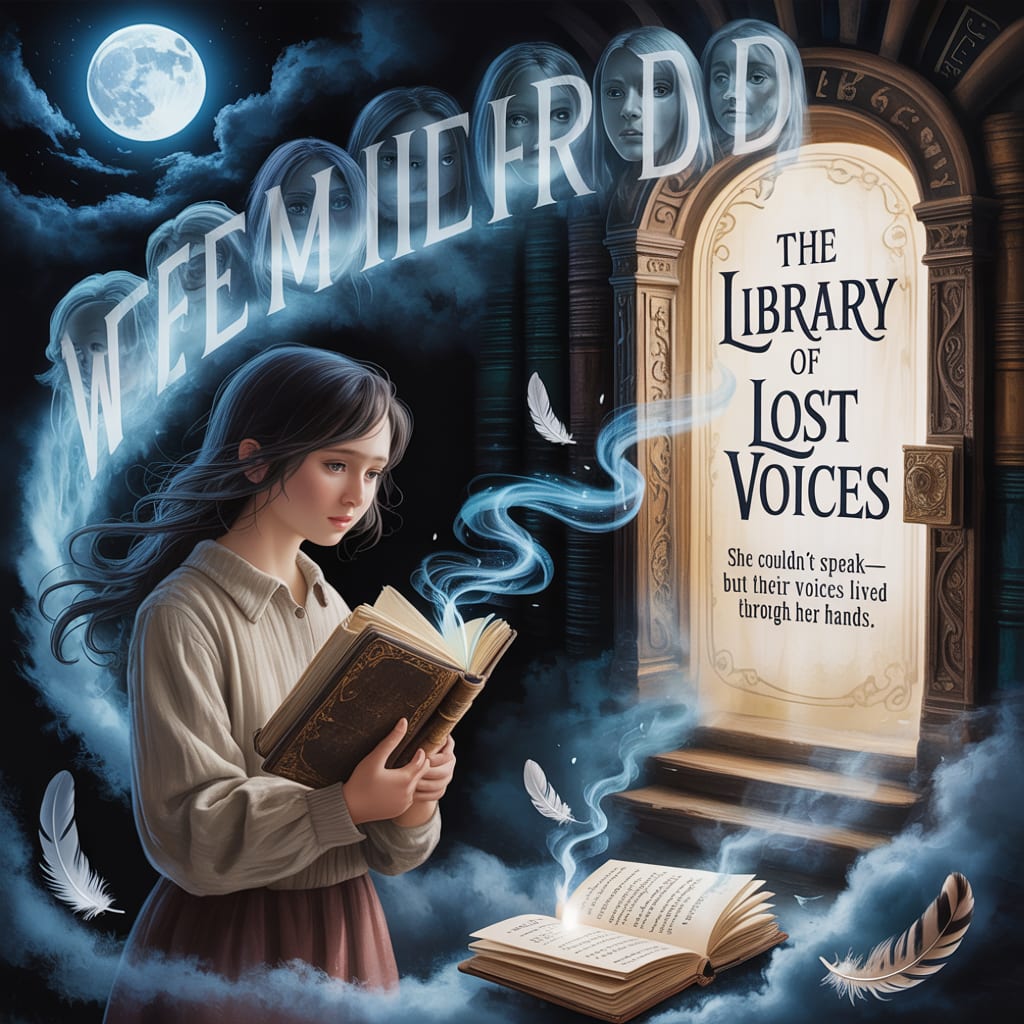
In a small coastal town that never made it to any map, nestled between two jagged cliffs, stood a library no one had built. It appeared after a storm that left the town quiet for days—no power, no internet, no sound. Just the wind, whispering secrets through broken windows.
The townspeople avoided it. Not out of fear, but out of something heavier—uncertainty. Its windows were always fogged, and its doors, though never locked, creaked open only for one person: Mira.
Mira was born without a voice. Not stolen by accident or tragedy—she simply never had one. Her silence wasn’t empty though; it carried weight, curiosity, and the kind of presence that made people lean in when she looked at them.
She found the library on the third day after the storm. Drawn by a pull she couldn’t explain, she followed her instincts down a twisted path lined with black feathers and silver pebbles until the stone archway emerged through the mist. The sign above read:
"The Library of Lost Voices."
Inside, it was warm, though no lights shone. The walls shimmered as if lit from within, and the air was thick with stories. Shelves stretched far beyond sight. Every book was unlabeled, their covers blank. Mira ran her fingers across the spines, feeling a heartbeat in each one.
She pulled one out at random. It vibrated in her hands. The moment she opened it, a voice—soft, broken, urgent—filled her mind.
> “I never got to tell her I loved her. I watched her train leave. I never moved. My hands stayed in my pockets. That was the last time I saw her.”
Mira gasped, dropping the book. But something had changed. Her chest felt warmer, her thoughts sharper. That voice wasn’t just heard—it was felt.
Each book in the library, she soon realized, contained the unsaid. Lost confessions, unheard apologies, screams swallowed by silence. But only Mira could hear them.
---
She returned every day, devouring the unspoken. The stories stitched themselves into her memory. She began writing them down—painstakingly, slowly—into journals she never showed anyone. But the words weren’t enough. They needed to be felt.
So, she began to perform.
Each Friday, in the old town hall, Mira stood before an audience. No microphone. No voice. Just her hands, a white screen, and shadows. Using shadow puppetry and subtle movements, she breathed life into the stories of strangers.
People cried. Others clutched their seats. No one ever left early.
Mira's performances became legend. She never introduced herself. Never asked for applause. She simply arrived, told stories without speaking, and vanished before questions could be asked.
---
One evening, Mira arrived at the library to find a book glowing. It was smaller than the rest, trembling as though alive. She opened it—and froze.
> “I tried to scream when the car sank. The water rushed in too fast. My voice never made it. I wanted my parents to know I didn’t blame them.”
Her hands shook. This voice… she knew it. It was her brother’s.
He’d drowned when she was seven. Everyone thought she’d been too young to remember. But she did. She remembered holding his hand. Letting go. And the silence that followed.
Tears blurred her vision. The book burned in her hands—but she couldn’t let go. She pressed it to her chest and felt her brother’s sorrow… and his forgiveness.
That night, for the first time, Mira broke her rule. She told a story that was hers.
No puppets. No lights. Just herself, sitting under one dim bulb, signing slowly, deliberately, as a translator spoke her words.
> “This is the voice of someone who never got to say goodbye.”
Her hands fluttered like falling feathers.
> “He forgave me. Even when I couldn’t forgive myself.”
The room went silent—not in confusion, but in reverence.
---
The next day, the library was gone.
Mira returned to the cliff path. The pebbles were scattered. The feathers, blown away. Where the doorway once stood, only wind remained.
But she didn’t cry. Not this time.
Because the stories weren’t lost anymore. They lived in her now.
She published her journals. Each story kept the original emotion, but was written with care, empathy, and heart. The book became a quiet bestseller, titled:
"Echoes Between the Lines"
She never explained where the stories came from. And the world, for once, didn’t demand answers. People just… listened.
---
Years later, a child stood at Mira’s grave. She held a blank book with no title, shaking slightly in the sea wind.
When she opened it, a soft whisper filled her mind:
> “Every silence is a story waiting to be heard. Listen closely.”
The child smiled. She had been mute since birth. But like Mira… she wasn’t voiceless.
She walked away, cradling the book, following the feathers down a path only the silent could hear.
The Library had returned.
Just for her.
About the Creator
Syed Kashif
Storyteller driven by emotion, imagination, and impact. I write thought-provoking fiction and real-life tales that connect deeply—from cultural roots to futuristic visions. Join me in exploring untold stories, one word at a time.
Keep reading
More stories from Syed Kashif and writers in Humans and other communities.
Instant Soul Recognition: The Subtle Cues That Signal a Lifelong Connection.
In a world filled with fleeting encounters and surface-level interactions, meeting someone who feels instantly familiar can be a rare and profound experience. This phenomenon—often called recognizing a kindred spirit—goes beyond mere chemistry or shared interests. A kindred spirit is someone whose energy, values, outlook, and inner rhythm align so seamlessly with yours that it feels like your soul has encountered an old friend, even if you've just exchanged names.
By Wilson Igbasi6 days ago in Humans


Comments
There are no comments for this story
Be the first to respond and start the conversation.