
The Legacy of Genghis Khan
Unraveling the Genetic Myth

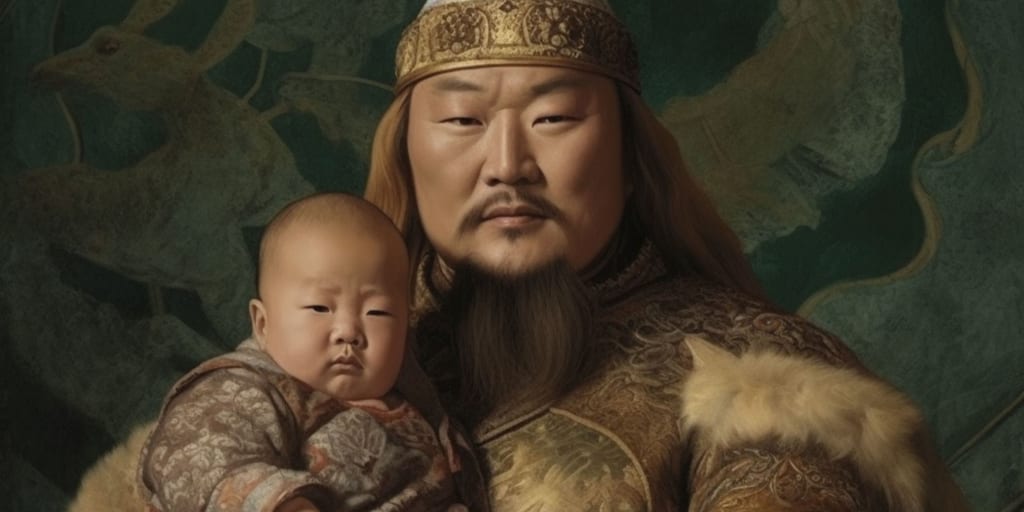
Genghis Khan, the formidable Mongol leader who conquered vast regions of Eurasia, is often surrounded by legends not just of his military prowess, but of his supposed prolific offspring. Some studies, and much of the internet, have popularized the idea that a significant portion of the population in Central and East Asia might be his direct descendants. But before you start claiming Genghis Khan as your great-great-great (and then some) grandfather, let's delve into how this idea originated and examine its validity.
Genetic changes within a population can occur through several mechanisms, such as natural selection or random chance, which affect the frequency of gene variants in individuals. Another method is through a "prolific breeder" whose DNA becomes widespread, which is where Genghis Khan's reputation comes into play.
To investigate how many of his descendants might exist today, researchers have focused on the Y chromosome, passed exclusively from father to son without recombining with the X chromosome. This makes it easier to trace its origin across generations. A pivotal 2003 study examined the DNA variation in the Y chromosome of thousands of men from Central Asia to the Pacific. Remarkably, about 8% of the participants shared the same Y chromosome haplotype, suggesting they descended from a single common ancestor around 1,000 years ago—likely in Mongolia. Given Genghis Khan's historical era and his well-documented reproductive success, the researchers proposed that he could be this ancestor.
However, this hypothesis faced challenges. The 2003 study couldn't conclusively link the Y chromosome haplotype to Genghis Khan, as his remains were never found, and thus his DNA couldn't be analyzed. The study's conclusions, while plausible, were largely speculative and garnered significant attention, reinforcing the narrative of Genghis Khan's genetic legacy.
A 2018 study revisited this claim by examining the Y chromosome group from the earlier research, expanding the sample size to over 18,000 individuals from 292 populations. Their findings suggested that the haplotype in question was much older—around 2,600 years old—predating Genghis Khan by centuries. Moreover, they identified a different haplotype more likely associated with Genghis Khan's direct descendants, and their research indicated that the 8% haplogroup likely represented the broader expansion of Mongolic-speaking peoples, rather than the offspring of a single prolific individual.
While the Y chromosome offers valuable insights into paternal lineage, it has limitations, notably that it only traces ancestry through a single parent, missing out on the genetic contribution of the other half. To get a fuller picture, researchers also use Identical by Descent (IBD) regions—fragments of DNA passed down intact from common ancestors. These fragments get more mixed over generations, but they still provide clues about shared ancestry.
A 2020 study ambitiously attempted to trace the interrelatedness of all humankind using IBD fragments. They found nine distinct genetic regions across the globe and confirmed that Central Asia, where Genghis Khan's empire was centered, is the most genetically mixed region. This aligns with historical accounts of the region as a hub of trade, migration, and conquest. The study also found that modern-day Central Asians are closely related to East Asians, but not necessarily due to Genghis Khan’s empire. The region’s genetic diversity likely stems from centuries of intermixing along trade routes like the Silk Road.
In conclusion, while we can't definitively trace our lineage back to Genghis Khan without his DNA, the notion of his widespread genetic legacy speaks to the broader theme of human interconnectedness. The history of Central Asia as a crossroads of civilizations means that many of us may share some genetic ties with the people of that region, whether or not Genghis Khan is among our ancestors. Humans are deeply interconnected, and our genetic heritage is a complex tapestry woven over millennia.
About the Creator
Mariana
I'm a storyteller at heart, weaving narratives that uncover the extraordinary. I write to provoke thought, inspire and stir the soul. Join me in exploring the magic in the mundane, where creativity and passion leave a lasting impact.
The CEO of Everything
They say "jack of all trades, master of none," but they forgot to mention the part where the jack of all trades is also the camera woman, the makeup artist, and the person currently yelling at a tangled Wii microphone cable in a her own bathroom while recording herself singing and trying to make it look realistic and professional. (As professional as you can make it with nothing but a cell phone camera and a mic that doesn't work)
By Sara Wilson7 days ago in Humans



Comments (2)
Excellent
Awesome piece