
The Kybalion
As Above, So Below

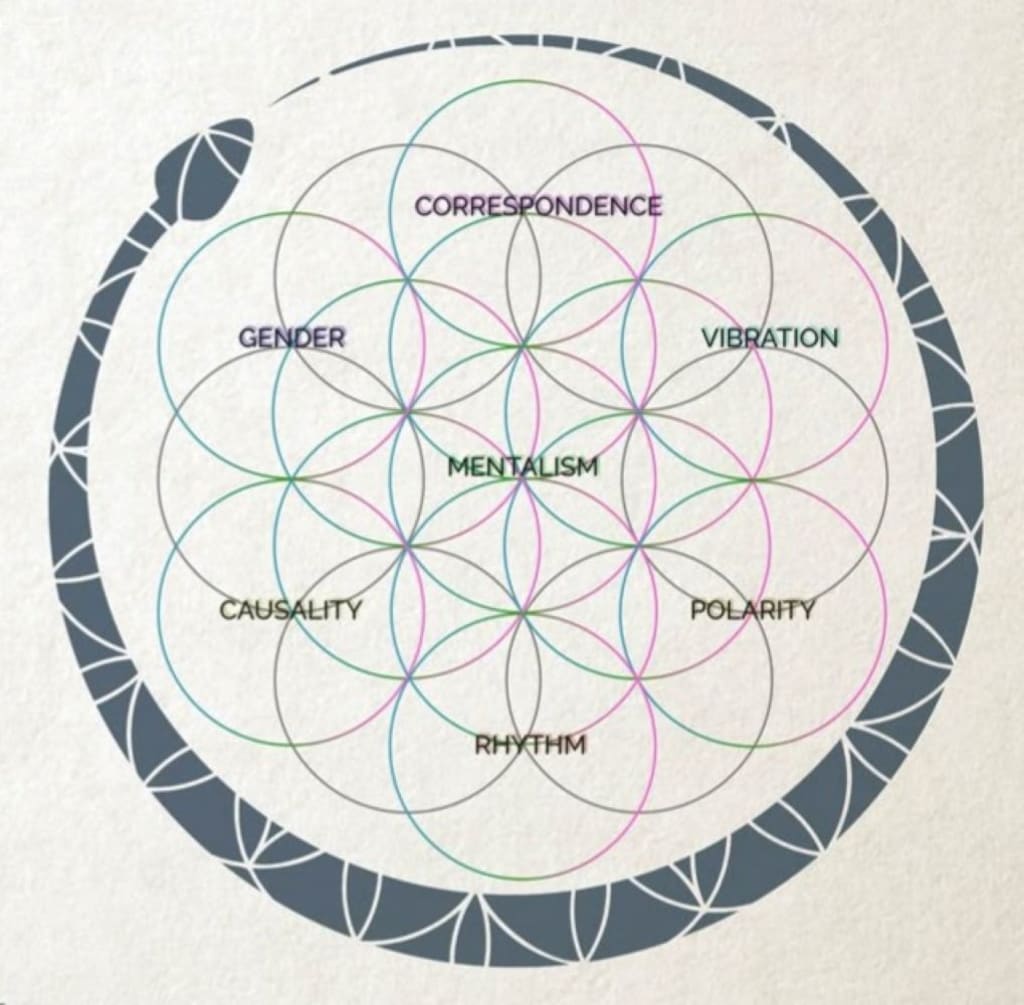
The Kybalion is a short occult/philosophy book first published in 1908 under the pseudonym “Three Initiates.” It presents a modern take on “Hermetic” wisdom—teachings attributed to the legendary Hermes Trismegistus—and claims to summarize universal laws behind nature and mind.
Originally published in 1908 by an anonymous group known as "The Three Initiates." It aims to convey the essence of Hermetic philosophy, which is an ancient spiritual tradition from Egypt and Greece. The book outlines seven fundamental principles that are central to Hermeticism, including:
1. Mentalism: "The All is Mind; The Universe is Mental."
2. Correspondence: "As above, so below; as below, so above."
3. Vibration: "Nothing rests; everything vibrates."
4. Polarity: "There are opposites in everything."
5. Rhythm: "Everything moves and everything vibrates."
6. Cause and Effect: "There is always a cause and effect."
7. Gender: "Everything is gendered."
These principles are believed to encapsulate the core teachings of Hermeticism and serve as a guide for personal growth and spiritual development.
Key points:
- What it is: A concise manual of esoteric principles meant to help readers understand and work with reality’s underlying patterns.
- Famous line: “As above, so below” appears as part of its Principle of Correspondence (the phrase itself comes from the older Emerald Tablet).
- Not ancient: Despite the Hermetic branding, The Kybalion is a modern work from the early 20th century occult/New Thought scene.
Probable authorship:
- Most scholars credit William Walker Atkinson (a prolific New Thought writer) as the main author, possibly with input from Paul Foster Case or others.
- It’s public domain today.
The Seven Hermetic Principles it teaches:
1) Mentalism: The All is Mind; the universe is mental in nature.
2) Correspondence: Patterns repeat across levels—“as above, so below; as below, so above.”
3) Vibration: Everything moves; differing rates of vibration produce different phenomena.
4) Polarity: Opposites are poles of the same thing, transformable by degree (e.g., cold/heat).
5) Rhythm: Cycles ebb and flow; movement between poles follows rhythmic laws.
6) Cause and Effect: Nothing happens by chance; causes produce effects across planes.
7) Gender: Masculine and feminine principles exist in all things (presented as energetic/creative polarities, not strictly biological).
How it differs from classical Hermeticism:
- Classical Hermetica (Corpus Hermeticum, Asclepius, Emerald Tablet) are late-antique texts mixing philosophy, mysticism, and spirituality centered on gnosis of the divine.
- The Kybalion reframes ideas through New Thought psychology and 19th century occultism—more self-help/metaphysical technique than historical theology.
Influence and critiques:
- Influence: Popularized “Hermetic principles” in modern esotericism, magic, Law-of-Attraction circles, and self-development.
- Critiques:
- Not historically Hermetic; it’s a modern synthesis.
- The Principle of Gender is often seen as simplistic/binary.
- The “all-is-mind” emphasis reflects New Thought more than ancient Hermetica.
How people use it:
- As a framework for meditation, reframing experiences, magical practice, or personal change (e.g., “transmuting” emotional states via polarity and rhythm).
- As a conceptual map for seeing correspondences between psyche, nature, and cosmos.
Where to read:
- It’s in the public domain; you can find free versions on Project Gutenberg, Internet Sacred Text Archive, and many PDF/epub sites.
If you want, I can summarize each principle with practical exercises, or contrast it with the actual Emerald Tablet and Corpus Hermeticum passages. Julia O’Hara 2025
THANK YOU for reading my work. I am a global nomad/permanent traveler, or Coddiwombler, if you will, and I move from place to place about every three months. I am currently in Peru and heading to Chile in a few days and from there, who knows? I enjoy writing articles, stories, songs and poems about life, spirituality and my travels. You can find my songs linked below. Feel free to like and subscribe on any of the platforms. And if you are inspired to, tips are always appreciated, but not necessary. I just like sharing.
YouTube Top Song List.
https://www.YouTube.com/results?search_query=julia+o%27hara+top+songs
Amazon PlayList
https://www.amazon.com//music/player/artists/B0D5JP6QYN/julia-o'hara
Spotify PlayList
https://open.spotify.com/artist/2sVdGmG90X3BJVn457VxWA
You can also purchase my books here:
https://www.lulu.com /spotlight/julie-ohara
I am also a member of Buy Me A Coffee – a funding site where you can “buy me a cup of coffee”
https:www.buymeacoffee.com/JulieOHara
About the Creator
Julie O'Hara - Author, Poet and Spiritual Warrior
Thank you for reading my work. Feel free to contact me with your thoughts or if you want to chat. [email protected]
Keep reading
More stories from Julie O'Hara - Author, Poet and Spiritual Warrior and writers in Humans and other communities.
Mara's Garden
The year Mara got her first plot in the community garden, she pressed her bare wrist into the soil the way her grandmother had taught her and flinched. “When it bites,” her grandmother used to say, “it’s still winter pretending.”
By Julie O'Hara - Author, Poet and Spiritual Warrior4 months ago in Humans
The CEO of Everything
They say "jack of all trades, master of none," but they forgot to mention the part where the jack of all trades is also the camera woman, the makeup artist, and the person currently yelling at a tangled Wii microphone cable in a her own bathroom while recording herself singing and trying to make it look realistic and professional. (As professional as you can make it with nothing but a cell phone camera and a mic that doesn't work)
By Sara Wilson7 days ago in Humans




Comments
There are no comments for this story
Be the first to respond and start the conversation.