
The Hiker Who Followed the Wrong Star
One man’s night under the stars turned into a terrifying fight for survival.


Every year, nearly 2,000 hikers in the United States get lost in the wilderness, many due to simple navigation mistakes. But for one young traveler, a single wrong decision—trusting the wrong star—turned a peaceful solo hike into a desperate fight for survival.
It was early autumn when 27-year-old Daniel Price set out on a solo backpacking trip in Colorado’s San Juan Mountains. He had read about the trail online, studied maps, and packed his gear with precision. Daniel wasn’t a beginner—he had been hiking for nearly a decade. But he was about to learn that nature doesn’t forgive even the smallest errors.
Daniel’s plan was simple: start at sunrise, camp overnight at a ridge with a view of the Milky Way, and return by midday the next day. The first part of the hike went smoothly—golden leaves crunched underfoot, mountain air filled his lungs, and the sound of distant streams accompanied him. By evening, Daniel reached the ridge just as the sun dipped below the horizon.
He set up his tent, made a small campfire, and waited for the stars to emerge. Out here, far from city lights, the night sky unfolded like a living tapestry—millions of stars glittering above him.
Daniel had always been fascinated by navigation using the night sky. His father had taught him that finding the North Star could keep you on course. That night, as he admired the constellations, he spotted what he thought was the North Star. Confident in his sense of direction, he decided to pack up earlier than planned and head back, hiking under the stars for a unique experience.
It was a decision that nearly cost him his life.
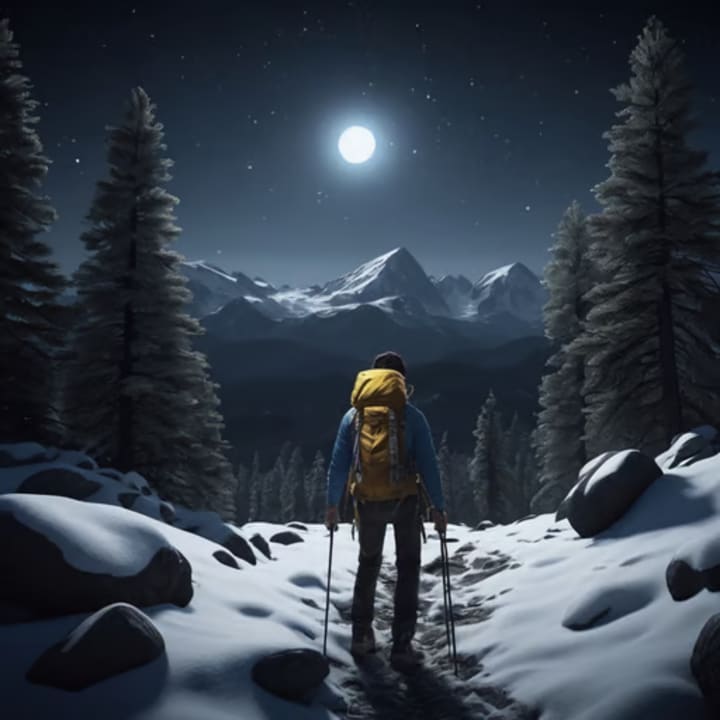
What Daniel didn’t realize was that he had mistaken a bright planet—Jupiter—for Polaris. The difference is subtle to the untrained eye, but crucial in navigation. The “star” he was following led him deeper into the wilderness, away from the trail and into a maze of valleys and dense forest.
Hours passed. The ground became uneven, shadows played tricks on his eyes, and the cold began to seep through his jacket. At first, Daniel thought he could simply retrace his steps. But without visible trail markers and with the terrain twisting unpredictably, his sense of direction quickly unraveled.
By 3 a.m., Daniel’s water was nearly gone. The temperature dropped below freezing. Fear began to replace confidence. He tried calling for help, but there was no cell signal.
The night was endless. His legs ached, and his breath came in quick bursts as panic threatened to take over. He remembered reading survival tips: stay calm, find shelter, conserve energy. Daniel tucked himself against a rock face, using his backpack as insulation against the wind. He wrapped his scarf around his face to keep his body heat in.
When dawn broke, Daniel’s hope reignited. He could now see the landscape clearly—a massive mountain wall to the east, thick pine forest to the west. He realized he had traveled far from the original trail. Without a map or GPS, he decided to head downhill, knowing rivers often lead to towns or roads.
It took another 10 hours before he found a dirt road. Exhausted, dehydrated, and shivering, Daniel was spotted by a passing ranger truck. They gave him water, wrapped him in a blanket, and drove him back to safety.
Later, Daniel learned just how close he had come to hypothermia. The rescue team told him that most hikers lost in similar conditions don’t survive more than two nights. He had lasted only one.
Daniel’s mistake was simple—he had placed absolute trust in his ability to navigate by the stars without double-checking. But that small lapse had spiraled into a near-tragedy.
Daniel now shares his story online, urging hikers to respect the wilderness and always prepare for the unexpected. His key advice:
Never rely on one navigation method. Bring a map, compass, and GPS device.
Tell someone your route and expected return time.
Don’t hike alone at night unless you are highly experienced.
The night sky is beautiful, but in the wilderness, beauty can be dangerous if you misread it. The stars have guided humanity for thousands of years—but as Daniel learned, one wrong star can lead you far from where you’re meant to be.
About the Creator
Dani khan
Hi, I’m Dani Khan! 🌟 I share cool facts, life tips, and inspiring ideas. Follow me to learn, grow, and stay curious every day! 📚✨ #StayCurious #DaniKhan
please hit the subscribe for more
When the Shelter Closes
Across the street from my house, a man slept under a tree, his dog by his side. My first, naive thought: he must be traveling through. But he kept coming back, often sleeping there during the day. Then it hit me—that person might not have a home.
By Bride of Sound2 days ago in Humans


Comments
There are no comments for this story
Be the first to respond and start the conversation.