
The Hidden Gift of Solitude: Why Being Alone Can Be Your Greatest Strength
Exploring the profound yet overlooked power of chosen solitude in a world that fears being alone.


In our hyper-connected world, the word "loneliness" often carries a heavy weight, conjuring images of isolation and sadness. We're taught to seek connections, build vast networks, and view solitude as a failure or misfortune. But what if we've been seeing it from the wrong perspective? What if the very thing we fear most actually holds a profound, hidden gift?
This isn't about the aching pain of unwanted loneliness, but rather the enriching power of chosen solitude.
"Don't mistake having fewer entanglements for a life lacking richness. Perhaps fewer complex family ties or a smaller circle of close friends simply means you're freer from the endless web of social obligations and emotional debts. Many people navigate incredibly complex relationships, constantly busy yet subtly caught, like marionettes pulled by strings of expectation and past dramas. You, however, might possess a different kind of freedom—the freedom to move through life less burdened, less indebted to the past, and less tangled in others' narratives."
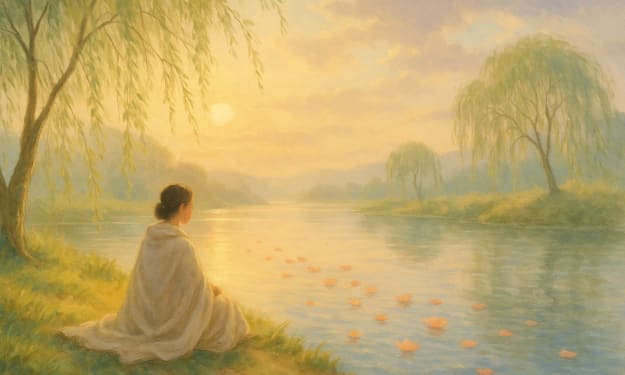
Thinking about solitude this way dramatically shifts the perspective, doesn't it? Seen from this angle, isn't solitude—the ability to find contentment and flourish in your own company—a profound form of fortune?
There's an old saying that resonates deeply: "To go one's own way is to be unique; the unique person is deeply valuable." The capacity to genuinely enjoy solitude is a rare and precious quality in our often-noisy world. Those who cultivate this quality possess something truly invaluable.
Learning to embrace solitude isn't merely adopting a different attitude or coping mechanism; it's accessing deeper wisdom for navigating life. It might even be considered an underrated blessing—a source of quiet strength and clarity.
The respected Chinese scholar Nan Huaijin once spoke of two types of blessings: "Hongfu," outward success, wealth, and status—easily enjoyed but often fleeting—and "Qingfu," the blessing of inner peace and simple contentment. "Qingfu," he noted, is much harder to attain. It doesn't necessarily involve material riches, but it fosters a life of inner calm, resilience, and personal freedom, enabling one to navigate life's ups and downs gracefully.
Many lives are consumed by juggling social demands, office politics, or external validation in the endless "marketplace" of modern life. We become caught in cycles of busyness and expectations, leaving our minds and spirits depleted despite material comforts. Burnout becomes worn as a badge of honor rather than recognized as a warning sign.
In contrast, those who value solitude find the space to connect with their authentic selves. They pursue activities aligned with their core values, maintain integrity, and cultivate genuine self-awareness free from external pressure. Solitude becomes a sanctuary for self-discovery, allowing us to clearly hear our inner voice amidst the external clamor.
The ability to comfortably be alone fosters resilience and inner strength. It proves to ourselves that our well-being isn't dependent solely on external validation or constant companionship. Paradoxically, it can also improve the quality of our relationships. When we don't constantly need others to feel whole, we can engage more authentically, choosing connections based on genuine affinity rather than fear of loneliness.
Moreover, solitude is often fertile ground for creativity and deep thinking. Many artists, writers, inventors, and leaders have found their greatest insights during periods of quiet reflection, free from distraction. It allows the mind to wander, connect disparate ideas, and access deeper understanding.
People who cherish solitude might appear quiet or reserved, perhaps even aloof from the outside. Yet often, they possess a rich inner world and profound wisdom cultivated through introspection. They've developed the patience to sit with discomfort, clarity to see through superficiality, and understanding that true freedom lies in a mind unburdened by constant external noise. They recognize inner peace and the liberty to move without excessive obligation as life's most precious and hardest-won treasures.
As the insightful writer Sanmao beautifully expressed in The Rainy Season Will Not Return: "Some interactions are a drain on the spirit. Others uplift the soul. If you cannot vibrate on the same frequency, it's better to be alone."
Finding those rare individuals who are truly "on the same wavelength" feels like a gift from the universe—kindred spirits are indeed worth seeking. But forcing connections or spending excessive time with those who drain your energy is a recipe for exhaustion. Recognizing this distinction is key.
Perhaps the ideal state isn't constant external stimulation but rather a state of "rich quietness" or "abundant stillness." This is a state anchored within yourself, not easily swayed by others' emotional currents nor obligated to manage their moods. Your inner landscape is calm; your focus is clear. You observe the world with equanimity, finding peace and contentment in your own presence. This isn't emptiness—it's fullness contained within, a quiet confidence from knowing and accepting yourself.
In the whirlwind of modern life, let's dare to re-evaluate solitude. It doesn't have to be the enemy. Instead, let it become a conscious choice, a sanctuary we retreat to for restoration, reflection, and reconnection with ourselves.
For the rest of our lives, may we find the wisdom to seek moments of tranquility amidst the hustle. May we savor the simple beauty of quiet mornings, changing seasons, and the company of our own thoughts. And may we allow these silent moments, periods of chosen solitude, to nourish our inner lives, blossoming into something enduring and beautiful, like a flower thriving peacefully in its own space.
About the Creator
Seraphina Maeve
Go your own way, and let them envy you.
Keep reading
More stories from Seraphina Maeve and writers in Humans and other communities.
The Unburdened Heart: Finding True Happiness in Inner Lightness
Ever notice how some days feel strangely paradoxical? You might pull a late night at work, arrive home bone-tired, yet somehow find the energy to hum while tidying up. Then there are other days – perhaps a lazy weekend with nothing much planned – where you feel utterly drained, heavy, like you can barely lift a finger, let alone your spirits. What gives?
By Seraphina Maeve9 months ago in Humans
The CEO of Everything
They say "jack of all trades, master of none," but they forgot to mention the part where the jack of all trades is also the camera woman, the makeup artist, and the person currently yelling at a tangled Wii microphone cable in a her own bathroom while recording herself singing and trying to make it look realistic and professional. (As professional as you can make it with nothing but a cell phone camera and a mic that doesn't work)
By Sara Wilson5 days ago in Humans
Dr. Martin Luther King Jr. Day
Introduction Dr. Martin Luther King Jr. Day is a special holiday celebrated in the United States. It honors the life and work of Dr. Martin Luther King Jr., a great leader who fought for freedom, equality, and justice. This day reminds people to treat everyone with respect and kindness, no matter their skin color, religion, or background. Dr. King believed in peace and non-violence, and his message is still important today.
By Farhan Sayed4 days ago in Humans


Comments
There are no comments for this story
Be the first to respond and start the conversation.