


Once upon a time, in a land far away, there was a small, oil-rich country called Kuwait. It was situated in the Persian Gulf, bordered by Iraq to the north and Saudi Arabia to the south. Kuwait was a peaceful and prosperous nation, enjoying its independence and sovereignty since 1961.
However, on August 2nd, 1990, everything changed. Iraqi forces invaded Kuwait, claiming it as their own. The Kuwaiti people were shocked and terrified as they saw tanks rolling down their streets and soldiers storming into their homes. It was a brutal and swift takeover, and within hours, Kuwait was under Iraqi control.
The international community was outraged by this blatant act of aggression, and the United Nations Security Council passed a resolution demanding Iraq's immediate withdrawal from Kuwait. However, Iraqi leader Saddam Hussein refused to comply, and the world was left wondering what would happen next.
Meanwhile, in Kuwait, the people were living in a state of fear and uncertainty. The Iraqi soldiers were ruthless and oppressive, and the Kuwaitis were subjected to all kinds of abuses and atrocities. Many were killed, and many more were forced to flee their homes and seek refuge in neighboring countries.
As the days turned into weeks and the weeks turned into months, the situation in Kuwait grew increasingly dire. The world was divided over how to respond, with some calling for a military intervention and others advocating for diplomacy and sanctions.
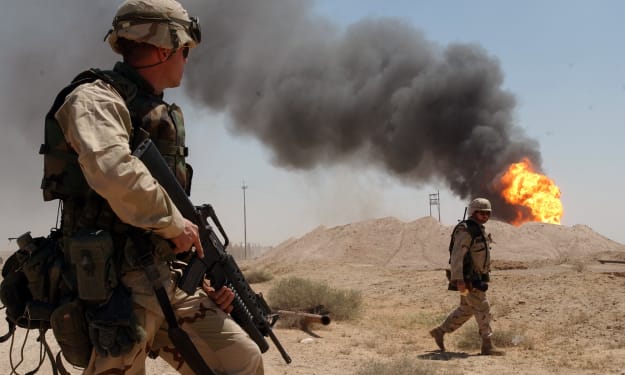
In the end, it was a coalition of countries led by the United States that intervened militarily, launching a massive air and ground assault against Iraqi forces in Kuwait. The war lasted for several months, and there were many casualties on both sides. However, in the end, the coalition forces emerged victorious, and Kuwait was liberated from Iraqi control.
The aftermath of the war was a difficult and complicated period for Kuwait and the region as a whole. There were many challenges to overcome, including the rebuilding of infrastructure, the return of displaced persons, and the establishment of a new government. However, the Kuwaiti people remained resilient and determined, and they eventually emerged stronger and more united than ever before.
Today, Kuwait is a prosperous and modern country, with a thriving economy and a vibrant cultural scene. The scars of the invasion and war are still visible, but the people of Kuwait have moved on and are looking towards a brighter future. And while the events of August 2nd, 1990, will never be forgotten, they serve as a reminder of the importance of freedom, independence, and sovereignty.
The invasion of Kuwait by Iraq in 1990 was not only a turning point in the history of Kuwait but also in the geopolitics of the Middle East. The invasion was an act of aggression that violated the principles of international law, and it had significant consequences for the global community.
The aftermath of the war saw many changes in the region. The balance of power shifted, and new alliances were formed. The United States emerged as the dominant military power in the region, with military bases established in several countries, including Kuwait. The war also had far-reaching consequences for Iraq, which faced years of economic sanctions and isolation from the international community.
The war in Kuwait also had a profound impact on the people of Iraq. The country was devastated by the conflict, and the civilian population suffered greatly. The infrastructure of the country was destroyed, and many people were left without basic necessities like food, water, and shelter. The war also had a significant impact on the environment, with oil spills and other forms of pollution affecting the health and well-being of the people and the natural world.
Despite these challenges, the people of Kuwait and Iraq have shown remarkable resilience and strength in the face of adversity. They have rebuilt their countries and their lives, and they continue to work towards a brighter future for themselves and their communities.
The legacy of the invasion of Kuwait lives on, and it serves as a reminder of the importance of diplomacy, respect for international law, and the need for global cooperation in resolving conflicts. It also underscores the importance of protecting the sovereignty and independence of nations, and the need to work towards a more peaceful and just world.
In conclusion, the invasion of Kuwait by Iraq was a tragic event that had far-reaching consequences for the people of the region and the world. However, it also served as a catalyst for change, inspiring people to work towards a better future and to strive for peace and prosperity for all. Today, as we reflect on the events of 1990, we must remember the lessons of the past and work towards a brighter future for all.
About the Creator
Suganthan
Hi world! I am from Wonder of Asia Srilankan. Happy to write stories and History blog.
I wanted to title this something different, but worried that my chosen title might cause problems entering the United States in the future so this is the new title. It's the greatest title. No one has ever written a title better than this. (All titles unrelated to content).
Let me be honest. I am finding this difficult. Now, I like a challenge, a stretch, a bit of an obstacle course. “Write about the decline of the British Empire in the form of a narrative poem in which your protagonist is an artichoke” I read, and flex my fingers. “Write a haiku to evoke the sensation of sibilance using only the first half of the alphabet.” “Well”, I think to myself, “this should be fun.” But “write about a system that isn’t working”? A system that isn’t working? Now? In 2026? ONE system? My favourite system that isn’t working? The sexiest system that isn’t working? The one giving me the most angst day to day? The one giving me the most existential dread? I am, as I say, finding this difficult. I will own that I have contemplated writing a thousand words on why the steady “all on” setting on my fairy lights is the EIGHTH of seven options which must be sequentially activated to get there, because that is a system that some fool came up with and it definitely doesn’t work, and now who is paying the price, eh? But how can I write about my fairy lights when…. When…. When….
By Hannah Moore3 days ago in Humans
Lying On a Prayer
Deepak Chopra is one of the most acclaimed spiritual gurus of our generation. While I have never followed or studied his teachings, many people, upon hearing about my psychological issues or my interest in yoga and meditation, have asked me to check out his teachings.
By Avocado Nunzella BSc (Psych) -- M.A.P 4 days ago in Humans


Comments
There are no comments for this story
Be the first to respond and start the conversation.