
The Gilded Shepherd
Light can be found even on the stormiest of nights.
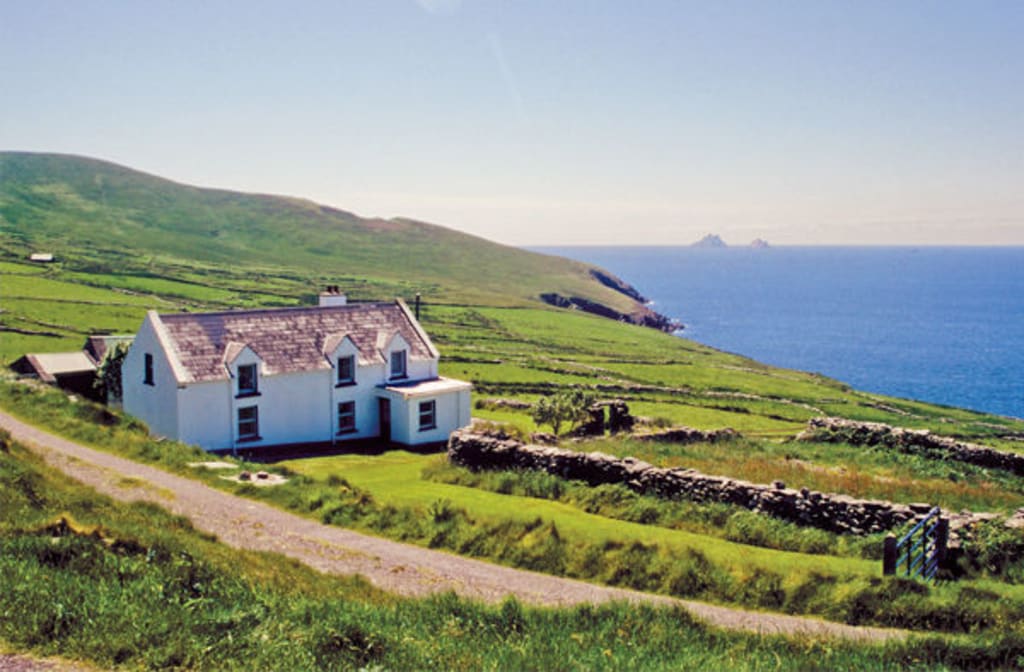
The sky blazed with brushstrokes of indigo and peach, dawn breaking over the small sheep farm just outside the village of Pettigo. The last signs of evening faded, revealing a thatched white cottage surrounded by a large garden, a small pond at its centre. Between the garden and a grove of wych elm sat a sheep pen and a greenhouse.
The backdoor banged shut, shattering the morning’s tranquility. Shane Reardon walked down the cobbled path that snaked through the garden. The air was cool, not uncommon for Donegal in May, though it looked like the rain might give them a rare miss.
He moved toward the pen, noticing that a section of fencing was down where the old shed had stood until yesterday’s storm. That would have to be mended, lest he find his flock roaming the county over. He walked past the gate and sat down on the splitting block nearby; taking out his pipe and the black notebook he’d inherited from his father, he watched the sun climb into the sky as a cloud of smoke slowly floated upward.
*
The old shed: so old, nobody alive in 1972 knew who built it. It had persevered through years of torment from the elements, the nearby Atlantic sending its regards. Helen had highlighted some structural vulnerabilities a month prior - “The damned thing is rotted to hell” – but Shane had decided to give the shed a vote of confidence and done nothing about it.
He had been standing in the kitchen with Niamh, fine-tuning a new game for his young daughter while the storm raged outside. She was very much her mother’s daughter: brown-eyed and olive-skinned, she had even inherited Helen’s imperious disposition. The two of them spent their days cheerfully bossing Shane around the house. He had agreed to incorporate the three-year-old’s suggestion of “Dancing, dada!” when an apocalyptic thunderclap crashed over the house. Shane heard a dreadful creaking from the yard. He rushed to the window: the shed, which was supposed to be attached to the greenhouse, was listing precariously. With a moan, the planks attached near the bottom gave out. The shed crumpled, carpeting the ground with splintered timber and glass. Shane noticed with a panic that scores of tools had been liberated from their confinement and were now swimming down the path towards the grove.
Helen ran in to relieve her husband of Niamh, who had begun to cry.
“Damnit,” she said, picking up their daughter and eyeing her husband pointedly. “Go on, I’ve got her.”
He rushed out, grabbing his slicker and galoshes. He made it to the other end of the yard without slipping, hauling the wheelbarrow out from the mud near the compost heap. He raced around, gathering armload after armload; he filled the barrow, sped it into the greenhouse, and dumped it. He had just yanked it around and out the door when a flash of lightning cleaved through the sky, illuminating the earth in grey light. Momentarily blinded, Shane’s eyes found the ground and he noticed, tucked inside the doorway, a wooden box. He bent down, ducking through the deluge, and picked it up, using the doorway as a shelter from the rain. It was remarkably heavy.
He had never seen the box before: it was ornate and ancient-looking, with a lacquered finish. It was smooth but for the lip of the lid, which had been left rough. He wiped water from his eyes and looked at the engraving on the lid. Sword in hand, lion under the tree, encased in leaves: the Reardon family crest. He stared at the familiar emblem, curious.
Another jolt of lightning, followed by more thunder, shook him from his reverie. He looked across the yard and saw that his toolbox had come to rest at the entrance to the grove. He set the wooden box on a nearby table and ran back into the storm: the toolbox had blown open and spread its contents throughout the bushes. Sighing, he hiked up his rubber collar and hurried into the wood.
By the time Shane finished wrestling his hoe from a tree, it was well past dark. Exhausted, he entered the kitchen, and saw a pot of stew still simmering. He helped himself and grabbed the day’s copy of The Times. He read through, noting the fresh spate of Troubles violence; since the Bogside Massacre in January, bloodshed was now an everyday occurrence. Lovely time to be living less than a mile from the border, Shane thought.
He bathed, then walked into the bedroom. He heard his wife’s gentle snore and crawled into bed next to her. He had met Helen five years ago, when they were freshman at Trinity College. Helen had been a law student, while Shane had hoped to one day become a psychiatrist. She was a pretty, witty, foul-mouthed girl from Westport, who shared Shane’s passions for Steinbeck and single malt. He had been smitten with her immediately. They had been together nine months when Shane’s father had died, leaving him, the only man in the family, in charge of the farm. He had left college for the funeral and not returned.
He remembered sitting in his father’s study after the funeral. Though he had loved his father, he had never wanted this life. He looked down at the mahogany desk and saw his father’s notebook. He thumbed through, glancing at the neat scribblings – detailed ledgers, notes on lambing, poems from Wilde and Yeats. When he left the study, the notebook was in his pocket.
Helen had followed him a year later. Shane had protested: he would not permit her to put her life on hold for him. Helen, though, was strong-willed, not to mention a much better debater than he. Shane had admittedly missed her terribly, and despite his objections, was overjoyed that she wanted to be with him - even here, in the middle of nowhere.
He crawled into bed, ready for a long slumber after the day’s exertions. He rolled over, and his mind flashed to the wooden box he’d found. He saw the family crest, the lush veneer of the lacquer. Despite his fatigue, his curiosity was piqued.
He got out of bed and began rooting through the closet. He found a wool tunic and some trousers and dressed. He tiptoed out into the hallway, opened the backdoor, and strode towards the greenhouse.
He entered, switched on the light, and saw the box where he had left it. He brushed the dried mud away. It was the size of Helen’s jewellery box and looked to be carved from wych elm. The emblem on the lid was flanked by fat strap hinges, each with four nacre inlays. He opened the lid and saw a navy velvet cloth, folded neatly, protecting the box’s contents. He removed the cloth and shouted, nearly dropping the box onto the gravel.
Nestled inside the plush velvet was a gleaming gold bar. Shane stared, his mind trying and failing to understand what it was seeing. The bar was covered with markings. Shane gathered himself and inspected it. At the top, there was a round logo with the initials R.M.R. stamped in the middle. The band encircling the initials identified the stamper as The Royal Mint Refinery. Below that, another stamp: 999.9 FINE GOLD. NET WT: 200 oz.
Shane sat on the floor, his mind racing. Whose was it? It could not have been his father, for there had been nothing in the will about any gold. Shane was sure the box had been carved from wych elm, the same wood found in the grove not 30 paces from where he was seated. The cottage had been in Shane’s family for several generations; the former owner must have been one of his kin!
An idea occurred to him. He replaced the velvet cloth, clasped the lid, and tucked the box under his arm. Looking out to be sure that the rain had not resumed, he crossed the yard and re-entered the house. He saw the newspaper where he had left it on the kitchen table. He grabbed it and flipped through to the finance section; he scanned the page until he found what he was looking for:
Gold: £40 oz.
He exhaled. The small brick sitting on his kitchen table was worth £8,000. $20,000 across the pond.
He leaned back, running a hand through his hair. He had never been the type to dream of money, let alone finding a prize like this in his greenhouse. Sure, there were nights - usually after having more than his fill down at Britton’s - where he imagined how his life might have turned out had his father not passed so suddenly. But those days were rare now, especially since Niamh had entered the picture. His former life no longer seemed so desirable once he began watching his daughter grow before his eyes. Moreover, under Shane’s careful stewardship (helped along by his father’s notes), the farm made healthy profits. It was a steady life, happy and unglamorous.
He then thought of Helen, languishing away on a farm far away from the world; of Niamh, growing up in a region teetering on the brink of war. Of himself, even: a life he had begun to accept as impossible could be had again. He could buy Helen a new house in Dublin so they could finish their studies. They could take proper vacations, fly to America or Cape Town or wherever. His daughter could grow up in peace.
The sky had begun to change its hue. He went to the cupboard and grabbed his favorite, the Lagavulin 16, and two crystal tumblers. Closing the cupboard, he slipped out the door.
*
He heard the backdoor shut and saw Helen walking toward him, looking sleepy. He hid the scotch behind the block as she approached, carrying two mugs of tea. He stood to take his and looked at her; her eyes were bagged, her hair a mess. He had never gazed upon a more beautiful sight in all his life.
“Niamh go down okay?”
“She’s fine,” Helen said, “it was you I was worried about.”
“What for?”
“Nothing. I just didn’t realize you prefer sleeping with the sheep over me is all.”
“Sorry,” Shane said, realizing how his feverish night spent in the greenhouse must have looked, “I found something in the shed. What was left of it anyhow.”
She raised her eyebrows, surprised.
“Something of your dad’s? Like an heirloom?”
“Well, not really an heirloom. Where the greenhouse and shed meet, there must’ve been a little alcove. Anyhow I found this old wooden box.”
He offered it to her. She took it in her hands, frowning.
“It’s bloody heavy, isn’t it? That’s the same wood as-“
“Yeah, wych elm. I’ll bet it was carved from a tree in the grove once upon a time.”
She opened the lid and touched the velvet cloth.
“It’s lovely. You don’t know whos – oh…oh my…”
She had removed the cloth, revealing the treasure within.
“Shane,” she said, breathless, staring at it, “Shane this – “
“I know,“ he said, beaming at her.
“How much – “
“200 ounces. Worth about £8,000.”
She looked at him in disbelief.
“£8,000?”
“£8,000.”
She started to speak, stopped herself, tried to start again and dissolved into tears as Shane laughed, took her in his arms and revealed the scotch. He passed her a generous portion and poured one for himself. They clinked glasses and downed them in one swallow. He saw her initial disbelief dissolving as the scotch went to work.
“£8,000!!” she cried at last. Her incredulity was giving way to excitement. Her eyes glistened, and she beamed at him.
*
“So what now?” she asked, as they started back towards the house. In that moment, Shane realized that whatever else was about to change in their lives, there was one constant. Always.
“Well dear,” Shane replied, looking back toward the pen, “I really ought to fix that fence.”
About the Creator
Keep reading
More stories from writers in Humans and other communities.
The CEO of Everything
They say "jack of all trades, master of none," but they forgot to mention the part where the jack of all trades is also the camera woman, the makeup artist, and the person currently yelling at a tangled Wii microphone cable in a her own bathroom while recording herself singing and trying to make it look realistic and professional. (As professional as you can make it with nothing but a cell phone camera and a mic that doesn't work)
By Sara Wilson6 days ago in Humans
Affection and Healing for Yourself
During the night of the last quarter moon, I gathered my ritual supplies. I carefully handled the chunk of black tourmaline that would protect me from your overall negative and narcissistic energy. I carefully walked the house with my stick of selenite in hand, asking the universe to cleanse our working space.
By Alisha Wilkins ✒️🦋🖋️4 days ago in Fiction


Comments
There are no comments for this story
Be the first to respond and start the conversation.