
The Future of Productivity
"Beyond the App Stack: How the transition from manual software to autonomous agents is reclaiming our focus and redefining professional excellence in 2026."


For years, the "holy grail" of productivity was finding the perfect combination of apps. We lived in a fragmented digital landscape, bouncing between Slack for communication, Notion for documentation, Trello for project management, and Google Calendar for scheduling. We called it a "stack," but in reality, it was a source of friction. Every time we switched tabs, we lost a piece of our focus—a phenomenon psychologists call "context switching."
In 2026, the landscape has fundamentally shifted. We are no longer looking for more apps to manage our work; we are looking for a single layer of intelligence to orchestrate it. After years of experimenting with every "productivity hack" in the book, I discovered the one tool that didn't just add to my workflow—it revolutionized it: The Agentic AI Orchestrator.
Whether you use an enterprise-grade platform like Zapier Central, a boutique assistant like Dume.ai, or a chat-native powerhouse like CodeWords, the shift to "Agentic Workflows" is the single greatest productivity leap of the decade. Here is how this technology works, why it is indispensable, and how it has reclaimed hours of my life every single week.
The Death of Manual Integration
In the early 2020s, automation was "linear." If A happened, then B followed. You had to manually set the triggers and map every data point. If a client sent an email, you could automate a notification to Slack, but you still had to read the email, summarize the request, and create the task in your project manager yourself. The tool that changed my life in 2026 does not follow a script; it understands intent.
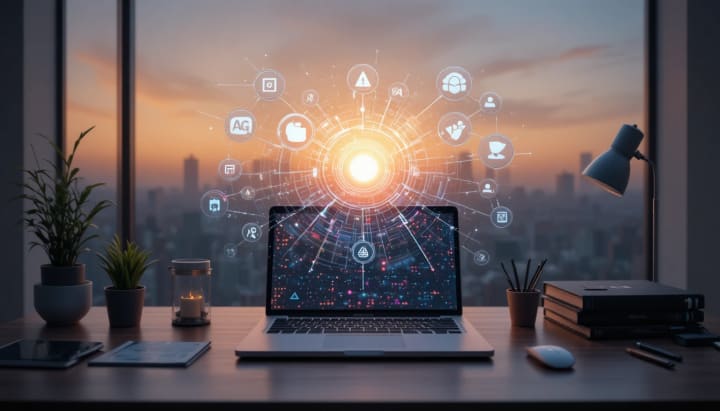
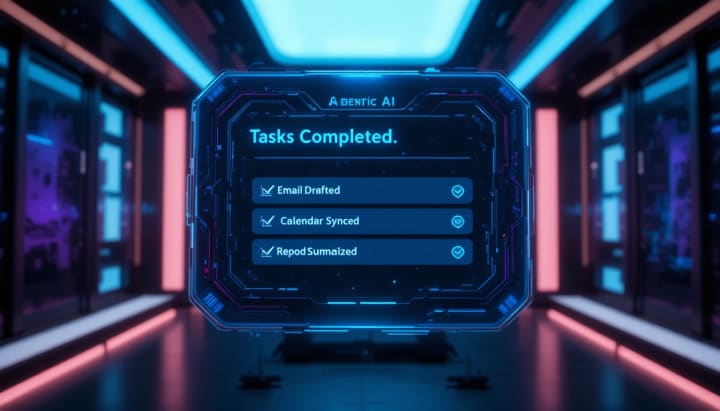
Today, my AI Agent sits as a silent partner across my entire tech stack. It doesn't just move data; it interprets it. When a project brief arrives in my inbox, the agent reads the document, cross-references it with my current capacity in my calendar, drafts a preliminary project timeline in Notion, and pings my team with a summary of their required actions. I haven't clicked a single "copy-paste" button in months.
From "Software as a Service" to "Service as an Agent"
The real magic of the 2026 workflow is the transition from static software to Autonomous Agents. We used to spend our mornings "doing work about work"—answering emails, updating statuses, and shifting deadlines. Now, we manage outcomes, not tasks. The specific tool I’ve adopted uses Natural Language Processing (NLP) to act as a Chief of Staff. I no longer "program" my automations. Instead, I speak to it:
"Hey, whenever a new lead comes from the website, research their company's recent funding rounds, draft a personalized outreach email based on my previous successful templates, and set a reminder for me to review it tomorrow morning."
By 10:00 AM, the administrative heavy lifting is done. I am not starting my day by clearing a mountain of digital clutter; I am starting it by making high-level decisions. The AI has moved from being a "calculator" to being a "colleague."
Three Ways This Tool Redefined My Day
To understand the impact of an Agentic Orchestrator, one must look at the granular changes in a typical workday. First is the end of the "Inbox Zero" obsession. Email has traditionally been the greatest thief of time. In 2026, my orchestrator acts as a sophisticated filter and drafter. It categorizes incoming mail not just by "sender," but by "urgency of action." It prepares drafts for 80% of my routine inquiries, meaning my role has shifted from "Writer" to "Editor." I spend twenty minutes reviewing and hitting 'Send' on what used to take two hours of drafting.
Second is Deep Work Protection. The greatest enemy of creativity is interruption. My workflow tool now has "Contextual Awareness." It monitors my calendar for blocks labeled "Deep Work" and automatically silences notifications, triages urgent messages, and even tells colleagues via Slack, "He's in a flow state; I've logged your request and will bring it to his attention at 2:00 PM." This proactive boundary-setting has increased my creative output by nearly 40%.
Third is Seamless Knowledge Synthesis. We are drowning in information but starving for wisdom. My tool now performs "Research Synthesis" across my internal databases. If I am writing a report on market trends, I don't need to search through six different folders. I simply ask, "Summarize everything we discussed regarding the Q3 strategy across Slack and our last three Zoom transcripts." Within seconds, I have a cohesive summary with citations.
Why "Agentic" Tools are User-Friendly
You might assume that a tool this powerful requires a background in computer science. In fact, the opposite is true. The "User Interface" of 2026 is Language. The formal beauty of these tools lies in their accessibility. If you can describe what you want in a clear sentence, you can build a world-class workflow. We have moved past the era of complex "Drag-and-Drop" builders. The barrier to entry has vanished, allowing artists, small business owners, and executives alike to operate with the efficiency of a massive corporation.
The Philosophical Shift: Reclaiming the Human Element
The most frequent criticism of AI in the workplace is the fear that it will make us "robotic." My experience in 2026 has proven the exact contrary. By delegating the mechanical, repetitive, and mundane tasks to an autonomous agent, I have become more human. I have more time for empathy-driven client meetings. I have more energy for creative problem-solving. I have the mental bandwidth to think strategically about where my career is heading, rather than just surviving the next hour of notifications.
The "One Tool" that changed my workflow didn't just make me faster; it made me more intentional. It stripped away the noise and left only the work that requires a human soul to perform.
Final Thoughts for the Modern Professional
As we navigate the remainder of 2026, the question is no longer which app you are using, but how those apps talk to one another. If you are still manually moving data, manually scheduling meetings, or manually summarizing notes, you are working harder than you need to. The transition to an AI Orchestrator is not a luxury; it is the new standard for professional excellence. It is the bridge between being "busy" and being "productive." If you want to change your life this year, stop looking for a better calendar. Look for an agent that knows how to protect your time.
About the Creator
M.Changer
Diving deep into the human experience,I explore hidden thoughts, echoes of emotion, and untold stories. Tired of surface-level narratives?Crave insights that challenge and resonate?You've found your next rabbit hole. Discover something new.
Reader insights
Outstanding
Excellent work. Looking forward to reading more!
Top insights
Compelling and original writing
Creative use of language & vocab
Easy to read and follow
Well-structured & engaging content
Excellent storytelling
Original narrative & well developed characters
Expert insights and opinions
Arguments were carefully researched and presented
Eye opening
Niche topic & fresh perspectives
Heartfelt and relatable
The story invoked strong personal emotions
Masterful proofreading
Zero grammar & spelling mistakes
On-point and relevant
Writing reflected the title & theme
The Immune System’s "Civil War": When the body forgets its own identity and begins to dismantle the nervous system.
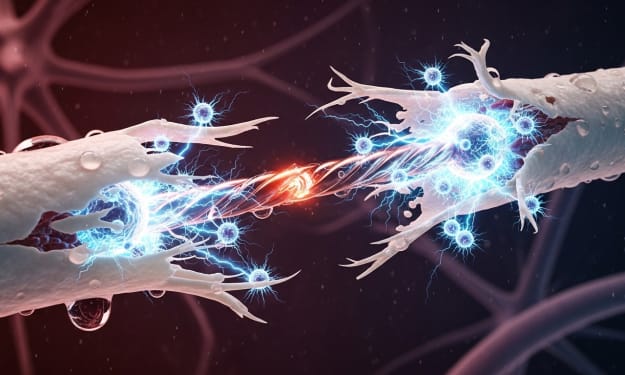
The smell of scorched copper and old, damp wool hit me first, rising from the patient's bedside like a foul incense. It was 3:14 AM. The woman in the cot didn't move her legs. She couldn't. She looked at them with a visceral detachment, as if they were two heavy logs left behind by a stranger. Her own T-cells, the very soldiers meant to protect her from the rot of the world, were currently stripping the insulation from her nerves. It was a microscopic demolition. It was a silent, internal arson. I watched her hand tremble as she reached for a glass of water—a jagged, stuttering motion that spoke of a command signal lost in a fraying wire.
By The Chaos Cabineta day ago in Humans



Comments (1)
Excellent ,keep it up looking for more