

Our first house was a two story 1930’s brick town house. It had that dusty wood smell that should have made me feel at home. There was an old fireplace and a bricked in patio with French doors. The rooms were all small with cream walls. They warned us about lead in the paint.
I showed up in my blue Ford fiesta with my parents trailing me in the truck, pulling a little trailer with everything I’d decided to bring. My fiancé stood on the curb under the bloomed-out cherry trees that lined the quiet street, waving us over to the empty parking lot in front of the house.
What do you bring when you drive twelve hours away from home to move in with your military fiancé? I’d lived the past four years driving between college and home. I had a handful of furniture; I wasn’t sure he needed. Silverware that he did not want. Books I couldn’t part with and a few boxes full of art supplies that I refused to apologize for.
I’d left a great deal at home. I’d left clothes that seemed too impractical, a baby grand that I had always enjoyed playing, and a parrot that would never understand why I had to leave him.
I’d never really needed to define myself as one thing or another, but suddenly I was a funhouse reflection of the things that I had left behind. I was a bird person, with a penchant for fancy hats and too many shoes. I frequently tracked mud through the house with out thinking. I always forgot the laundry in the machine so that it came out musty. I lined the window sills with nick knacks and then felt guilty for the mess. I was useless and faintly ridiculous, but worse, I was an unemployed college graduate following my military fiancé.
In those early days, while my husband worked an eight to five, I was left in the house. Between job interviews and eventually a job, I worked on my art projects. I’d unpacked my boxes in the sun room, my easel balanced on the painted over bricks. My paints were stacked on the step to the living room. I had boxes of fabric scraps, flowers, acorns, frames, scissors and pliers, chisels and brushes.
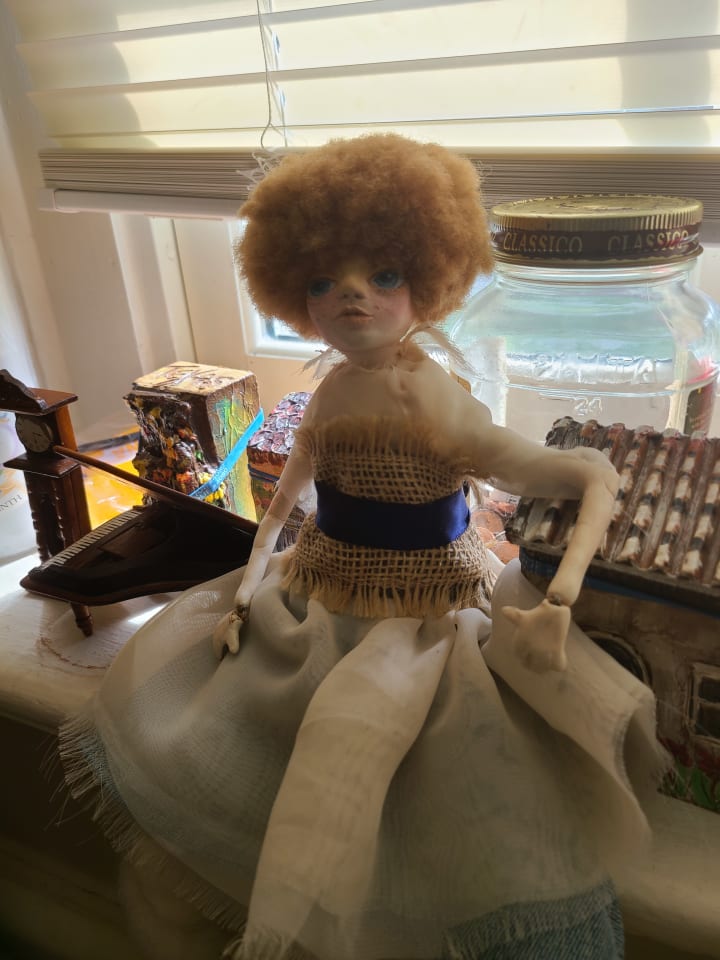
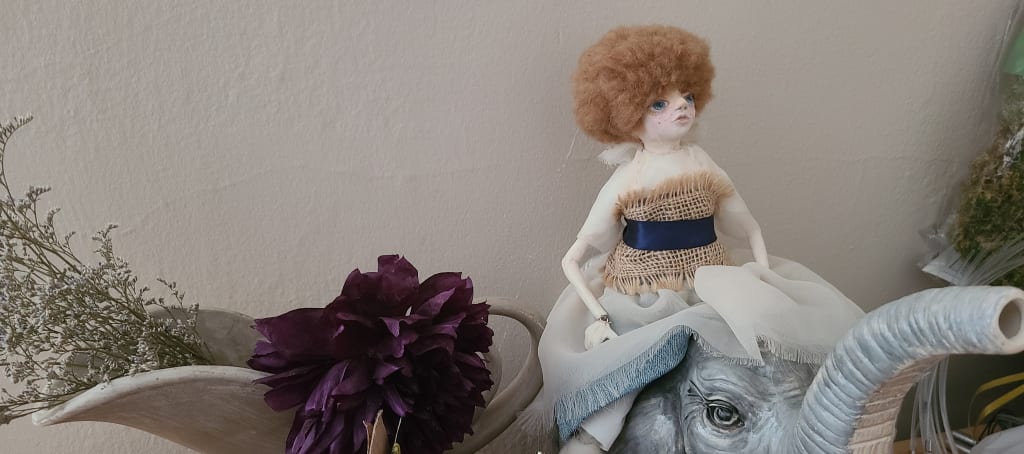
One of the projects I started then was a polymer clay and wire doll. Nothing says normal, like coming home to your soon to be wife baking a miniature disembodied head in your oven. I think that’s part of why she was so important. I’d always loved dolls. I had a huge collection at home. My old home. It was a part of me I didn’t want to leave in my childhood, but that I was also very self-conscious of. I think that’s how it started, anyway. She was an act of rebellion against my own fear.
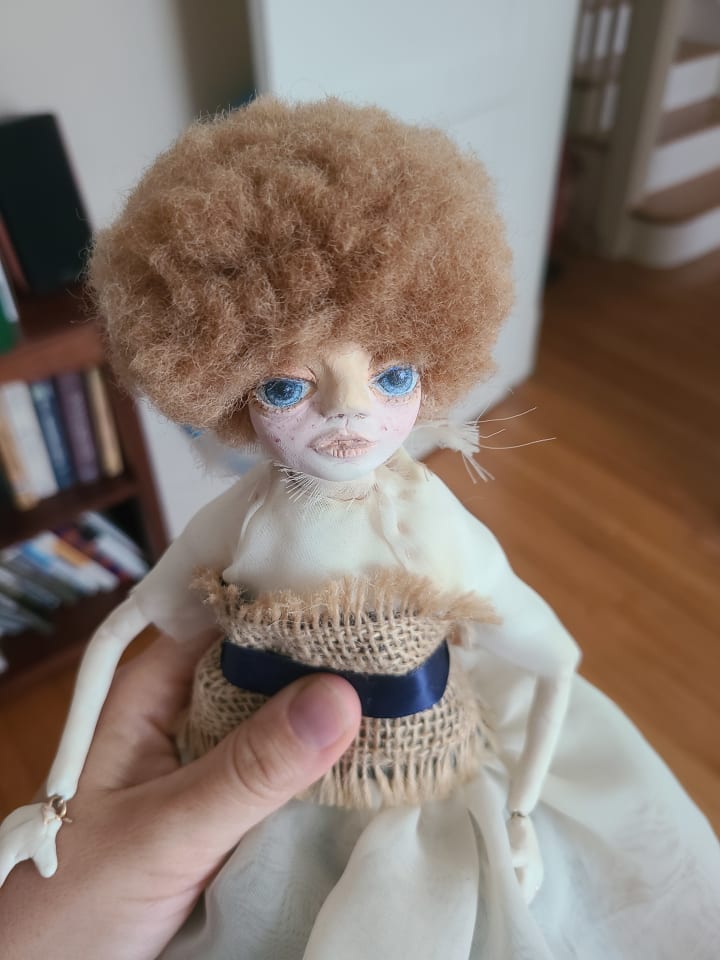
Right before graduating I’d found an Art Doll magazine at a craft store and my hands had been itching to imitate those magical creations ever since. I had no idea how they had done any of it. I read the articles, but they were too detailed to guide a true novice. I knew I wanted to use polymer clay. I was familiar with polymer clay although I didn’t have any tools. I worked on her face, hands and feet with just my fingers and a tooth pick.
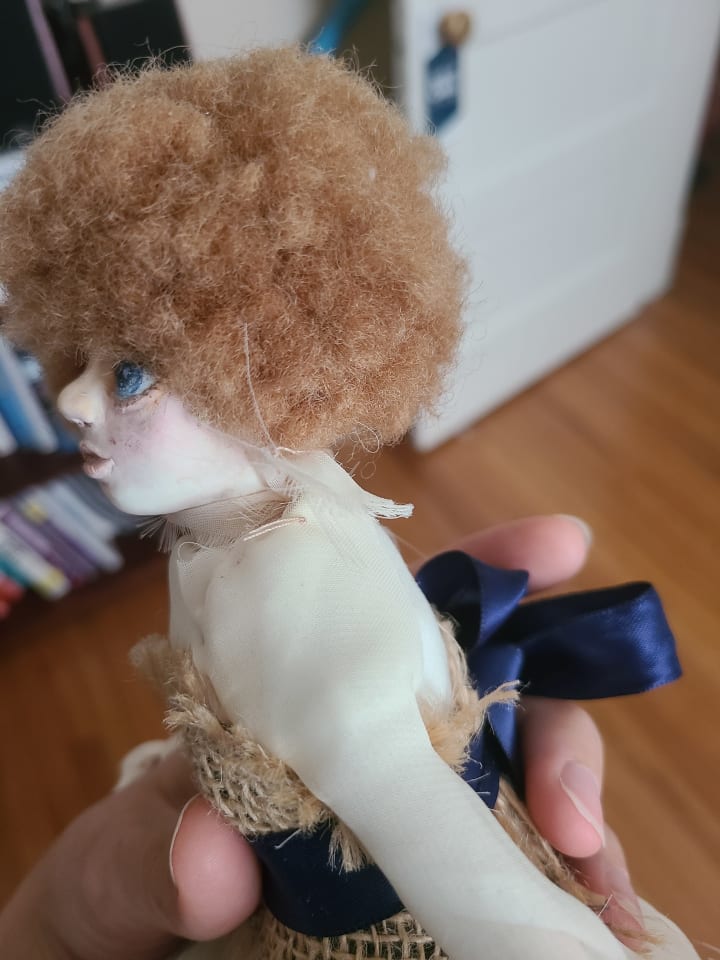
Her body was a wire frame. I connected her joints with wire loops so she could move her arms and legs. Then, I wrapped her in strips of wool and cut out a dress from some fabric scraps. Her hair was particularly fun. I had some burlap ribbon and I used it as the netting to weave through tea dyed wool until she had a full head of fluff.
Her face was difficult. I waited a good while to add any colors, because at the time I had no idea how to paint her. I didn’t have any sealer and I wasn’t very familiar with acrylics or any other classic blushing tools. Blushing is what doll painters call adding color to a doll.
Instead, I used oil paint the first time and I’ve added to her with markers and colored pencils since. She’s still not complete. Since then my husband and I have moved again and had two children together. Every so often I add a little something to her as she sits patiently on my craft shelf, unfinished and undefeated by that.
She is four years old now, a year older than my daughter. I’ve learned a lot about myself in those four years. Most of the time it feels like I’m Alice wondering through strange lands faced with the caterpillar asking persistently, “Who are you?!”
Sometimes it’s hard to hold on to who we are and see the value in ourselves. I think I was looking for myself when I made her. She's a bit odd looking, more than a little frivolous, and unfinished, but she's proud and beautiful and loved. I think that’s what crafting does for many of us. It lets us craft our reflection. It answers back that persistent question with just a fragment of ourselves that we can hold on to.
About the Creator
Keep reading
More stories from Umbrella Jack and writers in Humans and other communities.



Comments
There are no comments for this story
Be the first to respond and start the conversation.