
The Expanding Universe: Exploring the latest discoveries about the universe's expansion
Read the article to learn more

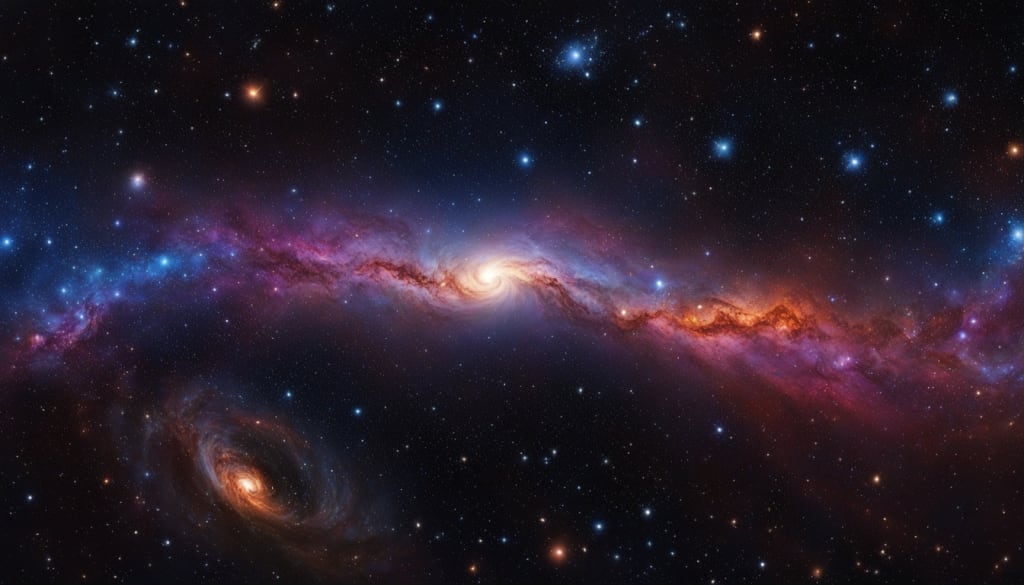
As a child, I used to look up at the night sky, amazed by the endless stars. I didn't know then that the universe was growing, expanding every second. Now, the story of our universe's growth is a top scientific discovery.
This article will cover the exciting research that tells us about the expanding universe. We'll look at the Big Bang theory and the role of dark energy in cosmic inflation. We'll see how our universe has changed since the beginning.
We'll also talk about important ideas like Hubble's law, the observable universe, and galaxy clusters. These help us understand the universe's history.
Let's start a journey to the edge of our expanding cosmos. Here, the past and future meet, revealing the beauty of our existence.
Introduction to the Expanding Universe
The idea of an *expanding universe* is key in modern astronomy. It comes from the work of pioneers like Edwin Hubble and Georges Lemaître. We see that far-off galaxies are moving away from us, a sign of *cosmological redshift*. This, along with the *Big Bang theory*, tells us the universe is getting bigger. Galaxies and clusters are moving further apart over time.
The universe's expansion is a key part of how we see the cosmos. It helps us understand where the universe came from and how it has changed over billions of years. By looking at the expanding universe, scientists learn about galaxy formation, matter distribution, and the universe's future.
Seeing the universe expand changed how we view the stars and space. It has opened new areas for research and discovery. As we explore more, studying the expanding universe will lead to more amazing findings. These discoveries will change how we see our world and the universe.
The Big Bang Theory: The Birth of Our Cosmic Realm
Explore the fascinating story of our universe's start with the big bang theory. This leading scientific idea says our cosmos began about 13.8 billion years ago. It was a super hot and dense spot called the singularity. Then, the universe quickly grew and cooled down, creating the forces and particles we see today.
The cosmic microwave background radiation is a key proof of the big bang theory. It's a faint glow all over the universe. Scientists think it's the leftover heat from the early universe. By looking at this radiation, they've learned a lot about cosmic inflation, the fast growth of space-time right after the big bang.
The big bang theory has been proven many times over. Many observations and experiments back up its main ideas. As we keep studying the universe, the big bang theory helps us understand our place in the universe. It guides us to a deeper respect for our role in the cosmos.
Hubble's Law and the Accelerating Expansion
In the early 20th century, Edwin Hubble made a key discovery. This changed how we see the universe. He found that galaxies far from us move faster. This showed the universe is expanding.
Later, scientists found something even more interesting. The universe is getting bigger faster over time. This speed-up is because of a mysterious force called dark energy. Dark energy fills all of space and plays a big role in making the universe expand faster.
Learning about Hubble's law and the universe's expansion helps us understand where we come from and what the future holds. By studying this, we learn about space-time and the forces that shape the universe. This ongoing research excites scientists and anyone who loves the stars.
The Expanding Universe
Exploring the world of cosmology, I'm amazed by the cosmic expansion that shapes our universe. This key feature shows how our cosmos is always changing and moving. It's a sign of the universe's dynamic nature.
Galaxies and galaxy clusters are moving further apart because space-time is expanding. This expansion changes how the universe looks and grows. It also sets limits on what we can see in the observable universe. This is the part of space we can study by looking at light and other signals.
Thinking about our vast universe makes me think of how much we've learned. Pioneers like Edwin Hubble and today's scientists have made big strides in understanding the expansion. Their work keeps us hooked, showing us the universe's ongoing story.
The universe's growth shows its amazing and changing nature. As we learn more, I feel more wonder and excitement for what's yet to be discovered.
Dark Energy: The Enigmatic Force Driving Expansion
Dark energy is a big mystery in our universe. It makes up 70% of the universe's energy. This force is thought to speed up the universe's expansion. But, what dark energy actually is, is still a big question. Scientists think it could be a simple thing called a cosmological constant or something much more complex.
Looking into the universe, dark energy becomes even more fascinating. Scientists are trying to find out what it is. They hope to learn about the universe's future by understanding dark energy.
Studying dark energy is key in modern astronomy. Researchers use advanced telescopes and complex models to learn about it. Their work is a big challenge but also very exciting in the field of astrophysics.
Cosmic Inflation: The Rapid Expansion of Space-Time
The universe we see today started with a big event right after the *big bang theory*. This event, called *cosmic inflation*, made space-time expand quickly. It smoothed out early rough spots and helped create the big structures we see, like galaxies and galaxy clusters.
This inflation lasted only a tiny fraction of a second. Yet, it made the universe grow from a tiny, dense spot to a big, even one. A mysterious force, *cosmic microwave background radiation*, pushed this growth.
The signs of this fast expansion are in the *cosmic microwave background radiation*. This faint glow fills the universe. It was found in the 1960s and shows the universe's early heat and energy. By looking at its tiny changes, scientists learned about the universe's early days and *cosmic inflation*'s role.
Galaxy Clusters: Tracing the Universe's Evolution
I find the study of galaxy clusters fascinating in cosmic exploration. These huge groups of galaxies stick together with gravity. They help us understand how the universe has changed over time.
Studying galaxy clusters tells us about dark matter and its role in the universe's growth. The way these galaxies move shows us the hidden forces at work. These forces help us see how the universe has changed since the beginning.
Exploring galaxy clusters shows us how they relate to the universe's forces. From the start to now, these forces have shaped galaxy clusters. They tell us about the universe's history.
Learning about galaxy clusters helps us understand the universe's past, present, and future. This journey shows our endless curiosity and helps us learn about our universe.
The Observable Universe: Mapping the Cosmic Frontier
Exploring the cosmos is truly mind-blowing. The observable universe stretches far beyond what we can see. It's the part of the universe we can study, limited by how far light has traveled since the Big Bang.
The cosmic horizon marks the edge of what we can see. It's where the universe's vastness becomes too big for us to observe. Beyond this point, light from far-off galaxies hasn't reached us yet. The cosmological redshift shows us how the universe is expanding by changing light colors.
Exploring the observable universe helps us understand the universe better. We learn about galaxies, dark matter, and energy. Every new discovery adds to our knowledge of the universe's past and future.
Conclusion
As we wrap up our look at the expanding universe, I'm filled with wonder. We've explored from the Big Bang theory to the mysteries of dark energy and cosmic inflation. This journey has shown us the dynamic and changing nature of our universe.
Edwin Hubble first suggested the universe is expanding. This idea has helped us understand where we come from, what our universe is like, and where it's going. Dark energy, which speeds up this expansion, is still a big mystery. Yet, it has led to new discoveries.
Thinking about the progress in cosmology, I see how our view of the universe keeps changing. Every new finding tells us more about space-time and the forces that shape our universe. I look forward to the future. I'm excited to see what new discoveries will reveal about our universe's beginnings, structure, and future.
About the Creator
Wilson Igbasi
Hi, I'm Wilson Igbasi — a passionate writer, researcher, and tech enthusiast. I love exploring topics at the intersection of technology, personal growth, and spirituality.
Keep reading
More stories from Wilson Igbasi and writers in Humans and other communities.
Why You Keep Manifesting the Wrong Things
I once believed in manifestation with all my heart. I would visualize, affirm, and meditate every day. I thought the universe would give me what I wanted. But instead, I got financial troubles, failed relationships, and missed chances.
By Wilson Igbasi10 months ago in Humans


Comments
There are no comments for this story
Be the first to respond and start the conversation.