
The Demise of Gratitude: When Tipping Became an Entitlement.
The exact moment tipping culture transitioned from optional appreciation to expected obligation.


Tipping. The word itself conjures a myriad of emotions, ranging from generous satisfaction to simmering resentment. Once a gesture of gratitude for exceptional service, it has mutated into something unrecognizable, a tangled web of social pressure, ethical quandaries, and frankly, blatant exploitation. We’ve all felt it: the cold sweat of calculating percentages on a tablet, the awkward pause after declining, the lingering guilt even when the service was subpar. But when did this all go wrong? When did tipping culture, already teetering on the edge, finally jump the shark?
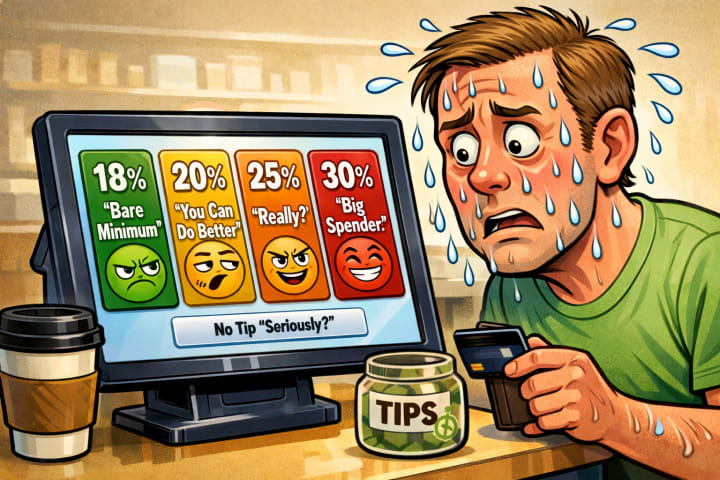
For many, the precise moment of tipping’s downfall can be pinpointed: the proliferation of digital tipping prompts. Suddenly, every transaction, from a simple coffee to a self-service frozen yogurt, became an opportunity (or obligation) to tip. The cashier at the hardware store? The barista who simply pours pre-made coffee? The person who hands you a pre-packaged sandwich at the airport? All demanding a percentage. The lines of what constitutes "tippable" service have been blurred beyond recognition, and the responsibility for fair wages has been conveniently shifted from employers to the customer.
This shift is insidious. Before the advent of digital prompts, tipping was largely confined to sit-down restaurants, bars, and certain service industries. It was a voluntary expression of appreciation for personalized attention and exceptional effort. Now, it's a standardized add-on, a psychological manipulation tactic embedded into every point-of-sale system. The default options, often starting at 18% or even 20%, pressure customers to over-tip, even when the service is mediocre or non-existent. We are essentially being guilt-tripped into subsidizing the wages of employees who are already receiving a base salary.
The argument for tipping traditionally centered around supplementing low wages. Restaurant servers, for example, historically relied on tips to earn a living wage due to notoriously low minimum wages for tipped employees. However, with the rise of minimum wage debates and calls for fair labor practices, the justification for tipping becomes increasingly tenuous. Should it really be the customer's responsibility to ensure employees earn a living wage? Shouldn't employers be held accountable for paying their employees fairly in the first place?
The digital tipping boom has only exacerbated the existing inequalities within the system. Counter workers at fast-casual restaurants, who perform essentially the same tasks as those at quick-service restaurants that don't typically elicit tips, are now presented with the opportunity to earn significantly more, simply because their employer has implemented a tipping system. This creates an arbitrary and unfair distribution of income, based not on merit or skill, but simply on the employer’s business model and the customer’s willingness to participate in the tipping charade.
Furthermore, the expectation of tipping often transcends the quality of service. We tip out of social anxiety, fearing judgment from employees or even other customers. We tip to avoid the awkwardness of declining, even when the service is slow, inaccurate, or downright rude. This creates a perverse incentive structure, where employees are rewarded regardless of their performance, and customers are penalized for exercising their right to withhold a tip.
The solution, however, isn’t simply to abolish tipping altogether. Many argue that tipping incentivizes better service and allows customers to reward exceptional performance. It provides a direct link between effort and reward, fostering a culture of customer satisfaction. The problem lies not in the concept of tipping itself, but in its rampant expansion and the shift in responsibility from employers to customers.
The answer lies in transparency and fair wages. Businesses need to be upfront about their pricing, factoring in the cost of labor into the menu prices or service fees. They need to pay their employees a living wage, eliminating the need for customers to subsidize their income. This would allow customers to make informed purchasing decisions, knowing that the price they see is the price they pay, without the added pressure of arbitrary tipping obligations.
The moment tipping jumped the shark wasn't a single event, but a gradual erosion of its original purpose. It was the proliferation of digital prompts, the shift in responsibility, and the normalization of tipping for services that never warranted it. To salvage what remains of the concept, we need to reimagine the relationship between businesses, employees, and customers, focusing on transparency, fair wages, and a return to the true spirit of gratitude. Only then can we escape the suffocating weight of the tipping culture and restore its original, well-intentioned purpose. Until then, we're all just swimming in shark-infested waters.
About the Creator
Wilson Igbasi
Hi, I'm Wilson Igbasi — a passionate writer, researcher, and tech enthusiast. I love exploring topics at the intersection of technology, personal growth, and spirituality.
Keep reading
More stories from Wilson Igbasi and writers in Humans and other communities.
The Myth of the Meritocracy: Why Romanticizing 'Hustle Culture' is Toxic.
We live in a society that often glorifies the relentless pursuit of success, praising individuals who are perpetually “on,” constantly working, and seemingly immune to fatigue. This is the insidious influence of "hustle culture," a pervasive narrative that equates self-worth with productivity and sacrifices well-being at the altar of achievement. But this romanticized vision is a dangerous fallacy, one that fuels burnout, exacerbates inequality, and ultimately undermines the very concept of success it purports to champion.
By Wilson Igbasiabout 23 hours ago in Humans
The Angry Man in Your House
"If you grow up with an angry man in your house, there will always be an angry man in your house" This statement has caused plenty of controversy online, people say its a statement that blames victims while also undermining those who break traumatic cycles to form health relationships... but if I'm honest now that I'm in my 30s it makes more sense to me than ever, and I'd argue that its not just about fathers and uncles.
By S. A. Crawford5 days ago in Humans
I've Just Realized
The President doesn't understand music. There. It felt very good to write that; it's some thing I just realized today. Oh , yes; he plays it. He TRUMPets it in rallies and meetings, pumps it across the airwaves when he gathers up our minutes waiting for his late arrival.
By Judey Kalchik 3 days ago in Beat




Comments
There are no comments for this story
Be the first to respond and start the conversation.