
The Death Of Socrates
The Birth of Western Philosophy

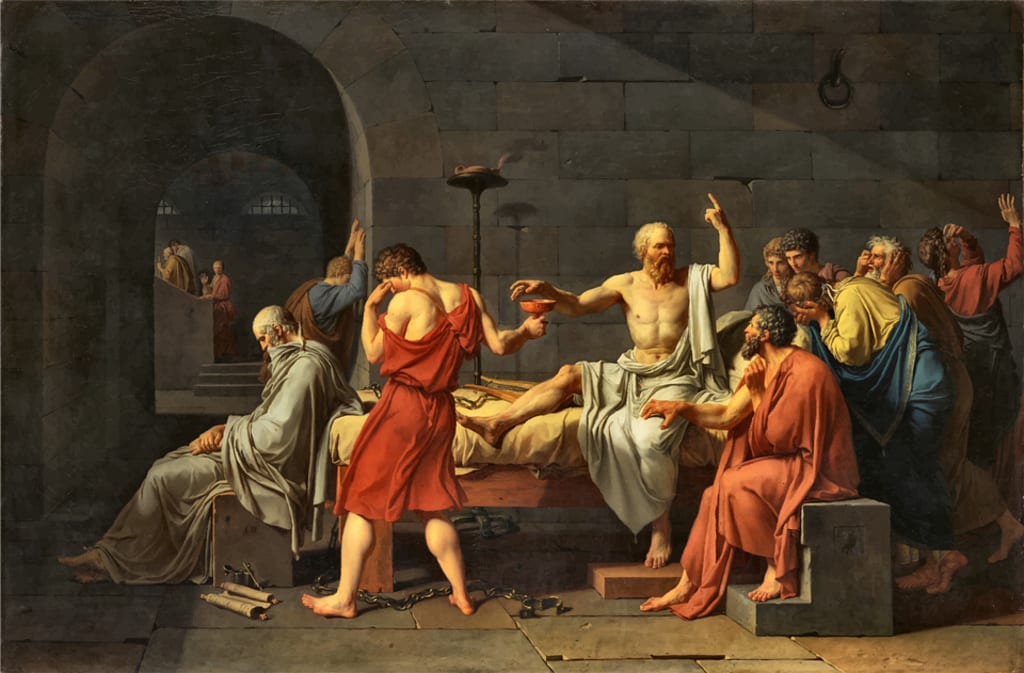
Socrates:
Socrates was a Greek philosopher who lived around 400 BCE. He is known for developing the Socratic method, which involved asking questions to stimulate critical thinking and deeper insight into a topic. He focused on the search for truth and the improvement of the individual through self-examination. Socrates was also known for his unorthodox ideas and his criticism of Athenian democracy, which led to his trial and execution. Despite his controversial life and death, Socrates remains an important figure in the history of Western thought, and his ideas continue to influence philosophy, education, and ethics to this day.
Trial of Socrates:
Socrates was brought to trial in 399 BCE in Athens, Greece, on charges of corrupting the youth and impiety (disrespect for the gods). The accusations against him were based on his unorthodox ideas and his critical comments about Athenian democracy and gods.
During the trial, Socrates was given the opportunity to defend himself,he had a chance to clear misunderstandings, but rather he chose to spread knowledge and his message to the audience, it was certainly his most precious minutes of existence because this small segment of time would decide his fate, but he refused to back down from his beliefs or to apologize for his actions. He argued that he was simply trying to seek truth and knowledge through his philosophical questioning and that his teachings were not intended to corrupt or harm the youth. He argued that his way of questioning had done nothing but good to society.
The whole trial of Socrates is vividly explained in Plato's APOLOGY. it is a great work of Plato and widely considered as his best Socratic dialogue which explores human wisdom, virtue, and integrity.
Plato's 'APOLOGY' records that Socrates said: "To put it bluntly I've been assigned to this city as if to a large horse which is inclined to be lazy and is in need of some great stinging fly and all day long I'll never cease to settle here, there, everywhere, rousing and reproving every one of you."
Death Of Socrates:
Despite his defense, Socrates was found guilty by a narrow margin of 280 to 220 votes. The penalty for his crime was death by drinking hemlock. Socrates accepted his fate and drank the poison in front of his friends and followers. Socrates agues that he does not fear death; indeed, to fear death is a sign of ignorance.
In the words of Socrates in 'APOLOGY': “For the fear of death is indeed the pretence of wisdom, and not real wisdom, being a pretence of knowing the unknown; and no one knows whether death, which men in their fear apprehend to be the greatest evil, may not be the greatest good.”
The trial and execution of Socrates have been the subject of much debate and analysis over the centuries, with many scholars arguing that his condemnation was a result of political and social factors rather than his actual guilt. Nevertheless, Socrates' legacy as a philosopher and a martyr for free thought has continued to inspire generations of thinkers and scholars.
Impact Of Socrates On Western Philosophy:
Socrates had a profound impact on Western philosophy, and his influence can be seen in many aspects of our modern world. His method of questioning and inquiry, known as the Socratic Method, has become a widely adopted tool for critical thinking, problem-solving, and teaching. His philosophy focused on the search for truth and the improvement of the individual through self-examination, emphasizing personal integrity and ethical behavior. These ideas have had a lasting impact on Western philosophy and continue to influence our understanding of ethics and morality.
Socrates' student, Plato, was deeply influenced by his teachings and philosophy. Plato went on to develop his own ideas, which became the foundation for Western philosophy. Plato is also widely considered as the greatest philosopher of all time due to many of his works, mainly due to his popular and critically acclaimed dialogue Plato: The Republic. Socrates' death has also had a lasting impact on Western philosophy, as he is remembered as a martyr for free thought and a symbol of bravery and integrity. His emphasis on personal integrity and ethics has also had an impact on the development of Stoicism, an ancient Greek philosophy that emphasizes self-control, rationality, and virtue.
Overall, Socrates' legacy has shaped Western philosophy in countless ways. His ideas continue to influence our understanding of ethics, morality, and critical thinking, and his emphasis on personal integrity and self-examination has remained an important foundation for modern philosophical thought.
"IN CONCLUSION WE CAN SAY THAT DEATH OF SOCRATES WAS THE BIRTH OF WESTERN PHILOSOPHY"
About the Creator
M.Salman Yasin
Hi, I'm Salman - a writer with a passion for storytelling. I believe that stories have the power to inspire and change lives. With a unique voice and style, I'm dedicated to crafting tales that captivate readers and leave a lasting impact.
Keep reading
More stories from M.Salman Yasin and writers in Humans and other communities.
Lost and Found
The story begins with a man named Jason attending his father's funeral on March 15th. His father was a janitor, but he was kind to everyone, despite being treated harshly by others. When his father was on his deathbed, he called for Jason to come and see him. However, Jason was preoccupied with his own work and decided to visit his father later. But, he received a call that his father's condition had worsened, and he rushed to see him. Fortunately, he arrived in time to see his father alive one last time.
By M.Salman Yasin3 years ago in Fiction
Minnesota and Illinois Invoke the 10th Amendment in Lawsuits to Block Federal Agents in Their Cities — Here’s Why That Matters
States Push Back Against Federal Enforcement Minnesota and Illinois have launched high-profile lawsuits invoking the 10th Amendment of the US Constitution in an effort to block or limit the actions of federal agents—particularly immigration enforcement officers—operating within their cities. The legal challenges mark a significant escalation in the long-running conflict between state governments and Washington over who has the authority to enforce immigration laws and how far federal power can reach.
By Aarif Lashari3 days ago in Humans
How to Succeed at the Benson Directory®
Congratulations and welcome to the Benson Directory® employee #22391! As our newest call handler, you will have the privilege of speaking with dozens of unique and interesting people on a daily basis as well as the opportunity to earn bonuses for high performance. Contained within this handbook you will find a set of ease to follow instructions designed to help you settle in to your new role and begin paving the way to success.
By S. A. Crawfordabout 15 hours ago in Fiction



Comments
There are no comments for this story
Be the first to respond and start the conversation.