
The Death of Journalism: How Activists Killed a Once Noble Profession
Let’s be real - they aren’t journalists. They're activists.

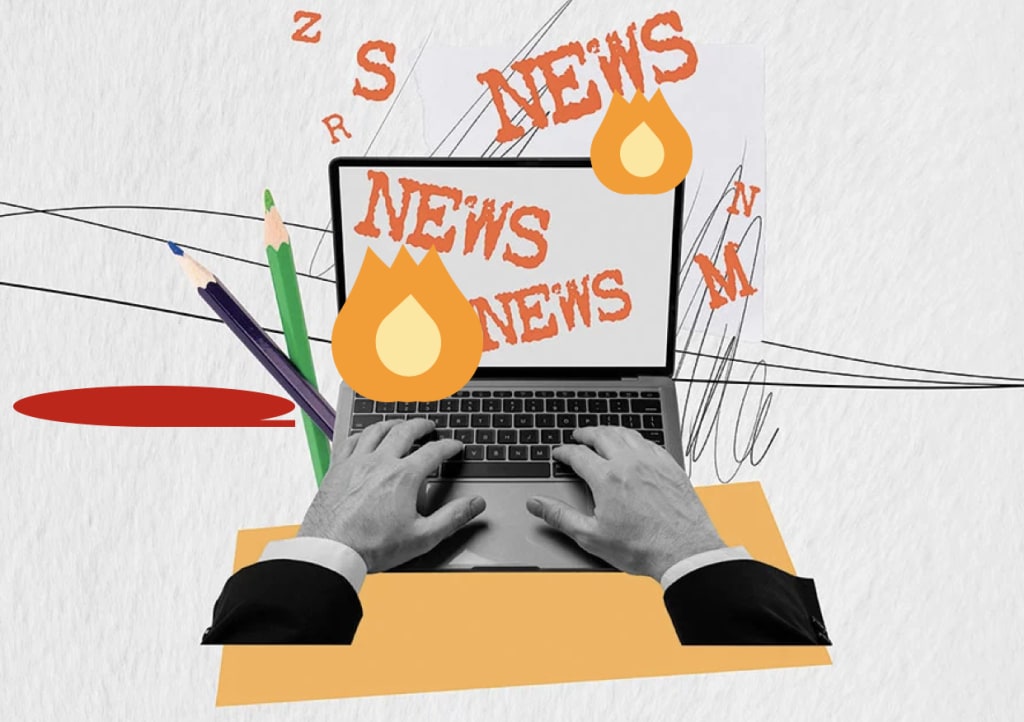
When I was in college from 2008 to 2012, I lived and breathed journalism. CNN was always on my TV screen in my dorm room. Anderson Cooper and Erin Burnett were my idols. My passion and excitement for what my future held was palpable – from finding the story, writing it, editing it, producing the images for print and going out to get the video footage (then coming back and editing that for a news package) to air for the campus news network was my daily grind. I couldn’t wait to graduate, feeling prepared that my school had done its due diligence in preparing me for the real working world of news media.
I’ll share a spoiler alert – I pursued a career in technology instead. The reason for this was that I became overwhelmingly depressed with the types of stories I was covering my senior year of college and shortly afterward. I decided that I didn’t want this anymore because my passion was gone. It was also hard to stay neutral when the majority of stories I was writing and reporting on involved politics, local stories, and some really dark stuff - real people who experienced real tragedies. I found myself writing more and more Op Eds (Opinion Editorials) so that I could voice my personal opinion, instead of serving up what I felt was just cold, hard, news. (Sidenote: I had strong liberal ideologies at the time, and would probably be offended if someone back then told me that facts don’t care about my feelings. Oh, and yes, this very piece is an Op Ed if you couldn't already tell.)
So that’s just it - did you catch that? I wanted to voice my opinion. Herein lies the conflict - how could I be reporting on the facts when I couldn’t keep my own biased opinions on a particular subject in check? My journalism professors in college were real working professionals who had many years of experience, honing their craft and then sharing to their students what makes a good interview, and ultimately what makes a good journalist - the ability to remain objective. “You should never know how a writer or reporter feels about a particular news subject. This is a news piece, NOT your diary,” one of my favorite professors often said to my class.
It’s about trusting that the American people are not stupid; you don’t need to baby-bird them by taking the facts of a story, inserting your own opinions and emotions into it, and then regurgitating it into an article that you’ve purposefully left some bits out of so that you could steer the views and opinions of the public to fit what YOU believe.
That’s not true journalism. In fact, it smells a lot like activism if you ask me.
A Brief History of Journalism
The profession of journalism has a storied history, rooted in the pursuit of truth and the dissemination of information vital to an informed public. From its inception in the early print presses of the 17th century to the digital revolution of the 21st century, journalism has served as the backbone of democracy, holding power to account and giving voice to the voiceless. Yet, in recent years, the landscape of journalism has drastically changed, with many declaring the profession ripe for a funeral. We must consider how the rise of activism has redefined—and, in many ways, undermined—this once-respected vocation.
Historically, journalism arose from a necessity to inform citizens. The first newspapers started as platforms for public discourse, news dissemination, and accountability. Figures like Benjamin Franklin recognized journalism's impact on society, believing that a well-informed public was essential for a functioning democracy. Throughout the 19th and 20th centuries, journalism evolved with advancements in technology, from the telegraph to the television, but its fundamental purpose remained: to report objectively and truthfully.
Investigative journalism flourished in the mid-20th century, with renowned reporters exposing corruption, corporate malfeasance, and governmental wrongdoing. The Watergate scandal, investigated by Bob Woodward and Carl Bernstein, exemplified journalism’s societal responsibilities. In this golden age, journalists were seen as guardians of democracy, armed with the mission of uncovering the truth, often at great personal risk.
The Rise of Activism in Journalism
With the rise of social media and the internet in the late 20th and early 21st centuries, journalism began to shift dramatically. The democratization of information allowed anyone with a smartphone and an internet connection to enter the fray. This was a double-edged sword; while it empowered marginalized voices and diversified discourse, it also blurred the lines between fact and opinion. Suddenly everyone has a smartphone, suddenly everyone is an investigative journalist. The waters certainly got muddy.
Activism, often propelled by social media movements, has reshaped journalism by introducing the idea that journalism must actively promote certain social justice causes. While the pursuit of equity and representation is noble, it has led to an increasingly polarized media environment. The emergence of "advocacy journalism," which aligns closely with activist ideals, often prioritizes ideological alignment over objective reporting. In this environment, journalists—once meant to serve as neutral arbiters of fact—have increasingly become players in the narratives they report.
The conflict escalated further with the notion of "fake news," a term weaponized by various actors to delegitimize dissenting viewpoints and discredit media outlets that dare to challenge prevailing narratives. However, I personally think that “news” filled with the personal opinions of the writer is correctly termed as fake news – REAL opinions, FAKE news. (AI also brings on a whole new complicated level to this, since anyone can curate images and videos to point the finger, but I’ll save that for another article.)
In striving to promote activism, some journalists have ironically abandoned the very principles that cemented their legitimacy, losing sight of the objectivity and rigor that once defined the profession.
The Consequences of Activist Journalism
The shift towards activist journalism has led to a homogenization of thought in many mainstream media outlets. When news organizations elevate certain social movements or ideologies above others, they risk marginalizing dissenting voices and alienating large segments of the populace. This trend has fostered a culture of distrust, where individuals seek news sources that reinforce their existing beliefs rather than challenge them.
Moreover, the pressure for immediacy in an era dominated by social media has compounded these issues. The rush to break news often overrides the commitment to accuracy, as journalists prioritize speed over verification. This has resulted in a slew of misinformation, further eroding public trust in journalism as a whole.
The Path Forward - Can Journalism Be Saved?
It’s 2025 and it feels like real journalism no longer exists. In its place are cringey crybaby activists who cannot fathom the thought of being objective in their work. They might as well say “If I have to be fair and unbiased, I’m quitting my job.” On that note, maybe they should quit. If it’s impossible for these people to stay neutral, we’ve really gone downhill. It’s one thing to write an Op Ed piece, as freedom of speech is welcomed and encouraged, but when an entire publication endorses a political figure for example, this is why Americans don’t trust the biased media. The mainstream media is one hell of a propaganda machine, and most of the American people know this. Give us all of the facts and trust us to make up our own minds based on those facts.
As we stand at the crossroads of the profession, it is crucial for journalists to reclaim their foundational purpose: to inform, investigate, and engage with the truth. While activism has an undeniable role in advocating for important social issues, it should not eclipse the core principles of journalism. The profession thrives when it is dedicated to uncovering inconvenient truths, challenging the status quo, and providing a platform for diverse perspectives.
To resurrect true journalism, we must advocate for a culture that values journalistic integrity over ideological consistency. Rigorous fact-checking, accountability, and transparency must take precedence, allowing journalists to become the trusted watchdogs they were meant to be.
In reclaiming its noble legacy, journalism can navigate the complexities of a changing world, serving as a beacon of truth in an era rife with misinformation and ideological division. I do think the profession is far from dead; rather it is in need of resuscitation, redefined not by the activism that seeks to overshadow it, but by a renewed commitment to factual storytelling and the unwavering pursuit of truth. Let’s do better, let’s be better, and let’s keep each other accountable when it comes to reporting ALL of the facts. ~
About the Creator
Li-Li 📓
Hi, my name is Li-Li & I'm just grateful to be able to share my words here. ♥
She Left Me For A Rich Guy, Look How She Turned Out
I sat back and watched you this weekend. I saw the photos. I saw the smiles. I saw the man you chose over the empire we were building. And for the first time in three years, I didn’t feel a sting of jealousy. I felt a cold, hard sense of irony.
By Nanu Nnabuife6 days ago in Humans



Comments
There are no comments for this story
Be the first to respond and start the conversation.