

Introduction
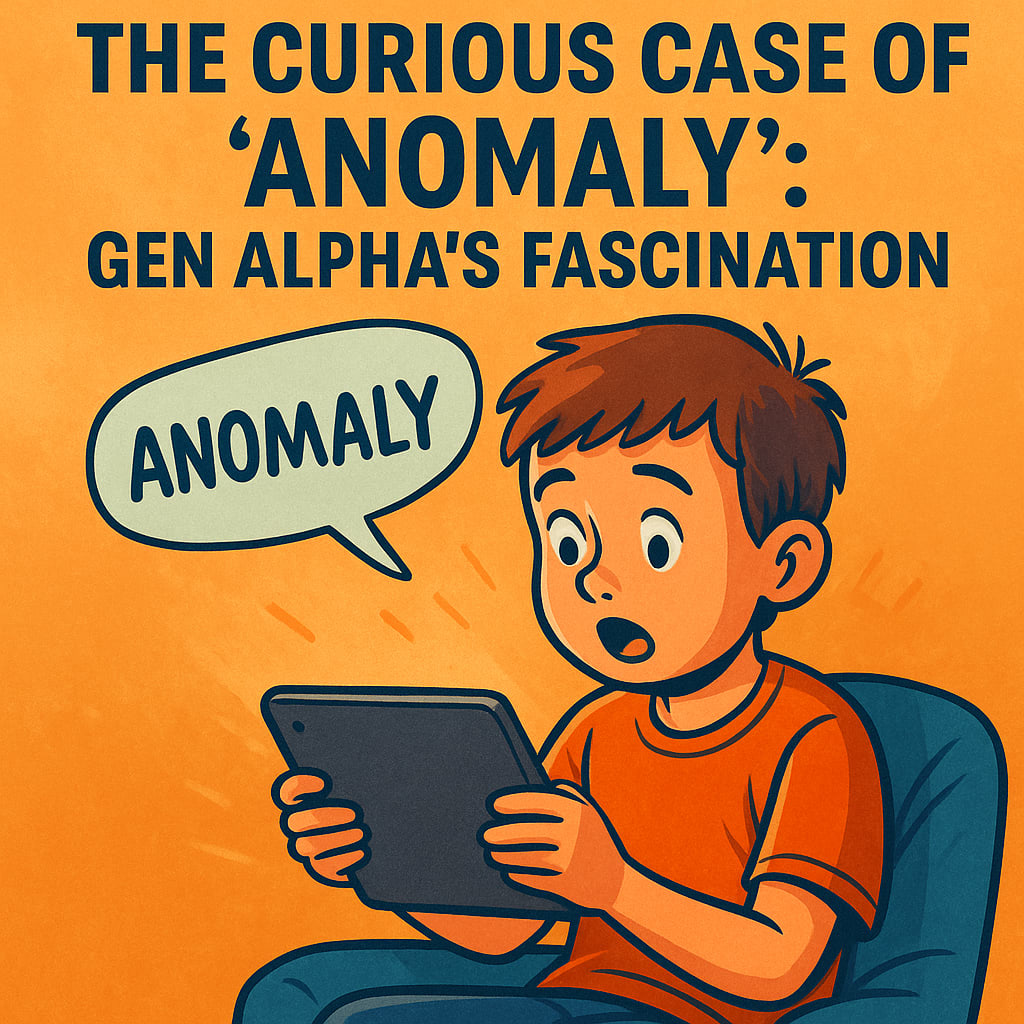
A new word has quietly crept into the everyday lexicon of Gen Alpha, and it’s surprisingly hard to define outright: "anomaly." Once reserved for scientific discourse or statistical outliers, this term has now become a cultural marker for a generation growing up with irony, uncertainty, and complex self-awareness. For older generations, it may seem odd that children born after 2010 are deeply fascinated by a term that literally means "something that deviates from the standard, norm, or expectation." But for Gen Alpha, anomaly is more than a word—it’s a symbol, a meme, and in many ways, a mirror for how they’re growing up in a digital age.
The Rise of "Anomaly" as a Meme and Mindset
It started subtly—first appearing in TikTok comments, online gaming chats, and school conversations. “That’s such an anomaly” became shorthand for something unexpectedly odd, endearingly eccentric, or uniquely amusing. Over time, the word evolved into a meme format. Kids began pointing at behaviors, styles, or speech patterns that stood out and labeling them as anomalies. Someone using outdated slang? Anomaly. A cat walking upright like a human? Anomaly. A student wearing a full suit on an ordinary Monday? Undoubtedly an anomaly.
Its appeal lies in absurdity and a shared recognition of weirdness. In a world where digital culture moves at lightning speed, spotting anomalies has become a way to pause and admire the strange together. For Gen Alpha, raised on algorithmic personalization, this term has also become a tongue-in-cheek way of expressing individuality.
Digital Native Meets Irony Native
What sets Gen Alpha apart is not just their fluency in digital tools but their deep understanding of internet culture. They are not merely users of the web—they were born from it. The meme-ification of “anomaly” reflects broader trends in how this generation communicates: everything is layered in irony, references, and coded language that speaks to a collective consciousness.
In many ways, the popularity of “anomaly” is a defense mechanism. Raised amidst uncertainty—climate crises, global pandemics, rapid technological change—Gen Alpha gravitates toward absurd humor as a way to process a chaotic world. When nothing feels stable, calling something an anomaly becomes both a joke and a quiet acknowledgment that normalcy has become obsolete.
Anomaly in Identity and Self-Expression
Beyond memes, the concept of anomaly has seeped into how Gen Alpha views identity. This is a generation far more comfortable with fluidity—be it in gender, culture, or personal interests. Celebrating the anomaly—those who deviate from norms and expectations—feels like a natural extension of their worldview.
Gen Alpha kids tend not to see deviation as a flaw. Instead, it’s embraced. A boy who paints his nails and codes after school? A cool anomaly. A girl wearing cosplay outfits outside of Comic-Con? An iconic anomaly. This embrace of oddity marks a shift from the performative conformity of previous generations toward a kind of aesthetic and behavioral individualism that defies classification.
From Internet Joke to Social Commentary
Interestingly, the term “anomaly” has taken on a second life—as a subtle form of protest. Pre-teens and teens use it to highlight social contradictions or hypocrisy. A teacher who talks about mental health but tolerates bullying? Anomaly. An ad campaign that preaches diversity but only showcases one type of person? Anomaly.
It’s playful, even funny, but it’s meaningful. This low-effort yet high-impact language allows Gen Alpha to critique the world they’re inheriting without sounding preachy. They don’t scream—they shrug and say, “That’s an anomaly,” inviting others to see the inconsistency too.
Platform and Algorithmic Influence
It would be a mistake to analyze this trend without examining the platforms that amplify it. TikTok, YouTube Shorts, Discord, and Roblox are not just digital playgrounds—they are cultural incubators. These platforms reward novelty, weirdness, and attention-grabbing content. In this landscape, anomalies are currency. The more surprising or unconventional your content is, the more likely it is to go viral.
Algorithms are designed to prioritize what’s different. Gen Alpha intuitively understands this. Posting something "normal" often gets ignored. But add a bit of anomaly—a glitch, a twist, an unexpected turn—and engagement spikes. In this way, celebrating anomalies is not just cultural but algorithmic.
Examples of Popular Anomalies
To understand this fascination more tangibly, consider some popular examples:
"Bombardillo Crocodillo" – A nonsensical phrase that originated in meme culture, often used as an inside joke with no clear meaning, but its randomness makes it perfect anomaly material.
"Tung Tung Tung Sahur" – A viral soundbite from Indonesian Ramadan culture that has been remixed and meme-ified globally, turning a traditional call into a humorous and rhythmic online trend. Its unexpected appeal outside its original context marks it as a prime anomaly.
AI voice mashups of cartoon characters singing 2000s emo songs – The absurd combination of SpongeBob singing Linkin Park is both hilarious and unexplainably fascinating to Gen Alpha.
People pretending to be NPCs in public – This performance art meets absurd comedy trend gained traction on TikTok, where individuals behave like video game NPCs (non-player characters) on the streets, becoming walking, talking anomalies.
Surreal filters and glitch edits – Distorted face filters or oddly edited videos that subvert expectations often get labeled as anomalies because they break visual norms in delightfully unexpected ways.
Concerns and Criticisms: Is It All Just a Joke?
Of course, not everyone is on board with this trend. Critics argue that labeling everything as “anomaly” can trivialize serious issues. When everything is ironic, does anything still matter? Does celebrating the abnormal blur the line between humor and sincerity?
There’s also a risk of emotional detachment. Viewing the world constantly through the lens of irony or memes can make it difficult to feel authentic emotions or understand complex truths. Some educators and psychologists worry that Gen Alpha may struggle with empathy or deep connection if everything is reduced to a joke.
What “Anomaly” Reveals About Our Time
Despite the concerns, the obsession with anomalies reveals something profound about the Gen Alpha zeitgeist. This isn’t just a phase or a passing meme. It’s a lens—humorous, yes, but also revealing. It shows how young people are processing a chaotic world. It reflects how they find meaning amidst madness. It echoes their desire to be seen, not as predictable patterns, but as something unique and unrepeatable.
In this way, anomaly is both a symptom and a statement. It tells us that Gen Alpha is paying attention—even if their language sounds bizarre. It shows that they are constructing a worldview—one that questions norms, celebrates difference, and finds community through shared strangeness.
Conclusion
To dismiss the anomaly trend as mere internet fluff is to miss its deeper meaning. This is a living language evolving in real time to meet the psychological and social needs of a generation. It is a word being stretched, redefined, and reimagined into a symbol of Gen Alpha’s digital identity.
Whether "anomaly" remains a buzzword or fades into the archives of internet history, its current prominence provides a window into the soul of a generation growing up online. And if we’re willing to listen—really listen—to what they mean when they call something an anomaly, we might learn something about the world they’re inheriting—and reshaping on their own terms.
About the Creator
Licht
I write for those who find the world too quiet—or too loud. If you’re looking for something that stirs the heart or sparks a thought—you’re in the right place.
Have fun reading!
Whiskey At Dusk
Guess the whiskey was more important to you in the end, wasn’t it? It was more than the well-being of your friends; more vital than showing up to the places you promised you would and could come to; more critical of a matter than fulfilling your damn responsibilities and getting the press off your back.
By Snarky Lisa4 days ago in Humans
Uranus in Twin Flame Relationships:
Uranus, the seventh planet from the sun and the eccentric rebel of our solar system, is known for its unexpected twists, sudden awakenings, and revolutionary energy. In astrology, it represents change, innovation, freedom, and breaking free from limitations. This planet’s influence is anything but subtle, often manifesting as disruptive forces that shake us out of complacency and propel us towards growth. When it comes to twin flame relationships, already characterized by intense and transformative energy, Uranus can act as a catalyst, introducing unexpected shifts and demanding a willingness to embrace the unknown.
By Wilson Igbasi7 days ago in Humans
The Path to Salvation
The late autumn evening air filled the monk's lungs, but it wasn't the season that chilled his bones. The heavy-handed presence of evil he had sensed upon entering the woods surrounding this mountain village had not bothered to conceal itself from him.
By Made in DNA7 days ago in Fiction


Comments (1)
Nicely written