
The Collective Care that Comes with Being a Black Artist
Creators share their stories, as well as highlight how art can uplift the Black community.

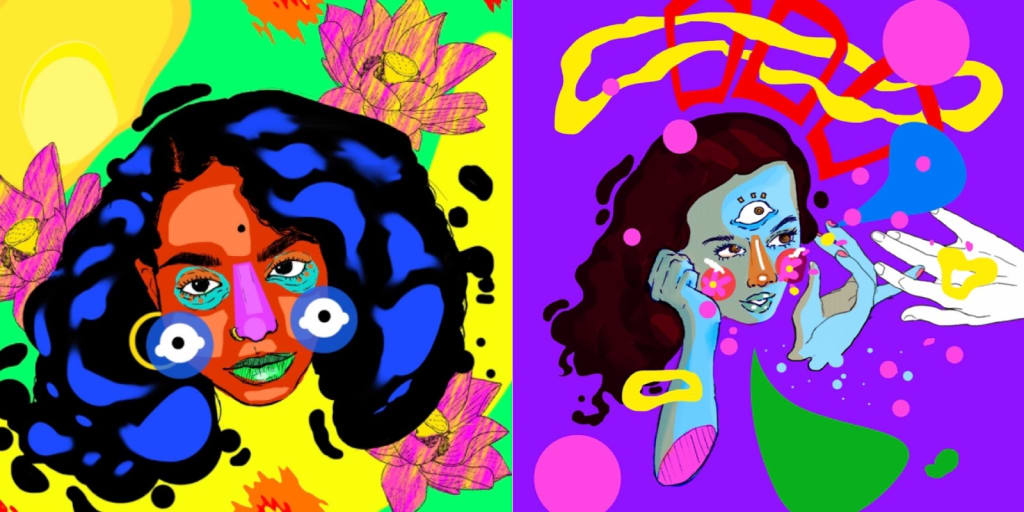
The Black Experience: Being Black in America presents different experiences for each person - though there is a collective method for many to emulate that experience through: art.
Western Washington University held a multitude of events last February in honor of Black History Month where many artists came to share their stories and provide guidance to students, one of which was creative director, Jordan Lyle.
Lyle could claim many titles: artist, designer, founder, creative director, and more. Based in Los Angeles, the Jamaican creator founded “For the Culture Club” a brand filled with a variety of goods to sell, all art from a Black perspective.
Pursuing Creativity
Creators like Lyle present an example for young Black creatives. Lyle said it’s something he thinks about a lot.
“Conversations are shifting right now, where the Black community is starting to see ourselves in ways that we hadn't envisioned ourselves in before. There might be some kid looking at me that's like, ‘Oh! I didn't even know that I could do this!’" Lyle said.
"That doesn’t mean it’s easy. When you hear a lot of noes, it can be discouraging,"
“You have to practice ‘persistent starting’ to adopt that mentality of continuing to begin the process,” continued Lyle.
Lyle trained in broadcast design and motion graphics but got his artistic start as a graphic designer, and eventually branched out from digital works on a screen to having a clothing collection.
“Building something that had a legacy for me was really important,” Lyle said. “I think ultimately, a huge factor in creating this brand was that you don't really see a lot of designers or Black creators in that way.”
Lyle emphasized the most important thing is the first step, and having the courage to take it.
“I think sometimes, as a student, your gut feeling is sometimes a feeling that you should go with,” he said. “It does propel you to invest in yourself in certain ways and believe in yourself when you feel like other people might not. That's something I'd probably tell myself: to just do it.”
Lyle said artists need to practice accepting help as much as they practice giving it to others.
“If you’re in a position of growth, we all are, seek out some mentors. And if you're in a position of knowledge, share that knowledge with people who can benefit from it,” he said.
The Colorful History Expressed Within Pieces
Katana Sol is a fourth-year industrial design major at Western whose art creates and works with illustrations and textiles — she explores personal questions and the layers of her experiences.
“I tend to illustrate my thoughts and emotions through the process as my work is really an opportunity to better reach a message to myself or to others to hear words of encouragement and see a representation of the self,” Sol said.
Sol’s abstract art brings a unique perspective through storytelling. She said she aims to share how art can also be therapeutic.
“I love to see Black artists take control over their pieces with voices spoken and colorful history expressed within pieces,” Sol said. “I also see art as therapy and think that within so much trauma and so many performative actions directed towards the community, that art is definitely a method of self-care and healing.”
Sol also thinks about legacy and how history is illuminated through her work.
“There are too many days where I feel like I lack a cultural connection,” Sol said. “I do not know about my family’s history or traditions, and sometimes feel in the dark in regards to what I should feel, with a feeling of emptiness or not knowing who I am.
“But I use design and art to reclaim ownership of what I want to be remembered as, and what I relate to through illustration, in order to move design forward with a new cultural narrative of my own,” Sol said.
The Power of Expression: Art is a Radical Act
Taking all of the years of trauma that the Black community has faced and putting it into art connects Sol and Sophie Meharenna.
Meharenna is a storyteller and strategist who works to find the beauty behind everything. Born and raised in Southern California, she sees the world as endless possibilities.
“Being an artist already in itself is a radical act, and [so is] being a Black artist, especially now in the pandemic era where social justice is a really big challenge,” Meharenna said.
Meharenna said there is a considerable need for art at this time because viewing art has a way to bring people together, uplift them, and focus the mind in the process.
“The arts are important for Black people because how else can we find a creative outlet to deal with the trauma we all experience? That's why I say it's a radical act. ... It’s a way for us also to document our history with honesty,” Meharenna said.
With the Black Lives Matter movement opening new conversations, art has become a method to present events and protests while also helping express the Black community’s voices.
“There’s a quote, ‘Art should comfort the disturbed and disturb the comfortable.’ I think that's key when it comes to Black art for a Black audience,” Meharenna said.
“The Black experience used to happen through a white gaze so often that now we’re taking the reins back by being the creators of our own identity and how that is portrayed. We can't control how we're perceived, but we can control what is put out there.”
About the Creator
dia ☁️
creative storyteller with a lust for life 🪷
Learning to Love My Blackness.
My parents never really taught me much about what it meant to be Black in the world, specifically what it meant to be Black in America; I grew up in a predominately white church, had (mostly) white friends, was continuously surrounded by white kids in school and overall just never really recognized my own Blackness as a kid.
By dia ☁️5 years ago in Confessions
Hind Rajab: A Child the World Heard Too Late
Cinema has always been a powerful medium for telling stories that history books often reduce to numbers. When a film chooses to focus on a single child caught in the machinery of war, it forces audiences to confront reality not as statistics, but as human loss. The movie inspired by the tragic story of Hind Rajab, a young Palestinian girl, does exactly that. It is not merely a film; it is a testimony, a memorial, and a question posed to the conscience of the world. Hind Rajab’s name became known globally after reports emerged of her final hours during the Gaza conflict. She was a child trapped in circumstances no child should ever experience. The film based on her story does not sensationalize her death, nor does it turn her suffering into spectacle. Instead, it approaches her story with restraint, dignity, and an unwavering focus on innocence lost amid violence. The Story at the Heart of the Film The movie centers on a young Palestinian girl who becomes separated from safety during intense military escalation. Through her eyes, viewers witness fear, confusion, and the fragile hope that someone, somewhere, will come to help. The film follows her final journey—both physical and emotional—using minimal dialogue and powerful visual storytelling. Rather than relying on graphic imagery, the filmmakers choose silence, pauses, and close-up shots to convey terror and vulnerability. This artistic choice makes the film even more haunting. The audience is left to sit with the child’s fear, her calls for help, and the unbearable waiting that defines her final moments. By focusing on Hind as an individual rather than a symbol, the film restores her humanity. She is not portrayed as a political tool, but as a daughter, a child with dreams, and a life that mattered. A Child as the Center of a Global Tragedy What makes this movie particularly impactful is its refusal to shift focus away from the civilian cost of war. The story does not revolve around soldiers, strategies, or power struggles. It revolves around a child who should have been worried about school, friends, and play—not survival. This narrative choice challenges the audience to rethink how conflicts are discussed in media and politics. Wars are often framed in terms of borders, ideologies, and victory. This film asks a different question: What is the price paid by those who have no role in choosing the war? By centering the story on Hind, the film exposes the imbalance of power and the devastating consequences faced by the most vulnerable. Artistic Direction and Emotional Weight The film’s direction is deliberately restrained. There is no dramatic background score overpowering the scenes. Instead, ambient sounds—distant explosions, static-filled phone calls, the quiet breathing of a frightened child—carry the emotional weight. This realism makes the film deeply unsettling. The young actress portraying Hind delivers a performance that is heartbreakingly authentic. Her expressions alone communicate fear, confusion, and bravery far beyond her years. The filmmakers avoid overacting or melodrama, allowing the story’s truth to speak for itself. Cinematography plays a crucial role as well. Tight frames and limited perspectives reinforce the feeling of entrapment, while long, unbroken shots force viewers to experience time as Hind did—slow, uncertain, and terrifying. A Political Film Without Political Speeches One of the film’s greatest strengths is that it does not rely on speeches or overt political messaging. Its power lies in its simplicity. By telling one child’s story honestly, it exposes the broader reality of civilian suffering in conflict zones. The film does not tell audiences what to think. Instead, it asks them to feel—and that is far more powerful. Viewers are left to grapple with difficult questions about responsibility, accountability, and the value of human life. This approach has made the movie resonate across cultures and ideologies. Even those unfamiliar with the details of the Palestinian struggle can connect with the universal themes of childhood, fear, and loss. Reception and Global Impact Since its release, the film has sparked intense discussion on social media, in film circles, and among human rights advocates. Many viewers describe it as one of the most emotionally challenging films they have ever watched. Critics have praised its ethical storytelling and refusal to exploit tragedy. For many, the movie serves as an entry point into understanding the human cost of the Gaza conflict. It has been screened at independent film festivals and community events, often followed by discussions about civilian protection and children in war zones. Most importantly, the film ensures that Hind Rajab’s name is not forgotten. In a world where news cycles move quickly, cinema has given her story permanence. Why This Film Matters This movie matters because it stands against normalization of suffering. It reminds us that behind every headline about war are real people, real families, and real children whose lives are forever altered—or ended. By immortalizing Hind Rajab’s story, the film becomes an act of resistance against silence. It insists that her life had meaning and that her death deserves acknowledgment, reflection, and accountability. In the end, this is not just a film about one Palestinian girl. It is a film about every child trapped in conflict, every unanswered call for help, and every moment when humanity fails its youngest members. Cinema cannot undo tragedy, but it can refuse to let it be ignored. And in doing so, this film ensures that Hind Rajab’s story continues to speak—long after the screen fades to black.
By Hasbanullah6 days ago in Humans


Comments (1)
!! UPDATE: Link change to Katana's Site !! https://www.designkatana.com/