
The Cartographer of Silence
Every stillness has its own geography

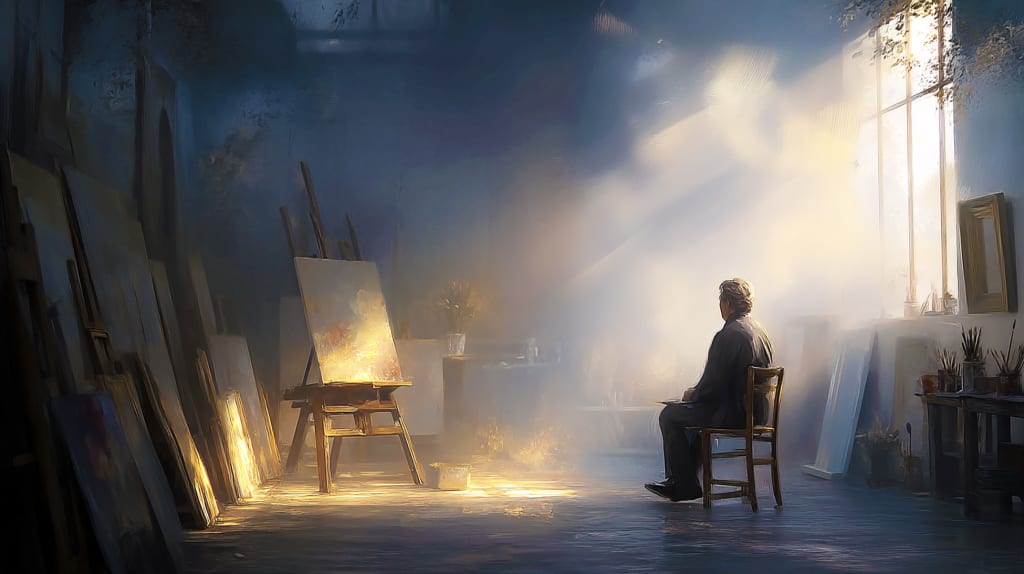
At first, silence wasn’t peace. It was a mirror held too close.
I came to it the way one comes to an unexpected border — without a plan, without a guide, certain that the map I’d been using no longer applied.
The house had grown quiet after a long season of motion. Paintings stood half-finished in their corners, brushes suspended in jars of cloudy turpentine. Even the air felt heavy, like a room waiting to be named. I told myself I was resting, but what I felt wasn’t rest. It was the uneasy stillness that follows when the music stops and you realize you never learned to dance without it.
I tried to fill the quiet at first — with music, conversation, small errands that meant nothing. But silence is patient. It waits for you to stop pretending you don’t hear it.
One morning, I sat at my worktable, hands folded, unable to begin. The light fell across the room in long, deliberate strokes. Outside, a single dove cooed and fell silent. I realized that everything around me was holding its breath — not to punish, but to listen.
That was the moment silence became visible.
________________________________________
The Sound Before Stillness
There’s a kind of quiet that feels like pressure — the air too thick with what hasn’t been said. But there’s another kind that arrives like weather: slow, insistent, elemental. It doesn’t demand; it reveals.
I began to notice its contours in daily life — the seconds between a question and an answer, the hush after laughter fades, the moment when a painting feels almost finished but asks for one more look before you sign your name.
Silence, I learned, is never uniform. It has weight and depth, shadow and light. It bends differently depending on what you bring into it.
The silence after joy is wide and golden. The silence after loss is dense and blue. The silence of concentration hums; the silence of doubt folds in on itself.
I started to think of it as a landscape.
Each morning I entered my studio like a traveler crossing into unknown territory. The familiar objects — brushes, paints, sketches pinned to the wall — became landmarks. But the real terrain was invisible. My thoughts were the wind, my emotions the shifting ground.
I found myself drawing small maps in my sketchbook, not of places but of feelings — arcs, lines, and points marking where the day had turned or softened. Sometimes they resembled coastlines. Sometimes weather patterns. Always movement within stillness.
It occurred to me that every life deserves such a map, even if no one else can read it.
________________________________________
Learning the Terrain
Silence taught me patience first. It refused to explain itself.
Days passed where I felt like a diver suspended just below the surface — light above, darkness below, time moving slower than my heartbeat. I couldn’t rush it; any struggle only stirred sediment. So I waited.
In time, textures emerged. I began to hear the faint hum of the refrigerator, the slow drip from a brush left in rinse water, the subtle rhythm of my breathing. The more I listened, the richer the quiet became.
It reminded me of painting with glazes: each transparent layer deepening the color beneath. Silence was like that — cumulative.
I discovered that silence isn’t empty; it’s full of beginnings. You just have to stop trying to name them.
One afternoon, Adi stepped into my studio. She didn’t speak, just looked around at the unfinished canvases. Then she smiled, nodded once, and left. The soft closing of the door said more than words could. In that instant, I realized she understood the map I was making — though she’d never seen it. She lives by touch, not sound, shaping clay with her hands, listening through her fingertips.
Later that day, I watched her in her own studio through the open doorway. Her movements were slow, deliberate. Each turn of the wheel seemed to echo my breath. Two artists, two kinds of silence, tracing the same invisible coordinates.
That’s when I began to chart its geography.
There were valleys of grief, where memory pooled and refused to dry. There were ridges of patience, steep but solid underfoot. Plateaus of surrender, where I could finally rest without needing to know what came next.
The most treacherous terrain was the plain of self-doubt — vast, flat, and without horizon. You could walk there for days and mistake motion for progress.
But beyond that, always, lay the forest of renewal — where birds began to sing again and ideas moved like wind through leaves.
Each part of the map belonged to silence, yet each taught me how to move through sound again.
________________________________________
The Compass Within
One evening, I returned to a canvas I’d avoided for months. It showed nothing dramatic—just a chair by a window, light spilling over its arm. I’d painted it in grief and abandoned it halfway.
When I stood before it now, the silence felt different—less like exile, more like invitation. I took up a small brush and began to work, not correcting, just continuing. The moment the bristles touched the surface, I heard my own breathing as if for the first time.
That was when I realized: silence doesn’t erase the world; it refines it.
For so long, I’d thought creativity came from noise—music in the background, conversation, the pulse of doing. But what silence showed me was this: every act of creation begins in listening. To paint is to hear what color wants to become. To write is to hear what thought sounds like before it finds words.
Each day, I felt silence shifting its compass points inside me. Sometimes it pointed toward memory, sometimes toward the unknown. But always, it directed me inward first.
In quiet moments I remembered people who had shaped me — teachers, friends, loved ones who had moved on. I realized how often their greatest gifts had come not from what they said, but from what they left unsaid.
Even grief began to change shape. It wasn’t a wound anymore, but a river running through the map — one that still nourished the ground it cut through.
When I listened deeply enough, silence spoke in gestures. The light falling across Adi’s clay figures. The desert wind carrying the scent of rain. The sudden stillness before a storm. Each one a coordinate, a reminder: You’re here. Keep walking.
________________________________________
The Map of Return
Eventually, I stopped drawing the maps in my sketchbook. I no longer needed the lines. The geography had settled into me.
I knew where the valleys were, where to find water, where the ridges offered a view. I learned to recognize the texture of each kind of quiet and what it asked of me. Some silences said wait. Others whispered let go. A few said nothing at all, trusting I’d learned enough to understand.
One morning, the silence changed again. It grew thin, almost transparent, as if waiting for something to pass through. I realized I was ready to make sound again.
The first brushstroke I laid that day wasn’t on canvas but in the air — a long exhale I hadn’t realized I was holding.
Paint followed. Words followed. Even laughter returned, tentative at first, then sure. The world began to hum with detail again, but now I could hear the quiet beneath it — the steady ground that had carried me all along.
I think of silence now the way I once thought of maps. Not as a boundary but as an invitation. A way of seeing how everything connects — the noise, the pause, the spaces between.
Sometimes I still get lost. I forget the path and wander into old territories of hurry and distraction. But I carry the compass now, the one silence left behind.
It’s simple: stop, breathe, listen.
The landscape always reveals itself when you’re still enough to notice.
This morning, I stood in my studio before dawn. The desert light was pale and soft, the hour before color decides what it will become. From Adi’s side of the house came the faint sound of her wheel turning, steady and sure. I listened, smiling.
The world was awake again, yet still held in quiet.
I looked at the canvas before me—just a wash of light so far—and dipped the brush in color.
The sound of that small stroke on canvas was the perfect echo of everything I’d learned.
________________________________________
I used to fear stillness as the edge of the map.
Now I know it’s the terrain that holds everything else in place.
________________________________________
About the Creator
Rick Allen
Rick Allen reinvented himself not once, but twice. His work explores stillness, transformation, and the quiet beauty found in paying close attention.
Keep reading
More stories from Rick Allen and writers in Humans and other communities.
Mapping the Distance Between Two Souls
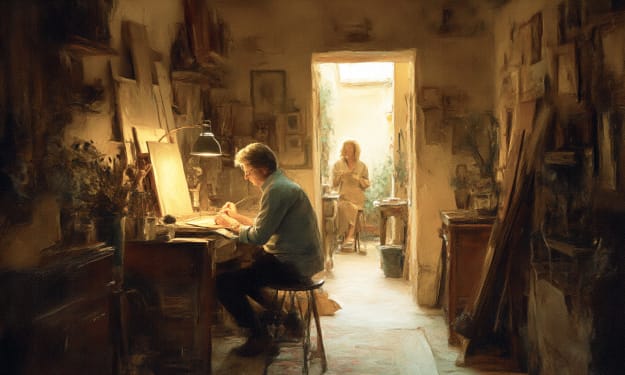
We share a roof, but our hours are oceans apart. I write and paint early; she works in the afternoon and evening. The rhythm of our lives passes like tides—each returning when the other withdraws, leaving small traces of what we’ve made. Clay dust gathers on her side of the house, and the scent of turpentine hangs on mine. Somewhere between the two, in the space neither of us owns, something quietly grows.
By Rick Allen3 months ago in Humans


Comments
There are no comments for this story
Be the first to respond and start the conversation.