
Mapping the Distance Between Two Souls
Love isn't a line we cross, it's the space we learn to honor.

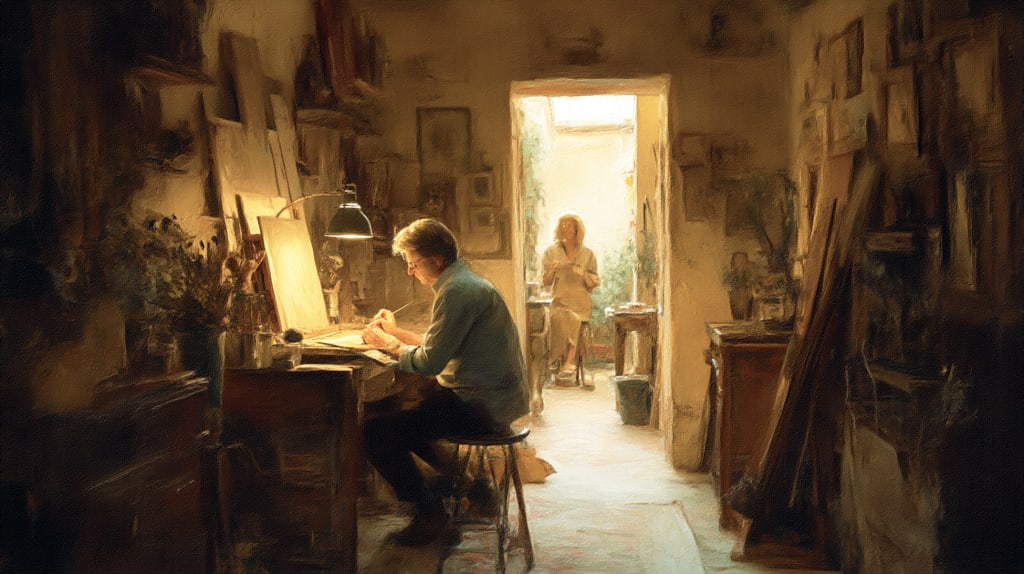
We share a roof, but our hours are oceans apart.
I write and paint early; she works in the afternoon and evening. The rhythm of our lives passes like tides—each returning when the other withdraws, leaving small traces of what we’ve made. Clay dust gathers on her side of the house, and the scent of turpentine hangs on mine. Somewhere between the two, in the space neither of us owns, something quietly grows.
Our home holds two studios divided by a narrow hallway. Hers hums with movement, mine with stillness. I can always tell what she’s shaping by the sound. Clay makes a soft, wet breath against her palms when it’s new; later, it resists her touch, turning stubborn, like time itself. My work moves in slower intervals—the pause before a brushstroke, the thin glaze of patience that paint requires to speak.
Sometimes I stop what I’m doing and listen for her. The tapping of her tools. The low tune she hums when she’s finding form. Every note she coaxes from the clay tells me where she is on her invisible map—how near she’s come to the place she meant to reach. I’ve learned not to interrupt. It’s her way of listening to what the world keeps hidden.
At first, I mistook our separate hours for distance. I thought sharing a life meant constant nearness: two points meeting in the middle. But love, like art, has its own geometry. It isn’t measured in inches or steps but in the honesty of space—what we allow each other to keep untouched.
________________________________________
The First Meridian
When we met, I thought I recognized her immediately. She carried the calm of someone already certain of her medium. I’d spent years studying faces, searching for what the eyes withheld. She, meanwhile, looked at the curve of a wrist or the hollow of a shoulder and saw a story already complete. Where I added layers, she stripped them away.
Our early days were full of small collisions—my love of planning, her faith in impulse. I wanted to show her the quiet joy of refining a line until it breathed. She wanted me to feel the courage of breaking form to find a truer one. We were, I suppose, two maps folded differently: the same terrain, different scales.
Her studio smelled of earth and rainwater. Mine of oil and old rags. When I watched her work, I noticed how quickly she moved—her fingers finding the pulse beneath the clay’s skin, shaping before she could name the form. It unnerved me at first. My process was slower, deliberate, a conversation of layers. She called me “the patient one.” I called her “the wind.”
There was a time I tried to sculpt beside her. I thought sharing a medium would draw us closer. But the clay refused me. It mocked my precision. My hands, trained for paint, wanted to control, not listen. I ruined more pieces than I made. When I finally gave up, she simply smiled and said, “You don’t have to shape what already sees you.”
It took me years to understand that she meant the love between us—the thing neither of us needed to mold into likeness.
________________________________________
The Middle Distance
We built a rhythm from that difference.
Each morning, we pass like quiet travelers—she carrying coffee to her studio, I returning from mine. We nod, exchange a word or two, but rarely linger. Affection lives not in interruption, but in recognition: a glance, a hand brushing a shoulder, a shared smile that says, I see where you are, and I’ll meet you when you return.
Silence became our language. She fills hers with movement; I fill mine with stillness. It isn’t an emptiness but a shared medium—like clay and pigment, both waiting to receive form.
Of course, there are moments of friction. I’ve ruined a painting trying to make it perfect; she’s lost a sculpture to dryness. We meet in our small defeats, sitting side by side with tea, speaking little. The ache of art is something only another maker understands. Our love learned to breathe through that ache—to let frustration exist without demanding it be fixed.
Sometimes, late at night, I wander into her studio when she’s asleep. I look at the shapes rising from her worktable—half-formed torsos, faces emerging from shadow. Each figure seems caught between worlds: human and spirit, presence and gesture. They remind me of what I’ve always painted for—the brief moment when someone’s truth shows through, unguarded.
In the morning, she’ll step into my studio and do the same. She stands before my portraits, hands tucked in her apron, and studies them without comment. I never ask what she sees. Her silence is never withholding—it’s reverent. She looks as if she’s waiting for my work to speak first.
Over the years, I’ve realized that our love exists in this rhythm of observation. We are each other’s mirror, but from a distance wide enough to see the whole reflection.
Once, during an argument, I told her she was too self-contained, that she lived in her own world. She replied, “I just know the borders of mine.” I didn’t understand then how wise that was. I do now. Every lasting love depends on the ability to remain oneself inside it.
________________________________________
The Emotional Geography
Every long companionship develops its own landscape. Ours stretches across seasons of creative weather: days when inspiration floods the house, and others when silence sits like fog.
We’ve learned its contours—the ridges of solitude, the valleys of laughter, the plateaus of understanding that arrive without words. In time, even our disagreements have taken on a familiar geography. They don’t break us; they remind us that distance, too, has a purpose.
If I could map this life we’ve made, I’d start with a compass built of simple things: her humming through the thin wall, the light under her door at twilight, the small clay thumbprint she left once on my coffee cup. These are my coordinates—the proof that love doesn’t need to declare itself to exist.
Her sculptures have grown rougher over the years, more abstract, less concerned with likeness. My paintings, paradoxically, have grown simpler too. I chase light now, not detail. Perhaps we’re learning the same lesson from opposite directions: that form is never the goal. Presence is.
We often exchange pieces without ceremony. She’ll place one of her small clay figures on my table; I’ll hang a portrait near her table. It isn’t gift-giving—it’s dialogue. Each piece we trade becomes a marker on the map of our shared life, a way of saying, I see where you’ve been, and I’m glad you returned.
________________________________________
The Shared Horizon
This evening, the air between our studios feels softer than usual. She’s still working; I can hear the sound of clay being trimmed—a delicate scrape that reminds me of rain easing off a roof. In my studio, I’m cleaning brushes, letting the last of the turpentine evaporate. The walls are full of light, the kind that holds everything without deciding its color.
Sometimes I imagine the two of us as travelers on the same vast plain. She charts by texture; I chart by tone. Between us lies the invisible line of faith—the belief that we are walking toward the same horizon, even when we can’t see each other.
There are days we meet in the middle, usually without planning. She’ll wander in with a cup of tea, or I’ll drift into her space just as she’s finishing a piece. We talk then—not about art, not even about us—but about ordinary things: groceries, errands, a bird that nested near the porch. Those conversations feel like cairns, small stacks of stone marking the path home.
When we do share our work publicly, we never stand side by side. I watch her from across the room, the way I did that first day, still learning her outlines. She does the same for me. It’s an act of quiet respect—to see the other as whole, not as extension.
I used to think maps were made to show direction. Now I believe they show devotion: the willingness to chart what can’t be claimed. The space between two souls isn’t a void. It’s the terrain where love learns to listen.
Tonight, after she’s gone to bed, I’ll walk through the house and stop at the midpoint between our studios—the narrow hallway that has carried our shared footsteps for years. There’s nothing remarkable about it: just a stretch of worn floorboards, faintly scented with clay and linseed oil. But to me, it’s sacred ground—the latitude where our lives cross and keep going.
If I’ve learned anything from these years beside her, it’s this: love doesn’t erase the map. It refines it. The longer we walk it together, the more I see that the distance between us isn’t something to close—it’s something to honor.
We’ve never needed to find each other on the map. The map itself is us: the distance, the nearness, the quiet terrain of creation and care—the uncharted places where one heart leaves room for the other to breathe.
________________________________________
About the Creator
Rick Allen
Rick Allen reinvented himself not once, but twice. His work explores stillness, transformation, and the quiet beauty found in paying close attention.
Keep reading
More stories from Rick Allen and writers in Humans and other communities.
10 Reasons Not to Sleep With Him If You Want Real Love
Real love is built with intention, clarity, and emotional safety. Physical intimacy holds power. When it occurs too quickly or for the wrong reasons, it can cloud judgment and silently obstruct the future you desire. On the Bloom Boldly platform, we speak with women who value self-respect, depth, and long-term connection. Here are ten reasons not to sleep with him if your goal is genuine love, not confusion or regret.
By Bloom Boldly2 days ago in Humans


Comments
There are no comments for this story
Be the first to respond and start the conversation.