
The Butcher’s Blessing
When a poor butcher loses hope before Eid al-Adha, a woman’s wisdom restores faith, compassion, and community spirit.

The Butcher’s Blessing
(by Shah Behram Ansari — English adaptation)
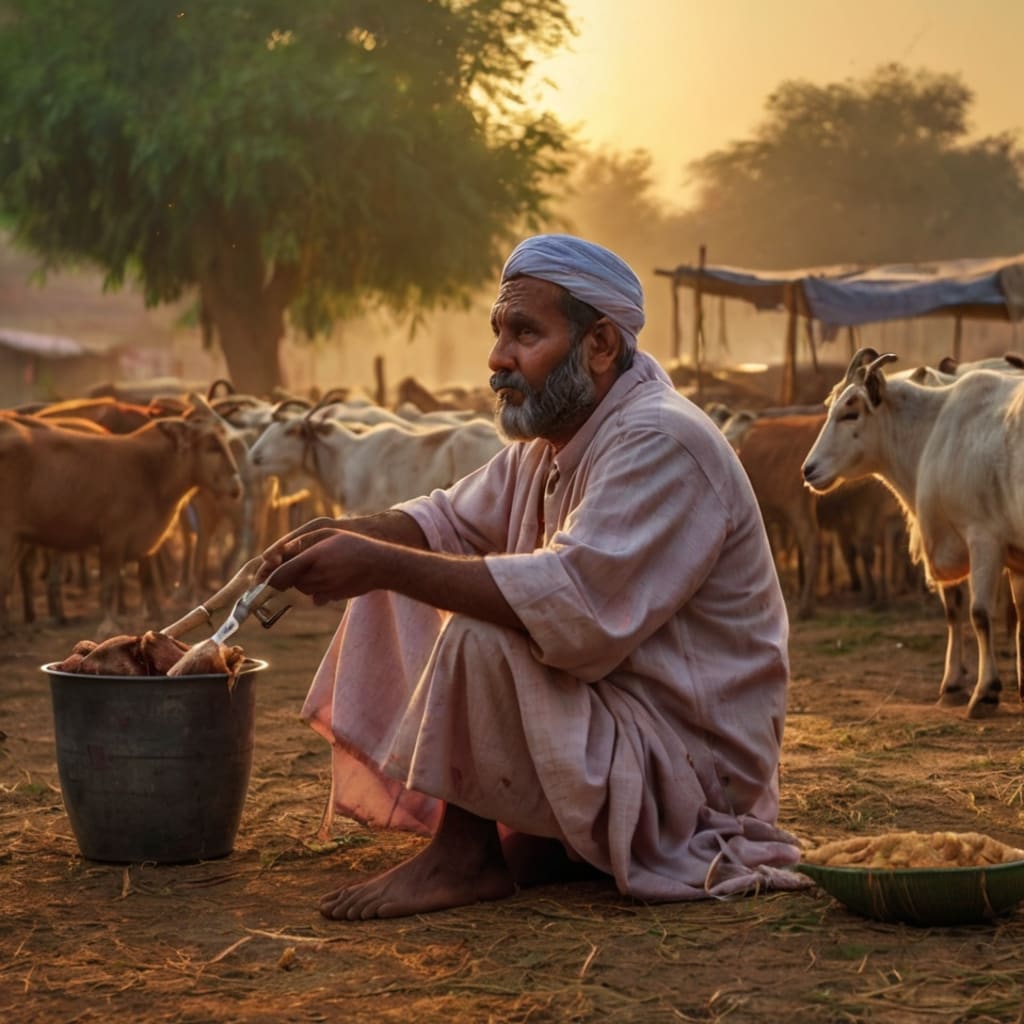
Eid al-Adha was just around the corner, and Butcher Mian sat on his old charpai, head bowed, lost in anxious thoughts. The festive season usually brought him endless work, but this year was different — not a single order had come in yet. His heart sank as he imagined his home without food, his children hungry while others rejoiced in the spirit of sacrifice.
His real name was Akram. Years ago, as a boy of barely thirteen, he had fled across the border with countless refugees when their homes were torn apart by violence during Partition. His parents didn’t survive the journey, but Akram, through sheer luck and divine mercy, found shelter in a refugee camp on the outskirts of Lahore.
There, fate introduced him to an elderly couple from a nearby town — a kind old man named Miraj Din and his gentle wife. They had no children of their own and saw in Akram the son they had always prayed for. They asked him lovingly if he would come live with them, and the orphaned boy, moved by their warmth, agreed without hesitation.
Their home was humble — just a single room with a small courtyard — but it was filled with peace, the kind of peace Akram had never known. The elderly couple treated him like their own flesh and blood. The old woman would wake him at dawn, make him hot makai ki roti and mustard greens, oil his hair, and line his eyes with surma. Miraj Din would walk him to the local teacher every morning, determined that the boy should study.
But Akram had no heart for books. His memories of loss weighed heavy, and soon Miraj Din decided to teach him the family trade — butchery. It was honest work, and in time Akram learned not only the art of slaughtering but also the deeper rhythm of animal life. He could sense a creature’s fear and calm it with a few gentle words.
Years passed. The old woman died first, leaving Akram broken with grief. Later, Miraj Din too departed this world, blessing his adopted son with his last breath. By then, Akram had grown into a skilled butcher — known across the town as Kasai Mian, or Butcher Mian. He married, had children, and carried forward his adoptive father’s trade with devotion and dignity.
Every Eid al-Adha, his shop buzzed with customers. People trusted his sharp knives and gentle heart. He was the kind of man who whispered prayers before every sacrifice, believing that kindness made the offering more blessed.
But this year was strange. The marketplace was empty, and the town’s usual excitement was missing. Livestock was scarce, and prices had doubled overnight. The reason was no secret — the town’s only animal trader, Rehan Butt, had monopolized the market, inflating prices beyond the reach of common people.
Even those who had saved all year to buy a goat or a cow now stood helpless, watching their dreams of sacrifice fade.
Butcher Mian, worried for the town’s faithful, decided to speak with Rehan’s wife. She was a patient and wise woman, known for her gentle heart. He explained his plight — that without affordable animals, there would be no joy, no sacrifice, no work for him or his apprentices.
That evening, Rehan’s wife sat beside her husband and spoke softly but firmly:
> “Rehan, please listen. By raising prices, you’re stealing joy from people who already live with so little. Eid al-Adha isn’t about profit — it’s about sacrifice, about giving for the sake of Allah. If people can’t afford an animal, what kind of Eid will that be? You have a chance to earn real reward — not money, but blessings. Lower the prices, and you’ll find peace in your heart.”
Rehan, a proud man, said nothing at first. Her words echoed through the night, chipping away at the greed that had blinded him. By morning, something within him had changed.
When he reached the marketplace, the townsfolk were shocked to hear his announcement:
> “From this moment, every animal will be sold at cost. No profit, no bargaining. This Eid, we celebrate together.”
The crowd erupted with joy. People rushed to buy goats, cows, and camels — their faces glowing with gratitude. News spread like fire, and before sunset, every animal in Rehan’s pen was gone.
Eid morning arrived in all its glory. Streets echoed with laughter and takbir. Butcher Mian was busier than ever — his courtyard filled with men waiting their turn, goats and cows tied in neat rows. One by one, he performed each sacrifice with care, whispering prayers as the knife met flesh, his hands steady, his heart full.
By afternoon, only two animals remained — his own goat and Rehan Butt’s. Side by side, they took them to the open field. The two men exchanged a silent smile — one born of redemption, the other of gratitude.
As the sun dipped low, Butcher Mian washed his hands and looked toward the sky. For the first time in many days, his heart felt light. The same boy who had once crossed borders alone now stood surrounded by faith, family, and community — proof that even in hardship, kindness always finds its way home.
That Eid, the people of the town didn’t just celebrate sacrifice — they celebrated the spirit of humanity that binds one heart to another.
And Butcher Mian? He finally understood that his work had never just been about slaughter — it was about mercy, about keeping alive the compassion that makes every sacrifice sacred.
About the Creator
Bomb Scare
It was 2027, and the world never thought it would happen. A missle hit the United States, but it wasn't where they had anticipated. A little town in the northeast was hit by a missile strike, they didn't know why, and they didn't know exactly where it hit, but they did know it was a coastal community, somewhere between Maine and Delaware.
By Gregory Paytona day ago in Fiction




Comments
There are no comments for this story
Be the first to respond and start the conversation.