
The Brain's Hidden Orchestra: How Music Rewires Our Minds
Explore the fascinating science behind how music shapes our brains, rewires our minds, and connects us to memories, emotions, and the human experience.

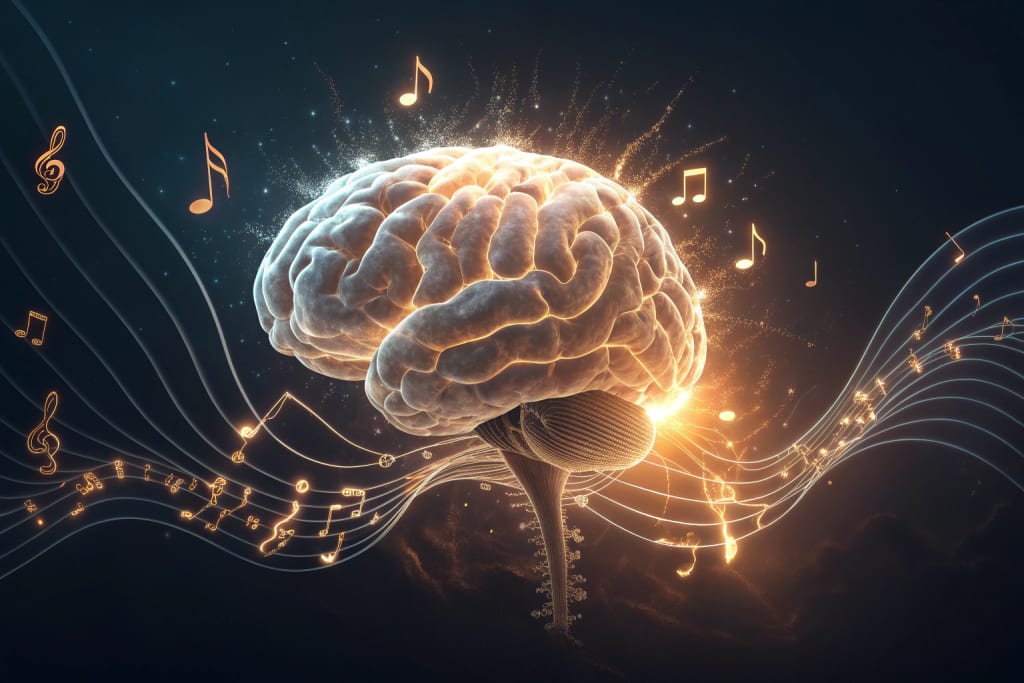
Introduction: When Sound Becomes Memory
A melody floats by—a song that you know—and suddenly, you're not here. You're back in your bedroom, singing along to the radio. Or on your wedding day, dancing to the dance floor. Or alone in a moment of need, comforted by a song that once helped you survive heartbreak. Music has an odd ability to transport us across time and space, combining fragments of our lives with invisible threads of rhythm and melody.
How does it do this? Unlike most sounds, music does not simply pass through our ears; it rearranges us. Music activates nearly all regions of the brain, integrating with memory, emotion, movement, and even decision-making. Music doesn't simply reflect human experience—music rewires it. Neuroscience is only beginning to map this quiet orchestra in the brain, but already what it has found is this: music is not a luxury or entertainment. It is part of being human.
The Neuroscience of Rhythm and Melody
Music might be described as organized sound, but to the brain, it's more than that—it's a sensory workout. As we listen to music, vibrations travel through the ear and are translated into neural impulses that light up the auditory cortex. But there's more. Rhythm recruits the motor system, getting us ready to tap our feet or rock back and forth. Melody recruits emotional centers like the amygdala. Harmony recruits the prefrontal cortex, where anticipation and pattern recognition exist.
Rhythm, however, appears to be particularly attuned to our internal clocks. Entrainment, a phenomenon where our brains anticipate beats before they are actually heard, is how our brains prepare us for rhythm. This is why we can sync up with a drumline or know when a drop is coming in a song. Melody, on the other hand, toys with expectation and resolution. When a note resolves as we expect, our brain releases dopamine—a neurotransmitter associated with reward and pleasure. When it subverts our expectation, tension builds, increasing the emotional response.
In essence, music gives the brain puzzle pieces of anticipation and fulfillment. Each chord pattern or rhythmic sequence is a conversation between anticipation and surprise, and our neurons respond by firing sequences that echo with the music itself.

Music, Memory, and Learning
Nothing reminds us of memory quite like music. Neuroscientist Daniel Levitin once explained how the brain remembers songs as "super-memories"—cooking together lyrics, melody, and emotional context and serving it up in a package to keep for decades. That's why an individual with Alzheimer's disease may lose the names of their children but remember singing along to songs as a youth.
The hippocampus, responsible for memory, is intensely activated by familiar melodies. So, too, though, are emotional pathways, charging musical memories with a depth that may not be present in everyday memories. Music not just remembers but hardwires memories. Students who reduce facts to song recall them more effectively. Language learners who sing words learn them faster. Even infants exposed to lullabies forge early memory pathways that guide linguistic development.
In schools, educators are rediscovering music as a way of implanting knowledge. In the lab, scientists are studying how melody might enhance memory rehabilitation for patients with brain damage. The science shows that music is not just riding along with memory—building it.
Music as Therapy: Healing Through Sound
Music's ability to activate emotion and memory has turned it into a valuable therapeutic tool. Music therapy is used in hospitals, mental health clinics, and rehabilitation centers worldwide. In Parkinson patients, rhythmic cues regain motor coordination and support enhanced locomotion. For trauma patients, music is a secure vehicle for reaching emotions too intense to access verbally.
Music reawakened patients who seemed lost to neurological loss, Oliver Sacks famously reported. Stroke patients, unable to utter a word, learned to talk again through song. Individuals with dementia regained fragments of self when music unlocked memories far back.
The mechanisms remain under investigation, but the result is not controversial. Music decreases cortisol, the stress hormone, and increases oxytocin, the "love hormone." It can calm anxiety, reduce depression, and lower blood pressure. Group singing even synchronizes heartbeats among participants, creating a shared physiological rhythm of the unity of emotions.
To many therapists, the magic of music is that it is universal. Where words will let them down, rhythm and melody pick up the pieces across minds.
Cultural Differences: One Brain, Many Music Worlds
Although the human brain seems to be born with music, culture determines how we perceive it. Western classical music favors harmony and development; Indian ragas hang out in microtones and improvisation; African drumming is all about polyrhythm and group participation. Every tradition shapes the neural pathways of its participants differently.
Research indicates that cultural context influences how the brain perceives scales and rhythms. A Western musician is likely to perceive dissonance in intervals that a Balinese gamelan player finds natural. Rhythms intuitive to sub-Saharan Africa are confusing to Western-trained musicians. This illustrates that even though the brain is biologically predisposed to find music meaningful, what that meaning is is based on cultural coding.
Ethnomusicologists argue that this variability shows music's adaptive function. It brings people together, houses history, and shares common values. To understand a culture's music is to understand how its constituents think and feel.

Evolutionary Origins: Why People Needed Music
Why did humans invent music in the first place? Unlike vision or language, there's no apparent survival function for music—yet it appears in every culture in world history. Evolutionary psychologists propose a few different theories.
One explanation is that music evolved as social bonding. Early humans may have used communal drumming and singing as a method for coordinating hunts, conveying oral tradition, or cementing group identity. Rhythm's timing promotes cooperation, trust, and empathy—qualities required for survival.
A second argument suggests that music evolved as a form of sexual selection. Similar to birds' use of song in finding a mate, humans may have utilized musical ability as a display of fitness, intelligence, and emotional sensitivity.
There is also evidence that lullabies, one of the earliest forms of music, enabled the formation of a vital mother-child connection. The soft rhythm of a parent's voice synchronizes the heartbeat of an infant and calms alarm, ensuring survival in the earliest years.
Whatever their origin in social, reproductive, or caregiving needs, music was forever engraved on the human brain as a singularly powerful means of relating.
Technology and the New Frontiers of Sound
Today, technology is not only transforming the way we listen to music but also the way we make and perceive it. Artificial intelligence can today compose symphonies as per Bach or write pop songs that adapt according to the mood of a listener. Some critics fear that it diminishes human creativity, while others see it as an expansion of musical possibilities.
Brain-computer interfaces are even more revolutionary. Paralyzed patients are given the ability to create music by dreaming up sounds, their brainwaves converted into digital soundpieces. Virtual reality and immersive audio platforms are extending music past the ear, immersing listeners in multi-sensory spaces.
Meanwhile, neuroscience is beginning to map out how personalized soundscapes—created to address particular brain activity—might heal diseases, enhance focus, or even raise learning. Imagine playlists calibrated not just for taste but for neurological function.
With music ever more influenced by machines, the questions arise: Is a song still "human" if no human wrote it? Does the emotional force of music reside in the hand that created it, or the brain that hears it?
Expert Voices: The Science of Sound
Neuroscientist Aniruddh Patel adds, "Music engages the brain more globally than almost any other stimulus. It recruits language circuits, motor planning, emotional processing, and memory. That's why its effects are so profound."
Music therapist Barbara Wheeler adds its humanistic potential: "Music reaches where medicine cannot. It comforts the dying, empowers the disabled, and gives voice to the voiceless."
Ethnomusicologist Steven Feld remembers that music is more than biology: "Every culture invents its own sound world. Music is not only about how the brain processes sound—it's about how societies imagine meaning."
Together, these notes reveal music as both universal and particular, biological and cultural, scientific and intensely personal.

Conclusion: The Universal Language of the Future
Is music the most universal of human languages? It doesn't require translation like spoken languages need. A drumbeat unites strangers, a melody brings tears to people's eyes no matter what culture they're from, a song lasts across generations. The brain's secret orchestra performs within us all, tuned by life experience, culture, and evolution.
The deeper technology probes, the more potentially powerful music might become—powerful for healing, for learning, for bringing people together. But its mystery persists. A song is never just notes; it is memory, movement, and meaning entwined. It is the mind seeing itself in sound.
And perhaps that is the reason why music will never lose its meaning. Far, far beyond words die out, melodies linger. They remind us it is not just to think or live human, but to feel attuned with the rest of mankind. In the symphony of existence, music is score and leader—remolding our brains, connecting our hearts, and pushing us into futures yet untried.
About the Creator
The Chaos Cabinet
A collection of fragments—stories, essays, and ideas stitched together like constellations. A little of everything, for the curious mind.
Keep reading
More stories from The Chaos Cabinet and writers in Humans and other communities.
Biohacking Humanity: The Promise and Ethics of DIY Biology
In the dark basement, shelves of glass beakers, pipettes, and agar plates cover the walls. A humming centrifuge occupies a corner, and fluorescent lights cast a soft glow over the cluttered workstation. On the center bench, a cluster of hobbyists carefully manipulates bacterial cultures, sometimes looking up at a laptop screen where sequences of DNA roll by. They are not in a university or corporate biotech lab. This is a home lab, a living room turned experiment microcosm. This is the world of biohacking—the new phenomenon of individuals immersing themselves in biology, genetics, and biotechnology outside of traditional institutions.
By The Chaos Cabinetabout a month ago in Humans
A Winter Devotional. Winner in The Ritual of Winter Challenge.
Large, fluffy white flakes swirl slowly to the ground in a gentle, choreographed waltz. Safe and warm inside my house, wrapped in a cozy blanket on the velvet couch, I watch in silence through the huge front window as everything becomes white. The world, time itself, lessens its pace to match the cadence of the first true snowfall.
By A. J. Schoenfeld27 days ago in Humans
Rob Reiner and the Stories That Shaped His Remarkable Career
Some names carry a weight that reaches beyond their immediate work. Rob Reiner is one of those names. Over decades, he has touched audiences through films that made people laugh, cry, and reflect on life. His influence is felt not only in entertainment but in the quiet ways stories shape culture. Behind the familiar name lies a journey of persistence, creativity, and personal struggle. From early exposure in a famous family to his own achievements, Rob Reiner’s story is about more than just movies. It is about how passion and vision can leave a lasting mark. This article explores his life, career, and the impact of his work, capturing the human side behind the films and the man himself.
By Muqadas khan4 days ago in Humans


Comments
There are no comments for this story
Be the first to respond and start the conversation.