
The Beauty of Humans
The Soul of Humanity, Where Flaws Bloom and Kindness Glows

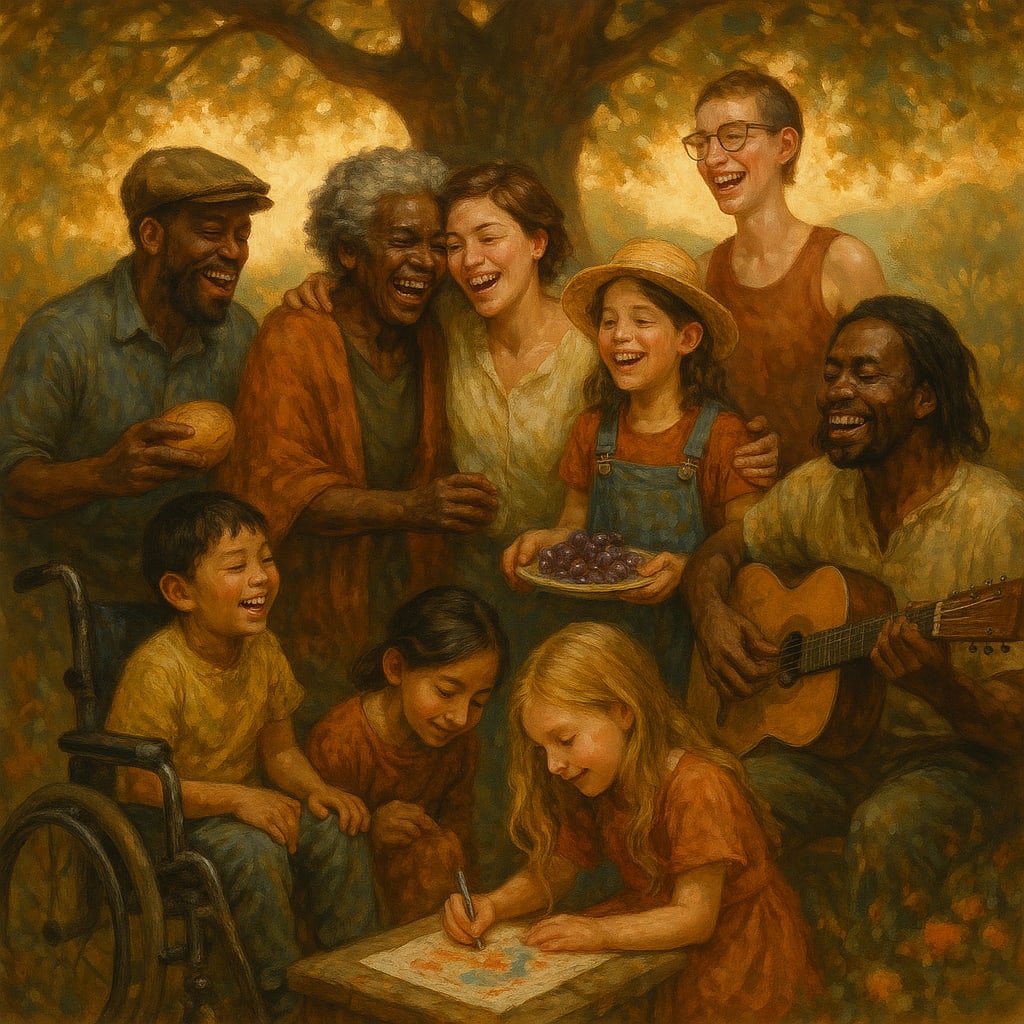
1)
There was once a man who sat beneath the banyan tree, where the roots coiled like ancient fingers into the soil and the leaves murmured truths in the language of the wind. He was neither old nor young, neither black nor white nor in between. He was simply a man—human. And he was thinking. About beauty.
I don’t know why, but that made me tear up.
He had wandered far across lands that seared the feet and others that chilled the bones. He had seen the almond-skinned girl who painted with her eyes, the coal-dark child whose laughter turned war into windchimes, and the pale boy who sang with a voice that made the sun blush behind the clouds. And yet, he noticed, the world still argued over shades, over lines drawn not by nature but by man’s stubborn thumb.
He had seen men praise flowers and yet hate skin. He had seen art adored, and the artist burned. And he wondered, again and again, what beauty really was. Was it symmetry? Was it lightness? Was it the curve of the lip or the swing of the hip or the color that danced on the cheek?
Beauty, he decided, was a mirror—one that showed you not what you are, but who you are. And yet, too many had clouded that mirror with dusts of pride, layers of igorance, and the thick smoke of history’s sins.
There was once a woman who walked barefoot through deserts. Her hair was like rain-washed midnight, her skin a rich melody of mahogany, her eyes a tale only the moon could understand. Men whispered behind her back, not in reverence, but in ridicule. They did not understand her beauty because it did not align with the palette of their prejudice.
Strange, isn’t it?
Anyway—where was I? Oh, yes!
But she did not bend. Because nature had not made her from sketches of trends or the whims of magazines. She was sculpted by centuries of sun and soil, her laughter inherited from the rivers, her grace from the gazele, and her strength from the mountains who had witnessed empires crumble at their feet.
And so she smiled, not because she was unaware of the sneers, but because she pitied the poverty of their perception.
There was a boy with ivory skin and hair like dandelion fluff. He lived in a land where he was the majority. And yet, even he did not escape. His peers mocked him for his softness, for his empathy, for his refusal to dominate. They said, “You are not strong. You are too kind to be a man.” But he, too, smiled. Because strength, he knew, was not in the voice that shouted the loudest but in the silence that held space for others. His kindness was not a weakness—it was a rebellion. He loved, even when the world taught him to rule. He wept, even when men were told to only bleed in wars.
There was a girl with freckles like cinnamon stars and skin the color of golden sand. Her face was not symmetrical. Her smile crooked. One eye slightly lazier than the other. But when she laughed, birds paused mid-flight. And when she hugged, it was as if the earth remembered spring again. Her beauty was not in the pages of glossy magazines or in the filters of social media—it was hidden in moments, in movements, in meaning.
And thus it dawned upon the man under the banyan tree, as the wind kissed his brow and the roots hummed their ancient lullaby—beauty was never a thing to be seen, it was a thing to be felt. It lived not in the mirror but in the ripple. Not in the face but in the effect.
Beauty, when true, was the power to heal. The ability to make another feel whole. To elevate, to inspire, to soften hard hearts and strengthen soft souls. It did not need validation—it gave it. It did not demand admiration—it invited understanding.
He recalled the old fables told by firelight—how beauty had been both a gift and a curse. How men had fought wars for it, misunderstood it, chained it, sold it, coveted it, and yet never truly seen it.
He remembered how they once told a tale of a princess so fair her face lit cities. But what of the mother whose hands bore calluses from feeding ten hungry mouths, whose beauty lived not in her skin but in her sacrifice? What of the boy who nursed the broken-winged pigeon and spent his only coin to buy grain for a stranger? Was their beauty not worth an epic?
He looked at nature. The flower that bloomed despite the thorn. The river that flowed despite the stone. The sky that never judged what colour the earth wore. Nature had no discrimination. It turned thrones into roses and deserts into oases. It did not ask who you were to gift you its miracles—it gave freely. And the ones who listened, who learned from nature, became beautiful—not by feature, but by essence.
The man sighed. The world, he felt, had spent too long defining beauty by boundaries. By skin tones. By bone shapes. By the arbitrary desires of marketeers and monarchs. But the truth was, beauty had no flag. No race. No religion. It was born when man chose to be more than animal. When he looked at another and saw not a rival or a threat—but a reflection.
And yet, irony played its part.
For in cities where billboards screamed perfection, humans grew insecure. In homes where parents praised fair skin, children learned shame. In churches, mosques, and temples, where beauty of the soul was preached, the ugliness of pride was practiced. In schools, children coloured with crayons labeled ‘skin’—one shade only, one lie told too early.
The man stood. The banyan tree bowed slightly in the breeze, as if in approval. He began to walk. And as he did, he smiled. Because he had made a choice.
To call every shade beautiful. To see light in dark eyes. To praise crooked smiles and wrinkled skins. To tell stories where heroes had scars, where princesses had calloused hands, where kings knelt not in war, but in compassion.
And most importantly, to teach children that beauty was not to be owned—but to be shared.
2)
He walked into the city—a beast of ambition wrapped in glass and metal. And in its heart, he saw people rushing, brushing past each other with eyes that never lingered and ears that never listened. They were surrounded by reflections, yet strangers to themselves. They moved like machines programmed to forget their own wonder.
He sat by the roadside and watched.
There came a woman in a navy suit, heels clicking like applause. Her hair was tightly bound, her face painted with precision. She walked like she owned the earth—but her eyes were tired. Beneath her makeup lay the lines of burden, sleepless nights, and dreams she was told to trade for “success.” She was beautiful—but she didn’t know it. Because her beauty wasn’t in her face. It was in the fact that she rose each morning to fight a world that didn’t make room for softness.
Then came a man with ink-black skin like polished obsidian, his clothes worn but neat, his shoes carrying dust and dignity in equal measure. People passed him like wind over stone—never touching. But when he helped an old woman lift her bag onto the bus, he smiled—not for praise, not for glory, but because kindness was his native tongue. His beauty was unspoken but seismic. The city missed it. But the man by the banyan tree did not.
Then, a teenager shuffled by, their hair a riot of colour, piercings glinting like starlight, jeans torn by intention or poverty—it didn’t matter. The world called them “lost,” “confused,” “attention-seeking.” But the man saw fire. Not destruction, but rebellion. The kind that dares to exist, to breathe differently in a place that demands conformity. The kind that declares, I am enough, even if you don’t understand me. Their beauty wasn’t loud—it was defiant.
He wandered into a park where children played, and there, the truth screamed with joy. A dark-skinned girl braided a pale boy’s hair while a chubby boy with a stutter recited poems to a blindfolded friend. Not one of them knew shame yet. Not one of them cared who was white or black or broken or shy. They only knew laughter, touch, voice, and presence.
And he wept.
Not because he was sad, but because he remembered what humanity forgets: that beauty begins before society interferes. That prejudice is taught, but love is native.
He passed mirrors on shops, saw people pausing to correct themselves. Suck in a belly. Widen eyes. Raise chins. Practice smiles that hid sadness. They all chased a lie—the illusion of perfection. But perfection, he thought, is what makes a statue, not a soul. And souls, unlike statues, must bleed, break, laugh, and learn.
He met a beggar—scarred, toothless, laughing. People tossed him coins with eyes averted, trying not to inhale his scent. But he offered the man a half-eaten biscuit and said, “It’s a good day when your teeth still hurt, no?” And they laughed together. In that moment, his face turned into a sunrise. He was not beautiful in the eyes of the world, but he was alive, and that, the man thought, was the most glowing kind of beauty.
He walked past a church, a mosque, a temple. He heard chants, songs, prayers. And he thought, So many paths to the Divine, and yet they quarrel over the road. He watched as people stepped out, peaceful for a breath, and then judged the clothes of the person beside them. A woman covered in cloth. A man covered in tattoos. Each carried a universe, yet were reduced to silhouettes.
The irony was bitter.
The God they prayed to was one of creation—of color, of sound, of variety. Yet they worshipped Him by fearing difference, hating contrast. If the Creator was an artist, then surely every human was a brushstroke. And yet, so many claimed their hue was the only holy one.
He visited a hospital next, where beauty had no filters, only raw faces twisted in pain, in hope. A nurse with a crooked back carried three trays without flinching. A bald child laughed at her own reflection. A man kissed his dying wife's forehead and whispered, “You're still my girl.” And in that room, no one asked who was rich, or thin, or famous. Only who was still holding a hand.
There, beauty was stripped of glamour. It was no longer spectacle—it was presence. The most divine kind.
He wrote words on the wall with chalk:
“You are beautiful when you make another feel seen.”
“You are beautiful when you carry your pain like a prayer.”
“You are beautiful when you forgive, not because they deserve it, but because you refuse to carry the poison.”
A janitor stopped to read. She was short, her skin like burnt sugar, her eyes hidden behind smudged glasses. She pointed and said, “You’re one of those poetry people, aren’t you?”
He smiled. “No, ma’am. Just a mirror.”
She laughed. “Well, I’m a mop. Been cleaning dirt off people’s souls for thirty years.” And she walked off singing an old lullaby that made his heart ache.
He remembered an old man he once met—white as snow, hands trembling, face like a dried leaf. He used to be a general, feared and followed. But in his final years, he confessed, “I wish I’d kissed my son more and yelled at the mirror less.” And the man learned: power fades, but kindness echoes.
He remembered a girl born without legs who painted with her mouth and told stories with her eyes. People called her tragic. But she was the freest soul he’d met. “They pity me,” she once said. “But I fly, and they walk in circles.”
And slowly, the man gathered his truths:
That beauty was not static. It moved. It danced. It hid in the unlikeliest corners—in scars, in wrinkles, in wrong notes sung with joy.
That it was a revolution to love yourself when the world says you shouldn’t.
That to call another beautiful was not flirtation—it was an act of rebellion in a culture that profits off shame.
And perhaps most powerfully—beauty, when truly understood, made a person good.
Because the one who sees beauty in another becomes gentle. The one who feels beautiful becomes generous. The one who is called beautiful becomes brave.
3)
The man walked into a marketplace—the raw, beating heart of the human hive. Noise poured from mouths and machines, perfumes wrestled with sweat, laughter clashed with curses, and colors—so many colors—danced on fabrics, fruits, flags, and faces.
And yet, amidst the chaos, there was harmony.
A woman in a veil bartered over spices with a man whose hair was dyed flame-red and whose shirt bore a cartoon skull. Neither cared for the other’s religion, or skin, or language. They smiled over the turmeric’s scent, and for a brief moment, the world’s divisions were dissolved in cumin and cumin alone.
A little girl with albinism twirled in front of a mirror stall. Her mother watched, neither correcting nor scolding, and the man could see it: a love so pure it made angels sigh. The girl spun like moonlight learning to walk, and for once, she believed the mirror instead of the world’s judgment.
He moved through rows of wares and tales—old men carving wood into birds, women weaving heartbreak into thread, a boy selling lemons and laughter. He realized then, with every step, that humans had buried their most powerful truth:
Beauty was not to be measured. It was to be made.
A man with missing teeth sang love songs in Spanish to no one in particular. A woman with burn scars told fortunes with a deck made from torn cardboard. Two old enemies now shared a fruit stall because they had run out of hate and found it tasted worse than mangoes.
There was irony everywhere.
In governments that demanded unity but fed division. In religions that preached peace but practiced pride. In schools that praised uniqueness and then punished deviation. In families that claimed to love unconditionally—until the condition was truth.
But still, beauty persisted.
He met a boy who had never spoken a word, but his fingers danced over sign language like a pianist conjuring storms. When the man asked if he ever felt left out, the boy wrote on a notepad:
“No one listens, even when they speak.”
It shook him.
He saw beauty again—not in voice, but in listening. In the presence that said, You matter, even in silence.
He wandered further and found a street painted with graffiti—angels crying, fists rising, kisses frozen mid-air. The artist was a woman with vitiligo, patches of milky white swimming across her deep brown skin like constellations. “They used to call me diseased,” she said. “So I turned my skin into a galaxy.”
The man stared at her. “You’re beautiful.”
She laughed, not shyly, not boastfully—but free. “I know.”
And there it was again—the beauty of knowing your worth even when the world tries to auction you cheap.
He passed an alley where two lovers held hands—one in a wheelchair, the other walking on a prosthetic leg. They laughed as if time owed them nothing. Their bodies were not symmetrical, but their souls were mirrors. They kissed not like movie stars, but like survivors—grateful to still feel, to still be.
He thought of all the people who chased perfection like dogs chasing shadows—never catching, only panting.
They bought skin-lightening creams and hair-straightening irons. They sliced noses, plumped lips, erased wrinkles. But for what? To become beautiful—or to become acceptable?
He wanted to scream:
“You were not born to be a mannequin of someone else’s madness.
You were carved from stardust, wrapped in skin by love, not to imitate—but to illuminate.”
He remembered stories.
Of a dark-skinned woman who sued a magazine for lightening her complexion on the cover. Of a boy who took his own life after being called “ugly” by peers he thought were friends. Of a trans woman who walked in heels through hate just to remind the world she existed. Of an old man who stopped looking in mirrors because all they showed him was time stolen by sorrow.
He carried them in his chest, each like a scar left by someone else’s blindness.
And yet, in this marketplace of humans, he saw hope.
He saw a black boy with dreadlocks teaching an old white man how to dance. He saw a Muslim child and a Sikh child swapping lunchboxes with giggles. He saw a disabled girl win a race because the others chose to run beside her, not ahead of her. And he realized:
Beauty is not in the winning—it’s in the choosing.
To lift instead of laugh.
To listen instead of label.
To celebrate instead of compare.
He passed a mirror stall once more. This time, he stood and stared.
He was not remarkable. His nose was slightly bent. His teeth uneven. His eyes more tired than alive. But as he looked, a woman came and stood beside him. She had a baby strapped to her back and worry strapped to her face. She saw her reflection, sighed, and turned to him.
“Do I look… okay?”
He smiled. “You look like someone who makes the world gentler.”
She didn’t answer, but her face softened. Her shoulders relaxed. Her eyes sparkled. And for a moment, she was not okay—she was beautiful.
He walked away, whispering to himself:
“Beauty is when someone sees you and you believe them.
Beauty is when you laugh with your whole face,
when you cry without shame,
when you forgive and forget, not because they earned it, but because you refused to carry the bitterness.
Beauty is not a gift you receive—it’s a gift you give, in how you see others, in how you speak their names like prayers.”
4)
He walked until the market faded behind him and the city folded into fields where wheat danced with the wind and sparrows recited ancient hymns of earth’s forgiveness. In the stillness of nature, beauty shed its human anxieties. It did not ask to be validated—it just was.
The man knelt and touched the soil, as dark as the skin that people called “too much.” And he thought: if this rich earth bore fruit without shame, why did humans? Was not every root, every stone, every drop of dew a proof that creation had no prejudice?
He watched the sky—pale at the edges, bold in the center. Clouds of every shade floated freely. The sun didn’t choose only golden fields; it shone on swamps, on deserts, on beggars and queens alike. It knew beauty was not merit—it was inheritance.
And yet man, the most intelligent creature, had become the most foolish judge.
He remembered an artist he once met. Blind from birth, yet her paintings were worshipped in galleries. “How?” he had asked. “How do you paint what you’ve never seen?”
She smiled, “Because I feel beauty, I don’t just see it. A kind voice, a warm hand, the rhythm of breath in a room of pain—that’s color to me.”
The man had stood stunned. A world obsessed with eyes, and yet the blind saw best.
He met a shepherd then, sunburned and wrinkled, his skin rough as bark. He sang to his goats in lullabies passed down for generations. “Why sing to animals?” the man asked.
“They listen without ego,” the shepherd replied. “They don’t care how I look. They care how I treat them.”
And there, again, was truth—raw and uncut.
He sat under a fig tree and began to write:
“Beauty is not in the face—it’s in the effect.
Not in the posture—but in the presence.
Not in being admired—but in being remembered.”
He wrote of a girl who cried during thunderstorms—not from fear, but joy. She said it made her feel close to God, like the sky was cleansing the world’s grief. She had no followers, no filters, but the world changed when she entered a room. That was beauty.
He wrote of a man who held the hand of his wife as dementia erased him from her memory. Every day she asked, “Who are you?” and every day he replied, “The one who still loves you.” That was beauty.
He wrote of an old teacher, pale as parchment, who taught her students to embrace their accents, to speak with pride, to know that language was a river and not all rivers ran the same. Her own voice shook with age, but it carried the power of galaxies. That was beauty.
He remembered the barber who cut hair for homeless people every Sunday. “I can’t fix their lives,” he said, “but I can help them see their own dignity in the mirror.” That was beauty.
And he thought of the boy who stopped a bully not with fists but by asking, “What hurt you so much that you became this?” That was beauty too.
Then he wrote something he wasn’t sure the world was ready for:
“The ugliest thing is not an unattractive face—but a beautiful face filled with contempt.
And the most beautiful thing is not a flawless face—but a broken face that still dares to smile.”
He recalled a woman he once loved. She had a limp from birth and a voice like cracked glass. People pitied her. But when she sang, stars gathered. “I’m not here to be adored,” she used to say. “I’m here to adore.” And she did—with a ferocity that embarrassed gods.
He remembered how people mocked her, and how she never flinched. “If their eyes are blind,” she said, “my heart won’t dim.” And that, he thought, was powerful beauty—the kind that didn’t shatter when unloved, but shone harder.
He walked to a village school and saw children playing in dust, drawing hearts in mud. One girl with six toes laughed as she danced, unashamed. Her teacher watched with pride. “We tell her she has a bonus toe,” she said. “Somewhere, a star is missing one.”
That night, the man lit a small fire and watched its flames flicker like anxious poets. He closed his eyes and whispered, “What is beauty?”
The wind responded with a sigh that carried distant lullabies. The fire answered in crackles like applause. And the stars watched silently, never needing to shine to prove themselves.
He dreamed that night.
Of a world where mirrors only showed kindness.
Where faces were not resumes.
Where skin was not ranked.
Where every person was taught that they were a seed planted by the divine, meant to grow not in comparison—but in compassion.
He dreamed of cemeteries where tombstones read, “She loved wildly” and “He forgave bravely” and “They listened deeply.”
He dreamed of kings who abdicated thrones to become gardeners.
He dreamed of beauty contests where people competed not in gowns, but in how gently they held others’ sorrows.
He woke with tears on his face, and they were not sadness—they were clarity.
Because he realized: the greatest deception ever sold was that beauty could be bought, modified, or measured.
It could only be embodied.
And once you knew that, you stopped chasing it. You became it.
5)
He walked through the rain the next morning, each droplet a kiss from the clouds. Children splashed barefoot through puddles. Lovers shared umbrellas like secrets. The city was quieter under the rhythm of the storm—as if even pride paused to listen.
And you know what? Maybe that's okay.
He passed a man singing on a street corner, voice soaked but smiling. His guitar had only four strings, yet it sang more than symphonies. No one stopped. But he kept singing.
And the man thought, That is beauty: to give, even when no one claps.
In the library nearby, he watched a girl with Down syndrome shelve books, humming to herself. Her name tag said “Zara.” She arranged the books in colors, not titles. “It looks happier this way,” she told him. And suddenly, the bookshelves smiled back.
A librarian scolded her gently, but Zara just nodded and continued. She wasn't there to organize knowledge. She was there to brighten it. And he realized that Zara’s world was more beautiful than most people’s truths.
He passed a wall of portraits—local heroes, artists, donors, all frozen in stiff poses. And he thought of the people who’d never be framed on such walls: the janitor who hummed while mopping blood in the ER; the mother who stitched her daughter’s torn bag with threads of love; the old man who rescued stray dogs in silence. Their beauty was quiet, uncelebrated—but it built the world.
He remembered the time he saw a man stop traffic to help an injured crow. The crow died anyway. But the man cried like he’d lost a brother. The world laughed. But the man—he mourned. And in that mourning, there was sacredness. The man had loved what others would have kicked.
That kind of beauty didn’t sell. But it saved.
He went to a nursing home, where elders sat like abandoned temples—still holy, but ignored. An old woman with trembling hands brushed her hair again and again, waiting for a visitor who’d stopped coming years ago. Another man stared at the wall and whispered names like spells: “Aisha… Jameel… Maria…”
He sat beside one of them, a man whose skin was like parchment, whose eyes had turned from windows into wells. “You came to hear a story?” the man asked.
“No,” he replied. “I came to be a page in yours.”
And so, the old man told him of a love that had lasted 70 years, of wars survived and hands held. “She was never the prettiest,” he said. “But when she looked at me, I remembered my name. That’s beauty.”
He left the home in silence, the scent of jasmine and time heavy on his clothes.
That night, under a modest streetlight, he watched a homeless man share his bread with a rat. He had nothing—not even teeth. But he whispered, “You gotta be kind, son. That’s the only warmth left when the firewood’s gone.”
The world would call him mad. The man called him holy.
He passed a billboard advertising skin lightening creams, where a model’s face was edited until it looked more alien than human. The slogan read: “Fairness is Power.” And he thought of every child who’d hate thier reflection because of it. He spit on the pavement.
Power, he thought, wasn’t in skin. It was in skin that did not flinch when insulted. In skin that held history, held dignity, held poetry.
He passed a crowd at a fashion show, where models walked like swans in silk cages. The crowd applauded, not knowing what they worshipped: the cloth or the confidence. He thought of the slum girl who wore torn pajamas like a queen, carrying her baby brother and her dreams at the same time. She walked every day through garbage, her spine straighter than any runway model’s.
That was beauty—not curated, not filtered, not sold. Lived.
He remembered a boy he’d once seen cleaning windshields at a red light. The boy had a missing eye, but he never missed a smile. “People look away when they see me,” he’d said once. “So I look at the sky instead. It never flinches.”
And that, the man realized, was the deepest irony:
Humans spent their lives trying to be seen—
while beauty spent its life asking to be felt.
He walked to a lake at dawn, where reflections told fewer lies. There, he saw people arrive—men meditating, women jogging, old couples feeding birds. He saw a woman with alopecia walk past with her head uncovered. Children stared. Adults whispered. But she held her head high like a lighthouse. She was her own hair, her own halo.
He asked her once if she ever missed it. She laughed, “Not once I saw the stars on my scalp. Hair hides so much.”
And then it struck him—perhaps beauty wasn’t what covered us. It was what we revealed when we stopped hiding.
He began to write again.
“You are beautiful when you love your own silence.
When you speak truth, even with a shaking voice.
When you dare to tell a child they are enough—before the world tells them otherwise.”
“Beauty is in calloused hands that feed, not fists that take.
In wrinkled eyes that remember, not lips that seduce.
In broken hearts that still beat for others.”
He thought of the world’s obsession with attraction. With lust. With curves and collars and currencies of vanity. And he laughed, softly, because he had seen what they hadn’t:
That the most attractive person was the one who made others feel beautiful too.
6)
He wandered further, into a village where life moved like a lullaby. The roads were dusted with the footprints of barefoot children and the wheels of wooden carts. There were no mirrors on the walls, only hand-stitched stories, old photographs, and the scent of truth.
He stayed a while with a family who had nothing—and yet everything. Their home was built of clay and compassion. The mother, sun-darkened and silver-haired, cooked lentils like an offering to the universe. She sang as she stirred, her voice cracked but melodic, as if time had given her wisdom instead of weariness.
When he complimented her food, she laughed and said, “It’s not mine. It’s God’s.” And he realized that humility was perhaps the most forgotten form of beauty.
The father was a quiet man with one arm and a thousand stories. He carved toys from wood for the village children, even though his own were grown and gone. “What makes you keep making them?” the man asked.
The father looked up, smiled, and replied, “Because laughter doesn’t need to be mine to be beautiful.”
That night, a storm came—lightning that split the sky like righteous anger, rain that hammered rooftops with the persistence of truth. The family huddled by the fire, telling stories. And the man thought: How rich is the heart that has warmth even in the storm.
The next morning, he watched the village wake. A girl with a cleft lip brushed her goat with delicate care. Her scar curved like a question mark on her face, and the world had often mocked her. But here, she was the sun. Her smile could melt cynicism. Her presence quieted pity.
He sat beside her. “Do you ever wish you looked different?”
She looked up with surprise. “No. I only wish the world looked at me the way my goat does.”
And again, he was humbled. That a child had to teach him what poets forgot—that love is the lens that makes all beauty visible.
He continued his journey, heart fuller than his bag. In a town nearby, he passed a group of teenage boys laughing. One of them was deaf. The others had learned sign language—not because anyone told them to, but because friendship demanded fluency in each other.
Their hands danced in the air like poetry made visible. And he watched them with awe. He had seen languages twisted into laws, into barriers, into insults. But here, in te hands of youth, language became a bridge.
He remembered a line from a book:
“To understand is to love. And to love is to beautify.”
He stopped by a train station where travelers rushed and platforms yawned. A girl with dwarfism struggled with her suitcase. No one stopped—except a boy with acne, thick glasses, and hunched shoulders. He helped her, then walked away without asking her name.
The man stopped him. “Why did you help her?”
The boy shrugged. “She looked like someone people don’t usually help. I know what that feels like.”
He nodded and smiled. The kindest people, he’d learned, were not born kind—they were made by pain, and by the courage to not pass it on.
He boarded a train and sat beside a woman in her seventies. Her eyes were bright but tired, her hands covered in liver spots. She wore no jewelry except a ring carved from wood. “It’s from my first love,” she said. “We were poor. He made this with a knife and a prayer.”
“Are you still together?” the man asked.
“No,” she smiled. “He died young. But this ring reminds me that beauty can be carved from the roughest hands. And that love doesn’t rot—it blooms in memory.”
The train passed cities and slums, palaces and graveyards. And he wrote:
“Beauty is not a performance. It’s presence.
Not a stage, but a sacred stillness.
It’s the moment you look into another’s pain and don’t flinch.
The courage to call a scar a story, not a shame.”
At one station, he saw a woman sitting alone. Her face was covered in a niqab, eyes dark and unreadable. A group of men laughed nearby, loud and cruel, mocking what they did not understand.
He approached her gently and said, “I hope they didn’t ruin your day.”
She looked up. “My peace is not so fragile. Let them laugh. I am not here to please their eyes. I am here to guard my soul.”
And again, he bowed—not physically, but spiritually. He had met models, actors, even poets who shivered at judgment. But this woman—wrapped not in cloth, but in purpose—was iron.
He realized then: Modesty is not shame. It's strength. It's the power to choose how the world enters you.
He remembered how the world defined beauty so narrowly—like a cage gilded in gold. And those who fit it were praised. Those who didn’t were ignored, erased, or pitied. But here, in these towns, in these quiet encounters, he had met a beauty so vast it refused to be reduced.
A girl who stuttered when nervous but recited poetry like fire when alone.
A boy who painted with his feet because his hands were gone.
A mother who carried her son’s wheelchair like a throne.
A man who read Braille under a streetlight and taught blind children to see stars with their fingers.
And he thought, with a heart now raw and reborn:
“Beauty is what remains after the world tries to break you—and fails.”
7)
The sun rose slowly the next day, like an artist reluctant to finish a masterpiece. He stood at the edge of a river, where the water reflected not just the sky, but the contradictions of mankind. A woman bathed her child on the bank, singing softly. Her clothes were torn, her feet cracked, her eyes weary—but the way she held the child, like a miracle in flesh, made her glow with a radiance no crown could mimic.
He approached. “You seem happy.”
She smiled, teeth crooked, heart straight. “I have love. Everything else is decoration.”
The river carried away the silence that followed.
He walked into a school where the walls were painted with handprints of every shade—brown, pale, freckled, ink-stained, dirt-covered. A teacher with a missing leg stood before a classroom of wild children, reciting poems from memory, dancing with a cane that looked more like a wand.
“You teach with one leg?” the man asked after class.
“I teach with a full heart,” she replied. “And two eyes that see potential, not problems.”
And again, he witnessed beauty—not in posture, but in purpose.
He remembered his own youth, when he had once fallen for a girl whose beauty blinded hte sun—but whose tongue cut deeper than swords. Her laughter left wounds, not joy. And he had learned: charm without compassion was poison. Now he searched not for glitter—but for glow.
In a dusty roadside theater, he watched a play performed by people with Down syndrome, autism, cerebral palsy. There were forgotten lines, missed cues, spontaneous giggles—but no one cared. The audience laughed with them, cried with them, stood and clapped like the world had ended in a standing ovation.
Backstage, one of the performers said, “Was I good?”
“You were the truth,” he replied. “That’s better than good.”
Because, he had learned, truth was beauty. And beauty was the courage to be exactly who you are—even when the world demands disguise.
He passed a tattoo parlor where a man inked his arms with names of children who had died in wars. “Why do you do this?” he asked.
The tattooist looked up. “Because people forget. I put pain on my skin so it doesn’t vanish.”
He had tears in his eyes, and art on his body. Every tattoo was a scar turned into song.
Later, in a café, he sat beside a young man in a wheelchair, typing furiously on a laptop. “What do you write?” the man asked.
“Suicide notes,” he said. “I collect them from people who survived. Then I turn them into poems of survival.”
And again, the man was silenced by awe. This was beauty—taking death’s darkness and planting gardens of words where once grew only despair.
Outside, he passed a street preacher shouting about sin, judgment, fire. People avoided him like plague. But beside him sat a trans woman holding a sign: “You are loved. Exactly as you are.” She gave hugs to anyone who wanted one. And more people came to her than to him.
He approached. “How do you stay kind when people spit on you?”
She laughed gently. “They don’t hate me. They hate their own confusion. I’m just the mirror.”
Her lipstick was smudged. Her nails chipped. Her presence shining.
The preacher called her “abomination.” But the man saw her as a lighthouse for evry lost soul trying to remember that they belonged.
Because true beauty, he had discovered, wasn’t clean, safe, or easy. It was brave.
He walked into a bookstore and found a section labeled “Self-Help.” It was full of books that told people to change—get richer, get thinner, get louder. None said, “You are enough.” None said, “Be still, be soft, be honest.”
So he took a pen and slipped a handwritten note inside each book:
“The world doesn’t need a better version of you. It needs the real you. That is where your beauty lives.”
He passed a child playing violin with one string, and an old woman listening as if it were a symphony. He passed a busker with no arms playing the harmonica with his feet, and a dog dancing beside him. He passed a refugee boy painting flags of peace in chalk, even as police erased them.
He passed a graffiti wall that read:
“I was beautiful until they told me I wasn’t. Then I learned I still was.”
And that, he realized, was the journey of every soul: from innocence to injury to insight.
He met a man who used to be cruel, a gang leader with broken teeth and tattoos of past sins. Now, he ran a shelter for abused children. “What changed you?” the man asked.
He looked down. “My daughter was born. Her first word was ‘Dada.’ And I realized I didn’t want her to fear her own father.”
And again, the man saw it—redemption was beautiful.
Because the soul, when it turned, did not just heal. It shone brighter than before. A cracked pot may leak, yes—but it also lets light out.
In a quiet church, a janitor with Down syndrome was arranging candles, speaking to them like friends. “Each one holds someone’s hope,” he said. “I like to make sure they stand tall.”
The man knelt and whispered, “You are holy.”
The janitor beamed. “I know. Mama says I glow.”
And indeed he did.
He ended the day beside a bonfire, where strangers became friends over bread and borrowed music. A boy with vitiligo drummed. A blind girl danced. A white woman kissed a black man’s scarred hand. No one asked for anyone’s story. They just listened to the rhythm of breath and heartbeats.
And as stars burst across the sky, the man closed his eyes and prayed—not with words, but with gratitude.
Because he had seen enough now to know the truth:
Beauty is not what makes people stare.
It's what makes people stay.
It is not decoration.
It's transformation.
Not performance.
Presence.
Not symmetry.
Sincerity.
8)
He woke the next morning with a quiet peace humming in his chest, as though something inside him had been re-threaded in golden light. He had walked through the world not as a traveler—but as a witness. And what he had witnessed was not ugliness, though the world was full of pain. He had witnessed a beauty deeper than bone, brighter than style, and older than the myths of men.
He sat by a fountain in a public park where pigeons gathered like monks and children screamed like poetry. A small boy with no shoes and a snot-stained shirt came to him and asked, “Do you want to see my treasure?”
He nodded.
The boy opened his hand. Inside was a rock shaped vaguely like a heart.
“I found it under a car,” he said, grinning. “It’s magic.”
And the man believed him. Because beauty wasn’t in what the rock was—but in how it was loved.
He walked to a hospital next, not to visit—but to feel. And there, in waiting rooms and corridors, he saw the highest form of human beauty: the capacity to hope despite evidence.
A man sat by his unconscious wife, whispering jokes into her coma. “She always hated hospitals,” he told the man. “So I’m making this room a comedy club.”
In the pediatric cancer ward, a girl with no hair and two days to live painted a rainbow on her IV pole. “It’ll feel less scary when it’s pretty,” she said.
An old woman dying of emphysema used her last breath to ask the nurse, “Did you eat something today?”
And again and again, the man saw that in places of decay, love grew like wildflowers. Beauty was not outside the body—it bloomed when the body was breaking. Resilience was the world’s oldest form of art.
He passed a chapel where a priest knelt beside a gay teenager sobbing into his hoodie. “They say I can’t be loved by God,” the boy whispered.
The priest placed a hand on his shoulder. “Then let me apologize on behalf of every voice that mistook fear for faith.”
And the man cried, not because it was sad—but because it was right.
He sat on a bench beside a man whose face was covered in tattoos of gang life—skulls, bullets, prison bars. But in his lap sat a baby wrapped in pink.
“My daughter,” he said, “is going to grow up knowing softness. I already carved the hard stuff into my own skin so she won’t have to.”
There was no scripture greater than that.
He stopped by a university where students of every shape and shade walked like possibilities. One of them was a girl who used a voice machine to speak. When asked if she liked her computer voice, she said, “I love it. It sounds like a robot with a soul.”
She was studying to be a teacher—not despite her difference, but because of it.
“Children learn more from who you are,” she said, “than from what you say.”
The man walked through art galleries and saw beauty framed. But he had already seen it unframed—raw, imperfect, alive. He found a janitor crying in a museum corridor. “What’s wrong?” he asked.
The janitor wiped his eyes. “I just cleaned the floor for a painting of a rich man. But my mother raised seven kids with nothing and no one ever painted her.”
The man hugged him. “Then let the world start painting now.”
He passed a bus stop where a drag queen sat beside an old farmer, and they shared an umbrella like they shared breath. The man asked how they knew each other.
“We don’t,” the farmer said. “But rain don’t ask for paperwork.”
And he laughed. Because there it was again—humans being human without permission.
He saw a bride with a facial birthmark walk proudly through a wedding hall as guests stared. Her groom kissed her cheek with more love than any poem could muster. He whispered, “You are not a bride despite your mark. You are a bride because of how you carried it.”
He saw an atheist comfort a Muslim man after his shop was vandalized.
He saw a white cop kneel and tie the shoelaces of a black boy who was too shy to ask for help.
He saw a poor man drop his last coin into the hand of a beggar poorer than him.
And he understood then what no religion, no politics, no education had ever fully taught:
Beauty is not found in agreement.
It is found in empathy.
It does not require sameness—only realness.
He sat in a graveyard at dusk and read the names of the dead. Some had long inscriptions. Others were just a name and a date. But in each stone, he felt it—a life lived. A child once held. A song once sung. A mistake once made and forgiven. A body once beautiful not because of what it showed, but because of what it carried.
The earth did not separate skeletons by shade or shape. It held them all as equals. And he whispered to the soil:
“In your womb, all pride becomes humility.
All appearance becomes ash.
All competition becomes silence.
But beauty—real beauty—survives even death.
It becomes legacy.”
And for the first time in his life, he felt no fear of dying. Because he had learned how to live.
Not to impress.
Not to perform.
Not to ascend.
But to witness beauty. To offer it. To recognize it—especially in places the world had abandoned.
9)
He wandered one last time through the city at dusk, when lights began to flicker on like fireflies remembering who they were. The world seemed softer in that hour—less sure of its cruelty, more willing to listen. And as he walked, he felt it again: the rhythm of beauty pulsing through cracks and corners, in places untouched by fame or fashion.
A little girl sat on teh curb, her legs twisted from birth, her wheelchair beside her. She was drawing flowers with chalk, colouring them in with crumbs of brick. Her fingers were stained, her hair tangled, her smile luminous.
“What are you drawing?” he asked.
“Things I want to grow inside people.”
And the man almost knelt—not in pity, but in reverence. Because only someone holy could say such a thing with so much certainty.
Further down, he saw a man watering plants outside a jail. “You work here?” the traveler asked.
“I serve here,” he replied. “I was an inmate once. Now I grow life where they buried guilt.”
He looked at the vines curling up prison walls. “These flowers,” he said, “don’t ask what the bricks did before they bloomed on them.”
And again, the man smiled. The plants were wiser than the courts.
He came upon a market where a blind fruit seller arranged his stall by texture and smell. “How do you know if they’re ripe?” the traveler asked.
The seller grinned, “I listen to them. Ripe ones don’t resist when you touch them. Like people who are at peace.”
And the man wondered: Could we have learned more from the blind than from all the mirrors of the world?
He stopped to rest at a small temple. A boy with a stammer stood in front, reciting verses not as a ritual—but as a rebellion. Each word took effort. Each syllable climbed a mountain. But he didn’t stop.
“Why do you keep trying?” the man asked after.
“Because one day, God will understand me perfectly. And until then, I’m practicing.”
It broke him. That kind of faith. That kind of hope. That kind of beauty.
He passed a wedding where the groom was paralyzed from the waist down, and the bride wheeled him in with flowers in her braid. Someone whispered, “She could have done better.” But she turned and said, “I did. I found someone who will never walk away.”
There were no violins—but the air played its own song.
He passed a woman with burn scars on her face rocking her child in a park. A stranger offered her money, mistaking her disfigurement for desperation.
“I’m not poor,” she said. “Just reshaped.”
The man apologized.
She smiled gently. “People think beauty is what remains untouched. But real beauty is what survives the fire.”
He sat beneath a banyan tree and watched two boys—one dark, one pale—build a sandcastle together. They argued, they laughed, they shared candy and insults. No one told them they were different yet. They were still in the Eden of innocence.
And he thought: Let the world unteach them slowly. But let love teach them faster.
A transgender woman walked by with her head high despite the murmurs. A little girl stopped her and said, “You look like a princess.” The woman smiled with tears in her eyes.
“Thank you,” she said, “I’ve waited my whole life to hear that.”
A busker nearby played a flute carved from a hollow stick. His clothes were torn. His face forgotten. But his music—his music made time weep.
The man placed a coin in his bowl.
“You play like the world is still worth saving,” he said.
The busker replied, “It is. I play for those who’ve stopped hearing their own soul.”
He sat again and wrote:
“Beauty is not what you look like in the light.
It’s how brightly you burn in the dark.
It’s not the applause. It’s the intention.
Not the face. But the faith.
Not the makeup—but the meaning.”
He wrote of a baker who fed the poor in secret.
A soldier who laid down arms to save a child on the other side.
A prostitute who placed a rose each night on a stranger’s grave, because no one else did.
A father who sang lullabies to a child he adopted not because he had to—but because no one else would.
He wrote of humans who were not saints, but seeds. Who were not perfect, but powerful in their gentleness. He wrote of broken things that bloomed anyway. And he knew then: This was the story he was born to tell.
Not of victories, but of virtues.
Not of celebrities, but of souls.
Not of those who were praised—but those who persisted.
He wandered to the highest hill and watched the world breathe. From above, evryone was the same size. The wealthy and the wasted. The scarred and the sacred. The liars and the lovers.
And he whispered, with a heart blooming:
“O mankind, you are beautiful—not when you win,
but when you wonder.
Not when you shine,
but when you share.
Not when you speak,
but when you soothe.”
He looked to the heavens and smiled.
The stars did not compete.
The moon did not compare.
The sun did not apologize.
Nature had no insecurity. No inferiority. It simply was. And in being what it was, it healed.
Just as humans could—if they only remembered.
10)
He sat beneath the same banyan tree the next morning as the sun filtered through leaves like ancient scripture, written in light and silence. He opened his notebook, now full, its pages heavy with voices, visions, and verses of what he had seen. Not a travelogue. Not a diary. But a mirror—for the soul of mankind.
He didn’t write today. He only read—line by line, memory by memory.
He remembered the girl with the cleft lip who painted with laughter.
The man with gang tattoos who now prayed over children.
The janitor in the museum who knew his mother deserved a canvas.
The blind fruit seller who listened to ripeness.
The child with twisted legs who planted dreams in chalk.
The boy with a stammer who rehearsed for God.
The scarred woman who called herself “reshaped.”
The drag queen who offered shelter beneath her umbrella.
The paraplegic groom whose bride chose stillness over spectacle.
The burned mother who rocked her child with hands of melted gold.
And he realized: He hadn’t been collecting stories.
He had been walking through a cathedral made not of stone, but of flesh and feeling.
A mosque of mercy.
A temple of tears.
A sanctuary of smiles.
He stood and walked one last time—not to seek, but to surrender. His soul no longer searched for beauty. It recognized it, everywhere, like light spilling through a cracked vessel.
At the corner of the street, he passed a beggar boy offering candy from a torn pocket to a stray dog.
He passed a girl praying with her hands, and a boy praying with his service.
He passed a group of black and white children building a tower of cups—plastic, uneven, wobbly—but together.
He passed a woman with vitiligo drawing hearts in henna on strangers’ hands.
He passed a trans man teaching young boys how to cry without shame.
He passed a refugee carrying books instead of bags.
He passed a professor teaching street kids beneath a highway bridge, his voice echoing through traffic like truth.
And he wrote one final line in his heart:
“The most beautiful human is not the one with the fewest flaws—
but the one who makes others feel flawless in their presence.”
He returned to the river, that same place where the mother bathed her child, where the chalk drawings had washed away, but their meaning had not. He lay on the bank and stared at the sky.
Above him, clouds moved like silent parades. He imagined the faces of those he had met swimming through them.
He didn’t feel alone. Not anymore.
He felt part of everything—the struggle, the suffering, the smile that breaks the suffering, the hand that holds the smile, and the soul that never lets go.
He closed his eyes and spoke—not to God, not to the world, but to the beauty that had never left him:
“You are not symmetry.
You are sincerity.
You are not perfection.
You are compassion.
You are not fame.
You are flame—
the kind that warms, not burns.
You are not gold.
You are grace.”
And in that grace, he saw every color not as competition—but as completion.
Black, white, brown, pale, golden, freckled, burned, scarred, albinic, vitiligo-kissed—each shade not a separate song, but a note in the same hymn. A skin not to divide, but to decorate the eternal spirit beneath.
He opened his eyes. The sky smiled back.
A child waved. A dog barked. An old man played a flute with three fingers.
Everything was as it should be.
And yet—more beautiful than it had ever been before.
Because the man had learned the final truth:
Beauty is not a possession. It's a participation.
It does not belong to the mirror—it belongs to the moment.
It's not in the body. It' s in the bond.
Its not what you carry. It'ss what you give away.
He rose from the riverbank with no destination, because he no longer needed one. He had walked the world and returned not wiser, but more tender. He had studied humanity and discovered that the syllabus was written in tears, laughter, stutters, lullabies, burn scars, poetry, protest, and prayer.
He walked into a world that was still broken, still bleeding.
But now he saw the veins beneath its bruises—pumping kindness, defiance, redemption, and light.
He passed a woman dancing to music no one else could hear.
And this time, he joined her.
Not to impress. Not to be seen.
But to celebrate.
Not her moves.
But her freedom.
And all around them, the invisibkle choir of beautiful humans—seen and unseen, praised and ignored, scarred and sacred—sang without mouths and shone without faces.
And the world turned quietly toward them, as if it too had remembered—
That it was beautiful, because they were.
Because you are.
Because we all are.
The End.
Author’s Note:
This story is inspired by people I’ve met, stories I’ve heard, and moments that quietly transformed me. Every line comes from my heart, not the headlines. Thank you for reading.
About the Creator
Muhammad Abdullah
Crafting stories that ignite minds, stir souls, and challenge the ordinary. From timeless morals to chilling horror—every word has a purpose. Follow for tales that stay with you long after the last line.
Keep reading
More stories from Muhammad Abdullah and writers in Humans and other communities.
The Mirror of Many Colors
In a forgotten corner of the earth, hidden behind mountains that kissed the heavens and valleys that held ancient whispers, there existed a village known only as Aloria. It was not found on any map, for Aloria was not made of land but of a spirit—an idea that floated beyond borders. The villagers were artists, but not of brush and canvas. They painted with their hearts.
By Muhammad Abdullah9 months ago in Humans
Why Didn't Anyone Tell Us
Men, move along. This is not for you. This is for the women. I was forty-five when I began menopause. It is pretty young for that to be going on in a woman’s life, but I had undiagnosed PCOS, my entire life. Thank you to all the gynecologists I had seen my entire life. That in itself should encourage women to keep seeking second opinions, especially when you are not getting correct answers or any at all.
By Alexandra Grant2 days ago in Humans
Common Mistakes in Medical Waste Disposal & How to Avoid Them
Key Takeaways You need to be extra careful when discarding sharps waste to avoid injuries. PPEs are integral in fostering safety during medical waste disposal. Avoid mixing medical waste with other household trash.
By Aaron Smithabout 10 hours ago in Humans
Worth the Wait: Puerto Viejo, Costa Rica
Beach bumming in a small Caribbean beach town sounded like a perfect way to end our 6-month trip through Mexico and Central America. Or so we thought. The foul, fishy stench of rotten seaweed hit our nostrils as we stepped from the cramped bus and looked out at a rather depressing, empty, and underwhelming black sand beach. It was pouring with rain, and we had to quickly fish out our ponchos. We thought, this couldn’t be it, could it?
By Sh*t Happens - Lost Girl Travel6 days ago in Wander



Comments
There are no comments for this story
Be the first to respond and start the conversation.