
The Battle of Pages and Screens
A Journey Between Tradition and Technology
ChatGPT said:
The Battle of Pages and Screens
(A story of words, wisdom, and war)
Once upon a time, in a world divided by ink and electricity, there stood two kingdoms — the Realm of Pages and the Empire of Screens. For centuries, they lived in uneasy peace. The Pages were ruled by Queen Bibliara, a wise monarch made of parchment and poetry. Her people — novels, storybooks, encyclopedias, and journals — lived in grand libraries and whispered stories to anyone who turned their pages.
Across the valley of fading attention, the Screens reigned supreme. King Pixelus ruled them with glowing pride. His subjects — smartphones, tablets, and computers — shone with brightness that could outshine the sun itself. They buzzed with information, streamed rivers of knowledge, and flashed pictures faster than thought. The people of the world adored them — and slowly, the light of Pages began to fade.
It all began on a quiet morning when the Library of Eternal Stories found itself empty. Dust gathered on ancient shelves, and books sighed softly, their covers growing cold. Outside, in homes and schools, children’s eyes were locked onto glowing screens instead of printed tales.
Queen Bibliara called her council together. “We are being forgotten,” she said gravely. “Our words are gathering dust while the world scrolls endlessly. We must remind them who we are — we must make them remember the joy of turning a page.”
Her knights — Sir Novel, Lady Poetry, and General Encyclopedia — nodded solemnly. “Your Majesty,” said Sir Novel, “the Screens have speed, sound, and color. But we have depth, soul, and imagination. Perhaps it’s time the world sees which truly matters.”
Meanwhile, in the neon-lit towers of the Empire of Screens, King Pixelus addressed his followers. “The world is ours now,” he declared, his voice echoing through fiber-optic cables. “No more waiting. No more dust. We give people what they want — instantly. The Pages cling to their fading glory, but the future belongs to light, not ink!”
And so, the Great Battle of Pages and Screens began.
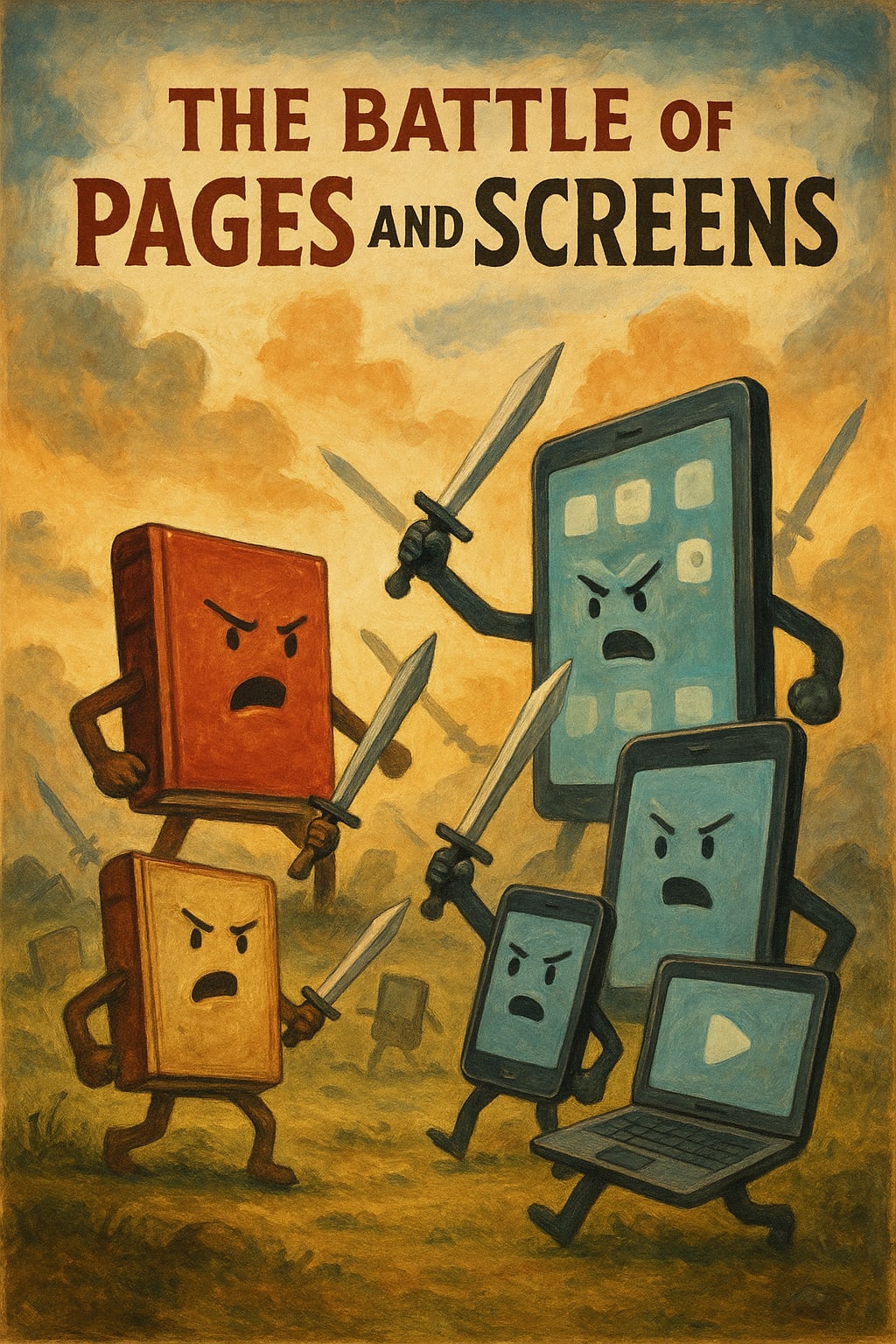
Across the Valley of Knowledge, armies gathered. On one side stood the warriors of literature, armed with quills, bookmarks, and the scent of old paper. On the other marched glowing devices, their screens flashing like shields, their chargers coiled like whips. The air buzzed with tension.
The first strike came from the Screens. Tablets fired bursts of images — colorful and loud — that filled the sky. Memes, videos, and pop-ups swirled like fireworks. Many young readers turned away from their books to watch. The Pages staggered, their words scattering like fallen leaves.
But Lady Poetry raised her quill high. “Ink does not fade when hearts remember!” she cried. Her voice flowed like melody, wrapping around the battlefield. The Books rallied, sending forth waves of imagination — dragons, heroes, love stories, and wisdom. Each page turned was a spell, painting the air with wonder.
King Pixelus smirked. “Old tricks,” he sneered. “Let’s see them survive a software update.” He signaled his army of apps and notifications. They launched a storm of distractions — buzzing alerts, endless feeds, flashing banners. The battlefield was chaos. Many young readers forgot which story they were in.
Queen Bibliara saw her forces faltering. “We cannot fight them with speed,” she said to her knights. “We must remind the world of stillness.”
So, she sent forth the Old Books — the Classics, bound in leather and history. They opened their pages and whispered tales of courage, love, and truth. Slowly, the storm began to quiet. The Screens flickered uncertainly as readers paused — remembering how a single paragraph could stay in the heart forever.
But the battle was not over. The Screens adapted quickly, streaming audiobooks and e-libraries, mimicking the Pages’ wisdom. “See?” laughed King Pixelus. “We can be stories too!”
Queen Bibliara smiled sadly. “Yes,” she said, “but can you feel the touch of a page, the quiet between words, the scent of paper that carries memory?”
At her command, the Books opened together. Their words rose into the sky, forming constellations — glowing letters that illuminated the battlefield. The Screens, dazzled, could not look away. For the first time, even King Pixelus hesitated.
A small child wandered into the valley then — a little girl holding both a book and a tablet. She looked at the two armies and whispered, “Why are you fighting? I love both of you.”
Her voice silenced the war. The Pages lowered their quills. The Screens dimmed their lights. She sat down under a tree, opened her book, and rested her tablet beside her. She read the story on one and watched its pictures on the other — words and images dancing together.
Queen Bibliara and King Pixelus exchanged glances. Slowly, they approached the child. The Queen spoke first. “Perhaps,” she said softly, “there is room in her world for both of us.”
King Pixelus nodded. “Perhaps the light and ink can work together — we can bring stories to all, in every way possible.”
And so, the war ended not with defeat, but with understanding. The Pages and Screens made peace, uniting their strengths. Books found new life as e-readers, stories traveled across the internet, and children learned to love both the feel of paper and the glow of pixels.
The valley bloomed again with words and light. The Libraries were filled once more, their shelves alive with laughter. And in every home, from the smallest village to the tallest city, stories — whether on paper or screen — continued to shape dreams.
About the Creator
Keep reading
More stories from abdul qadir and writers in Humans and other communities.
Why Humans Lie
Why Humans Lie Subtitle: The Truth Behind Our Deceptions The rain fell softly on the glass windows of the small café, blurring the city lights into streaks of gold and silver. Inside, a man sat alone at a corner table, his coffee untouched, his eyes fixed on the steam rising from the cup. His name was Daniel Hart, a psychologist who had spent twenty years studying human behavior — but that night, he wasn’t thinking as a scientist. He was thinking as a man who had just told the biggest lie of his life.
By abdul qadir5 months ago in Humans
How To Overcome Dating App Burnout And Stay Hopeful Finding Love
The burnout of dating apps is an everyday experience of a modern single person. Infinite swipes, shallow communication and unmet expectations may bring frustration, burnout, and demotivation. Such experiences may over time diminish confidence and lead to cynicism in regard to dating.
By Robert Smith4 days ago in Humans


Comments
There are no comments for this story
Be the first to respond and start the conversation.