
The Battle for the White House: Kamala Harris vs. Donald Trump
The Final Showdown: Will Kamala Harris Make History or Will Trump Reclaim the White House
As the U.S. election day on November 5 nears, Americans face a pivotal choice: electing their first female president, Kamala Harris, or giving former president Donald Trump another term in the Oval Office. With the backdrop of a tense and divisive political climate, the race has captured the nation’s attention, and polling data offers a glimpse into this high-stakes battle. Let’s explore the current state of the race and what it could mean for the future of the United States.
The Road to November: A Heated Campaign
In an unexpected twist, this election was set to be a rematch between Joe Biden and Donald Trump. However, in July, Biden announced he would not seek re-election, endorsing Vice President Kamala Harris as his successor. Harris quickly gained momentum, taking an early lead in the national polls by nearly four points by the end of August. This lead gave her campaign a strong foundation, but the race has since tightened, especially as Trump rallies his base and intensifies his attacks on her policies.
National Polls: A Snapshot of Support
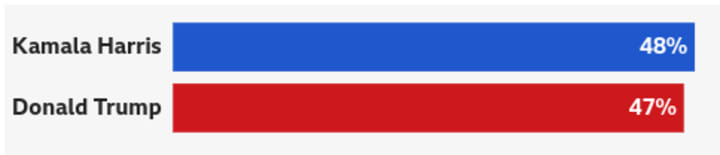
Since entering the race, Harris has generally held a narrow lead over Trump in national polling averages. But with every passing week, these numbers shift, reflecting the volatile nature of American politics. By mid-October, Harris’s initial lead had narrowed, underscoring just how competitive this race remains.
However, while national polls provide insights into the general sentiment of voters across the country, they aren’t the most accurate predictor of the final outcome. America’s electoral system relies on the Electoral College, where states carry weighted votes based on population. With 538 electoral votes up for grabs, a candidate needs to secure at least 270 to win. This system turns the focus to specific battleground states rather than the national vote alone.
The Battleground States: Decisive Arenas
In every election, there are a few key states where both parties stand a chance of winning—these “swing states” hold the power to sway the election. This year, the spotlight is on states like Arizona, Georgia, Nevada, North Carolina, Michigan, Pennsylvania, and Wisconsin. Historically, these states have swung between red and blue, creating nail-biting suspense each election cycle.
As of now, the polling in these swing states shows razor-thin margins, making it difficult to determine a clear leader. For instance, while Harris led in some states early on, recent polls show Trump making gains. In states like Arizona, Georgia, and North Carolina, Trump currently holds slight leads. However, in Michigan, Pennsylvania, and Wisconsin—key states Biden won back in 2020—Harris has been competitive, though her lead has also diminished recently.
The stakes are especially high in Pennsylvania, which holds the most electoral votes among these battleground states. Winning Pennsylvania could be a game-changer, giving the victor a substantial boost toward reaching the 270-vote threshold.
Decoding the Polls: What They Really Tell Us
Polls provide a snapshot of public opinion, not a crystal ball. Many factors can influence the final outcome, and past elections have shown how the numbers can be misleading. For example, in both 2016 and 2020, polls underestimated Trump’s support, with 2020 showing the largest polling error in four decades. Analysts believe this discrepancy arose from factors such as the last-minute decisions of voters and an underrepresentation of certain demographics, like non-college-educated voters who tended to favor Trump.
In 2020, the pandemic further complicated polling accuracy, as record turnout and changes to voting processes left pollsters struggling to capture the full picture. Polling experts have since adapted, incorporating new methods to reduce bias and increase accuracy. For instance, they now strive to achieve a balanced representation of voters by education level and geographic location, among other factors. The 2022 midterms were promising for pollsters, with predictions closely matching results, but only November 5 will reveal if these adjustments hold up with Trump back on the ballot.
What Lies Ahead?
This election has become a focal point for debates about America’s future and the path it will take. On one side, Kamala Harris represents a continuation of many of Biden’s policies, with a focus on social equity, climate change, and economic stability. On the other, Donald Trump has promised to reverse many of the current administration’s initiatives, rallying a base motivated by concerns over inflation, immigration, and national security.
As the days count down, both candidates are vying for every possible vote. The road to the White House has become a marathon, with swing states representing the toughest—and most important—hurdles. America awaits the outcome, and no matter who emerges victorious, this election will undoubtedly shape the nation for years to come.
Can We Trust the Polls?
Ultimately, polls should be seen as a tool, not a guarantee. They capture trends and provide insight into voter sentiment, but they don’t always predict the future accurately. While Harris maintains a slight lead nationally, the real battleground remains in those swing states where every vote will count.
This election promises to be one of the most unpredictable in recent history, with Harris aiming to break barriers as the first female president, and Trump seeking a remarkable return to power. With the finish line in sight, the U.S. and the world are watching closely, awaiting the final word on who will lead America next.
About the Creator
Keep reading
More stories from Bill nathan and writers in Humans and other communities.
10,000 Years Ago We Stopped Eating This and It Was a Huge Mistake
In today's world, diet advice is abundant and often contradictory. Social media, Netflix documentaries, and countless podcasts offer a myriad of eating recommendations, making it difficult to know what humans are truly meant to eat. To find the answer, we must look back to our ancestral roots and understand what our bodies are naturally inclined to consume.
By Bill nathanabout a year ago in Humans
Time to change your life.
Is it even possible for you to change your life? A lot of people, more than there should be, are unhappy with their lives. But what are they doing about it? Usually nothing. People talk about how shitty their lives are and want change, but are they not taking the actions to change?
By Jen Phillips3 days ago in Humans
IS IT EVEN POSSIBLE TO CHANGE YOUR LIFE?
Is it even possible for you to change your life? A lot of people, more than there should be, are unhappy with their lives. But what are they doing about it? Usually nothing. People talk about how shitty their lives are and want change, but are they not taking the actions to change?
By Muhammad Haroon khana day ago in Humans


Comments
There are no comments for this story
Be the first to respond and start the conversation.