
The Art of Making Small Problems Look Like Monsters
Why our brain chooses to overthink, and how we can finally break the cycle of stress.

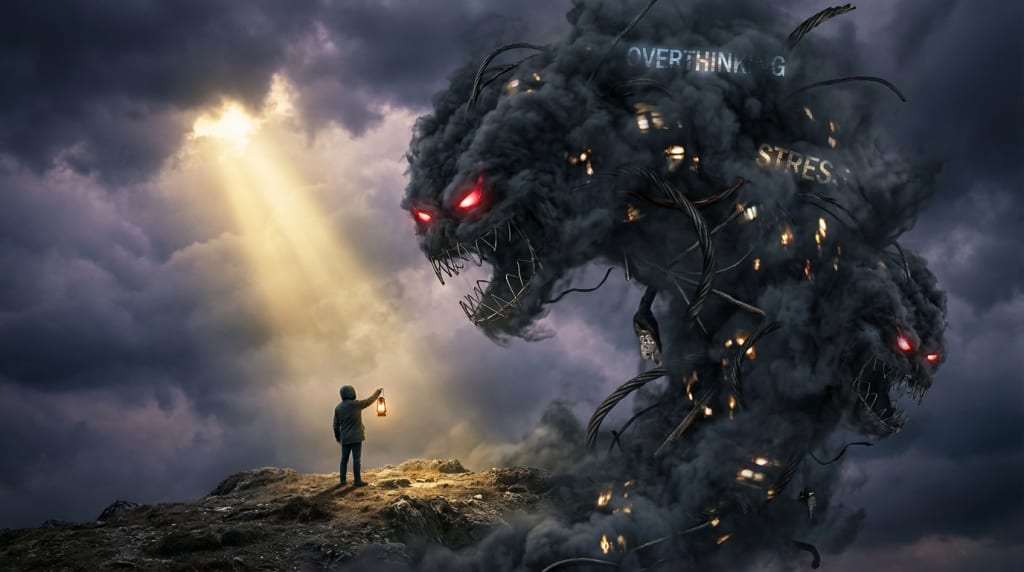
Why We Make Small Problems Look Like Monsters
How Our Mind Tricks Us into Stress and How to Stop It
Life is not always easy.
Sometimes, things go wrong.
A small mistake at work.
A cold reply from a friend.
A bill that we forgot to pay.
These are small things.
In a normal world, we should solve them and move on.
But for most of us, that’s not what happens.
We take a small problem.
And we turn it into a giant monster.
Psychologists call this "Catastrophizing."
I call it "The Overthinking Trap."
The Habit of Making Things Worse
Imagine you drop a glass of water.
It’s just a broken glass.
You can clean it in two minutes.
But your brain starts talking.
"Why am I so clumsy?"
I can't even hold a glass properly."
This is how my whole life is going."
"I am a failure."
Suddenly, a broken glass is no longer about water.
It becomes about your entire personality.
This is how we make things worse.
We take a level 1 problem.
And we give it level 10 energy.
The Science of the "Foggy Brain"
When we start overthinking, something happens inside our head.
Our brain thinks we are in a real battle.
It goes into "Fight or Flight" mode.
This is the mode our ancestors used when they saw a lion.
But there is no lion here.
It’s just a small problem.
However, the brain doesn't know the difference.
It shuts down the logical part of your mind.
The part that solves problems.
The part that stays calm.
It stays blocked.
Literally.
The Loop of Fear
When the logical brain is blocked, we become "Reactionary."
We don't think. We just react.
We make more mistakes.
We say things we don't mean.
We lose sleep.
And when we are tired, the problem looks even bigger.
It’s a circle.
A problem creates stress.
Stress creates overthinking.
Overthinking creates more problems.
And the circle never ends.
Most people spend their whole lives in this circle.
They feel trapped.
They feel like life is one big disaster.
But the disaster is often just in their perception.
How to Break the Circle
So, how do we stop this?
How do we see the world as it really is?
The first step is to Notice the Voice.
Next time you are stressed, stop for a second.
Listen to what you are saying to yourself.
Are you telling the truth?
Or are you telling a scary story?
Ask yourself: "Will this matter in five years?"
Most of the time, the answer is "No."
If it won't matter in five years, don't give it more than five minutes of worry.
The Power of "Looking Up"
Just like we discussed before, your direction matters.
When you look down at the problem, you feel defeated.
When you look back at the past, you feel guilty.
But when you look up, you see the bigger picture.
The sky is huge.
The world is vast.
Your problem is just a tiny dot in that big world.
Looking up helps the brain come out of "Fight" mode.
It tells your heart that you are safe.
It allows the logical brain to turn back on.
Taking the First Step
Don't try to solve the whole month in one day.
Don't try to fix your whole life in one night.
Just focus on the next five minutes.
What is the smallest thing you can do right now?
Maybe it's just drinking a glass of water.
Maybe it's just taking a deep breath.
When you take a small step, the "Monster" starts to shrink.
You realize it wasn't a monster at all.
It was just a shadow.
And shadows disappear when you bring in the light.
Final Thoughts for the Reader
Life will always have challenges.
You cannot stop the wind from blowing.
But you can stop yourself from building a storm inside your head.
Stop being your own worst enemy.
Start being your own best friend.
Look at your problems with clear eyes.
See them for what they are—not what you fear they might be.
The future is not as scary as your mind says it is.
The future is waiting for you to walk into it.
One calm step at a time.
Look up.
Breath in.
The fog is clearing.
And you are going to be just fine.
About the Creator
Hazrat Umer
“Life taught me lessons early, and I share them here. Stories of struggle, growth, and resilience to inspire readers around the world.”
Keep reading
More stories from Hazrat Umer and writers in Humans and other communities.
Your Mind Matters: Simple Steps to a Stronger, Happier You
We live in a busy world. Every day, we see messages telling us to work harder, do more, and be better. In all this noise, taking care of our own minds can feel like the last thing on the list. We might even feel guilty for taking a break. But here is the truth: caring for your mental health is not a luxury or a sign of weakness. It is the most important work you can do. It is what makes everything else in your life—your job, your relationships, your joy—possible. Think of it like building a house.
By Hazrat Umera day ago in Humans
Cabin Fever Because of Snow, Sleet, and Freezing Rain That Turned to Icy Roads
What Is Cabin Fever? The short answer is that cabin fever is restlessness from being in a confined area. Cabin fever is the distressing irritability or restlessness experienced when a person or group is stuck at an isolated location or in confined quarters for an extended time. Research shows that prolonged cold, gray skies, and being stuck indoors can trigger mood shifts similar to “winter blues.”
By Margaret Minnicks8 days ago in Humans
George Grant: Canada’s Moral Conscience
In the heart of Toronto’s York University, a quiet professor with a fierce intellect and a sorrowful gaze penned a sentence that would shake Canada’s post-war complacency to its core: *“The truth is that we are a colony of a new kind of empire.”* The year was 1965, the book was *Lament for a Nation*, and the man was George Grant—philosopher, conservative revolutionary, and the unsettling moral conscience of a country perpetually unsure it had one.
By Fred Bradford5 days ago in Humans
Rachel Reviews: Lunch Tales: Teagan by Lucille Guarino
Well, I did enjoy this! Sometimes, all you need is just great storytelling and this is what Lucille Guarino delivers here. There's no big message to this book; it's just about folks and families, living their lives and coping with everything that's being thrown at them and finding their way. But when it's done well, like it is here, then you have characters to whom you can relate, tension which leaves you rooting for a better outcome, attraction which has your heart racing and an urge, as a reader, to see the characters happy with the people with whom they belong.
By Rachel Deeminga day ago in BookClub




Comments
There are no comments for this story
Be the first to respond and start the conversation.