

I promised myself one year. Now, eleven months to the day after disembarking an overnight bus from Bangor, I juggled the tables of a packed lunch rush with persistent pangs of dread.
My boss, Frankie, sized up my limp demeanor and firmly grabbed me by both shoulders.
“Tyler,” he began. “Our guests come to Vincenzo for celebration, not commiseration. What’s the matter? Do you need a day off?” A flicker of annoyance betrayed his genuine but exaggerated concern.
“I’m fine, sir. See, big smile. Don’t adjust my schedule; I need the hours.”
“Your next victims are seated. Attend to them.”
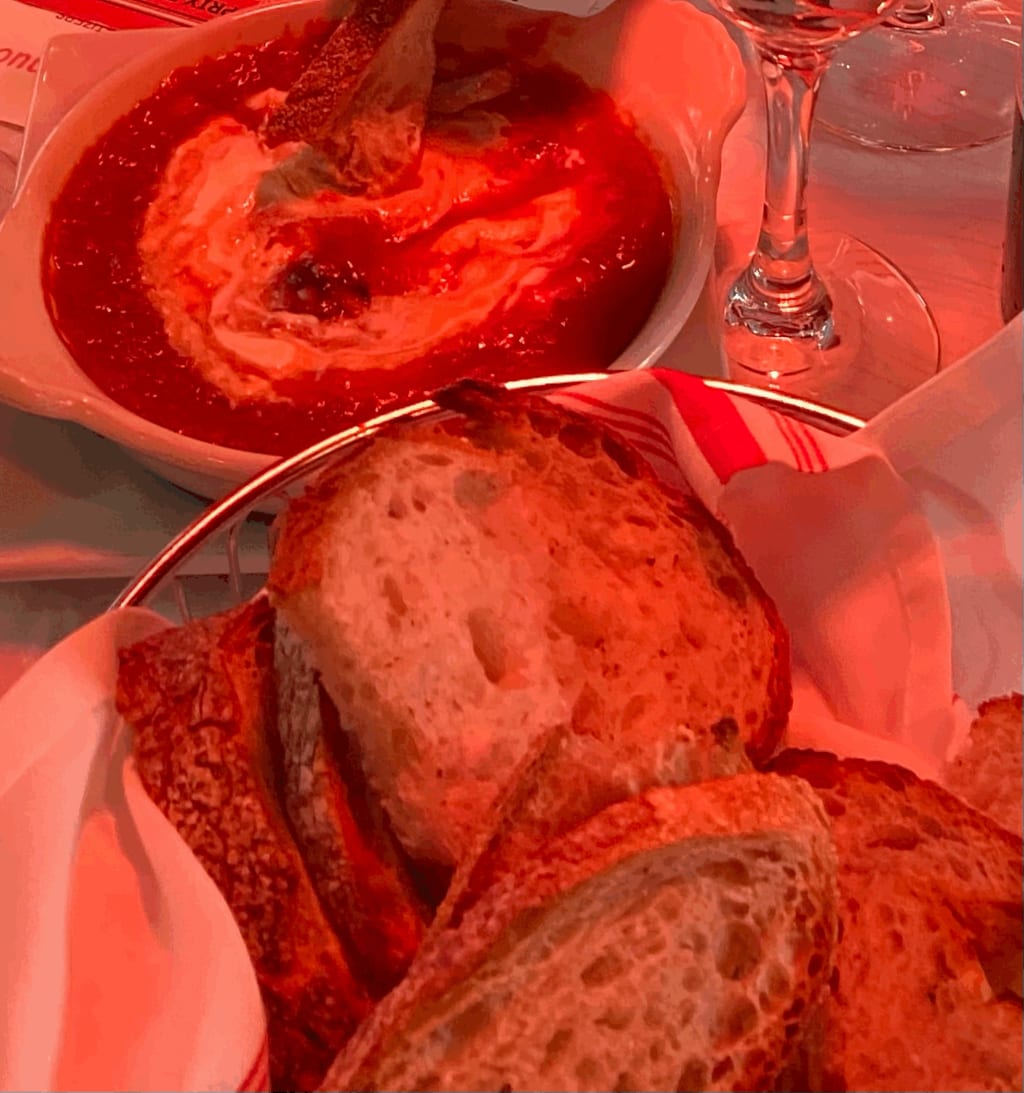
Collecting a serving of the complimentary goat cheese in tomato sauce appetizer that had made Vincenzo an Upper East Side staple, I spun back towards the two-top in the front window.
Seated there were two guests seemingly so mismatched that I wondered if strangers had agreed to share a table to spare the other a wait. On the left, a handsome and suave, if overly eager, executive type in his mid-thirties wore a neatly tailored suit. Opposite him, an eccentric-looking older gentleman who accented a nondescript black sweater and trousers with a fuchsia floral-patterned silk scarf tied loosely around his neck, a black tam which he was gingerly removing, and a pair of dangling rhinestone earrings with pearl tentacles that swept across his shoulders as he gesticulated.
I heard his voice first: grand but delivered at a pleasant volume, with an affectation that indicated his companion might not just be a suit, but a suitor.
“Good afternoon, gentlemen,” I announced, placing the Italian manna squarely in the table’s center.
“Just barely on the dial, but fully in disposition,” Fuschia answered.
Suit released a convulsion of nervous laughter.
“Enjoy this with fresh bread on the house. I’ll be back to take your drink and meal orders.”
“Young gentleman,” beckoned Fuschia. “Introduce yourself.”
“My apologies. I’m Tyler.”
“My name is Gerard Manchester. This is Benjamin Baxter. We are having lunch.”
“You’re in the right place. Pleased to meet you both.”
“Yes. Each of us will have a vodka martini with pitted olives. Steak tartare to share. And please inform the chef that I intend to request the chocolate dessert since it says here you require advance notice for that indulgence.”
“Certainly. Anything else at this time?” I asked, nodding towards Benjamin.
“No,” answered Gerard Manchester.
Benjamin nodded conclusively.
“Alright, I’ll be back with your drinks in a moment.”
“Cocktails.”
“I’m sorry?”
“Cocktails. Martinis are cocktails. ‘Drinks’ implies the careless comingling of a spirit with soda.”
“Of course,” I conceded. “Cocktails.”
Shuffling back to the bar, I couldn’t shake the impression that I’d met this dandy before. If so, surely I’d remember him with more clarity? Facing away from their table, I pulled out my phone and searched his name.
Gerard Manchester.
GERARD MANCHESTER.
At the Vincenzo lunch rush and more than twenty five years later, I hadn’t recognized him. But now, his face on my screen and at my table transported me back to the living room of our family home in Maine in the mid-nineties. There, one summer afternoon, I had sat on the floor in front of the television watching a raucous group of outrageously costumed characters on a daytime talk show describe their shenanigans in the downtown New York City nightlife scene. These wayward quasi-adults had escaped their modest and meager Midwest childhoods to find community and calamity south of 14th Street. I was transfixed.
One of their members stood apart from the combustible crowd. Though he was at least a decade older than his counterparts, they had adopted him — prizing him like a trophy for how he had ignited early 1970s off-off-Broadway theaters with a bawdy, biting one-man show. A recluse since that time, he had been pulled out of obscurity by these club goers.
Gerard Manchester was at Vincenzo. At my table! And he wanted his martini, now!
“I’m sorry for the wait, Mr. Manchester, Mr. Baxter. Here are your cocktails. The tartare will be right over, and the chocolate cake is being prepared. Have you decided on mains?”
“Yes, Benjamin will have the seafood lasagna, and I will have the spaghetti and meatballs. Will you please package half of both orders to go and deliver those to me with dessert? Thank you.”
“Certainly. Cheers.”
As I turned towards the kitchen, Benjamin slipped me his credit card.
Moments after finishing his chocolate cake, Gerard Manchester stood, adjusted his scarf, placed the tam back on his still full head of silver hair, extended his hand towards Benjamin — who responded by warmly, if self consciously, kissing it — picked up the to-go bags with his other hand, and left.
I made a beeline towards Benjamin.
“Sorry about my guest’s...decisiveness,” he offered. “He’s a legend.”
“The performance artist, right?”
“Yes! I idolized him when I was a teenager. I used to watch him on TV and dream about going to clubs with that crew.”
“Same! How did you two become friendly?”
“The Arrangement.”
“Oh...”
“No, no, it’s nothing like that. Gerard doesn’t have a source of income these days. There aren’t video or audio recordings of his show to sell, and he saved none of his writings. But he has to feed himself. So, he put word out that he’ll accept a restaurant meal invitation from anyone who asks, provided of course…”
“...that they pick up the tab.”
“Yeah. Unsaid, but that’s The Arrangement. A colleague gave me his number. He won’t take selfies, unfortunately. Says mobile phones are pedestrian. He keeps all of his numbers and engagements in a little black Moleskine notebook that never leaves his person.”
“Would you mind giving me his number? I might not be in the city for too much longer and I’d love to ask him to dinner before I go.”
Benjamin wrote Gerard Manchester’s telephone number — it had a 212 area code, of course — on a Vincenzo napkin and handed it to me.
That evening, I called Gerard Manchester.
“Hello, this is Gerard Manchester,” began his answering machine greeting. “I am not at home. Tell me your name, telephone number, and preferred date and time for a meal à deux if that’s why you’re calling. Goodbye.”
“Hello, Mr. Manchester, this is Tyler King. I’m a waiter at Vincenzo. I served you at lunch today. Cocktails, not drinks. Anyhow, I’d love to invite you back to the restaurant for dinner — maybe tomorrow night?”
I left my number and hit the End Call button.
Three hours later, Gerard Manchester called me back.
“Hello, Mr. King. You work fast.”
“Yes, sorry about that. I —“
“Don’t apologize for an act requiring no apology; it sets a dangerous precedent. Tomorrow evening suits me. Eight o’clock? Another ride along the 4/5/6 line.”
“Yes, 86th Street Station.”
“Goodbye.”
Twenty-one hours later, after a lunch rush I could barely remember, under Frankie’s circumspect gaze, and with an in-case-of-emergency-only credit card in my pocket, I escorted Gerard Manchester to our table.
“Hello, Mr. King.”
“Please call me Tyler.”
“Hello, Tyler.”
“I’m sorry to say I didn’t recognize you at first yesterday.”
“Another unnecessary apology.”
“Sorry.”
“You’re nearly forty?”
“Thirty-eight.”
“You watched me on The Darby Sand Show.”
“I did.”
“You were a precocious, closeted homosexual boy in...Massachusetts?”
“Maine.”
“Ah! Maine.”
Gerard Manchester pulled out the little black Moleskine notebook and a pen from the inside pocket of his oxblood velvet blazer. He opened the notebook and next to an entry with my name and phone number, plus the name, address, and phone number of Vincenzo with today’s date and 8:00 p.m., he wrote ‘Maine’.
“I’m keeping track of the details of these lunches and dinners for a new project.”
“Oh? What is the project?”
“Since putting myself out there, as it were, I’ve determined that I have as much to discover from my meal companions as they have from me. The opinions, questions, and challenges from you and your counterparts will form the lens through which I engage theater audiences.”
“I don’t follow.”
“My stories — the stories you undoubtedly hope to hear this evening — they exist in the past. They happened, but they’re over. I want to know what’s happening now, in your life — in the lives of young homosexuals, bisexuals, the transgender community, and even a few heterosexuals, who in some ways have become more fascinating than we are of late. I have no children or even nieces or nephews from whom to extract this information. In my next show, I will tell my stories about your stories.”
“Where should we start?”
“You seemed glum yesterday — at least until you identified me on your device.”
“You saw me do that? Sorry. When I moved to New York I told myself I’d give it a year. If I hadn’t found my footing by then, I’d go back home. Yesterday marked one month until my time is up, and my footing is not yet solid.”
“Where do we want our feet to land?”
“Madison Avenue. I’m in advertising. An Art Director and trained graphic designer. I’ve spent my career at an independent agency in Bangor but I’ve always dreamed of working on the big national brands here.”
“Advertising.”
“Yeah.”
“I see.”
“Sorry.”
“For that, I accept your apology. But one must make a living.”
“I’ve sent my portfolio to all the major agencies, taken Creative Directors for coffee, applied for every job posting, but so far, no bites.”
“Are you good? Your work, I mean.”
“I’ve won some awards in regional competitions back home.”
“Nevertheless, are you good?”
“I think so, yes.”
“You need more time. The saying is not ‘if you make it here in twelve months, you can make it anywhere’.”
“Time is money.”
“In the face of uncertainty, one must keep one’s expenses low.”
“How’s four grand a month? Because that’s what I’m burning just with rent and the basics.”
“I haven’t moved apartments in forty years. It keeps the rent low.”
“I’ve got a month left before I run out of money and patience. And pride.”
“Come to my apartment tomorrow at one o’clock. Bring your portfolio.”
Gerard Manchester opened his notebook and created a new entry for the following day: “Tyler King: Lunch.”
I made a mental note to trade tomorrow’s lunch shift with my colleague, Angie. Frankie motioned to me that he had generously comped our dinner bill.
The following day, and twice weekly for the next three weeks, I brought lunch to Gerard’s apartment. I shared stories about my job hunt misfortunes and dating escapades — notes from both of which he jotted in his little black notebook for monologue inspiration.
On the first visit of what would be our final week of visits given my dwindling funds, I arrived at Gerard’s apartment with a bag of takeout tacos and not-for-profit ad comps I had sketched at his direction.
The door to his unit was ajar. I eased it fully open.
Inside, the building’s superintendent, startled, asked me if I was family.
“No,” I said. “Just a friend.”
“I’m sorry: Mr. Manchester, he passed away. He called 911 but then he was gone by the time the ambulance arrived. Heart attack.”
I turned to leave, bewildered, when I spotted Gerard’s treasured black notebook in the keep-all by the apartment door.
“Mind if I keep this?”, I asked the superintendent, picking up the notebook.
He shrugged. “We’re going to put his belongings on the street. Help yourself.”
I left Gerard’s apartment for the final time — walking a few blocks before processing what had happened: Gerard Manchester was gone.
I flipped through the notebook to the final page that held his handwriting. There, folded and tucked into the seam, was a check. I unfolded it. It was made out to Tyler King in the amount of $20,000. The memo read ‘5 months’.
THE END.
About the Creator
Anthony Patrick Hello
Anthony Patrick Hello is Host and Executive Producer of ALL THE BOYS: THE PODCAST. He has written and is developing a solo play in two acts based on the podcast called ALL THE BOYS.
Keep reading
More stories from writers in Humans and other communities.
Autonomy Is The Real Privilege
Good morning, freedom-seekers! Today we’re gonna be looking at autonomy. A strange word, I know; one many would probably look at blankly and run away from on sight. We’re gonna figure out what it actually means, consider how it’s achieved, and decipher just how deeply most of us are tangled up in dependence without realising it.
By That ‘Freedom’ Guyabout 4 hours ago in Humans
The Connection Between Pink Salt Blocks and Liver Wellness
The liver labours on a second-by-second basis to detoxify the body and aid in digestion, thus requiring tender attention to remain proper. Natural wellness practices are some of the practices that people explore today in order to support this vital organ. The use of Pink salt blocks at home and for wellness is one of the trends on the increase. These luminous mineral blocks make the indoor space feel warm, pure and balanced. These methods are also combined with Himalayan salt bricks by many users to enrich the atmosphere and make the space relaxing to aid in recovery and detox.
By david smithabout 8 hours ago in Humans




Comments
There are no comments for this story
Be the first to respond and start the conversation.