
The Architecture of Heroism
Strength Without Spectacle

The Architecture of Heroism
Strength Without Spectacle
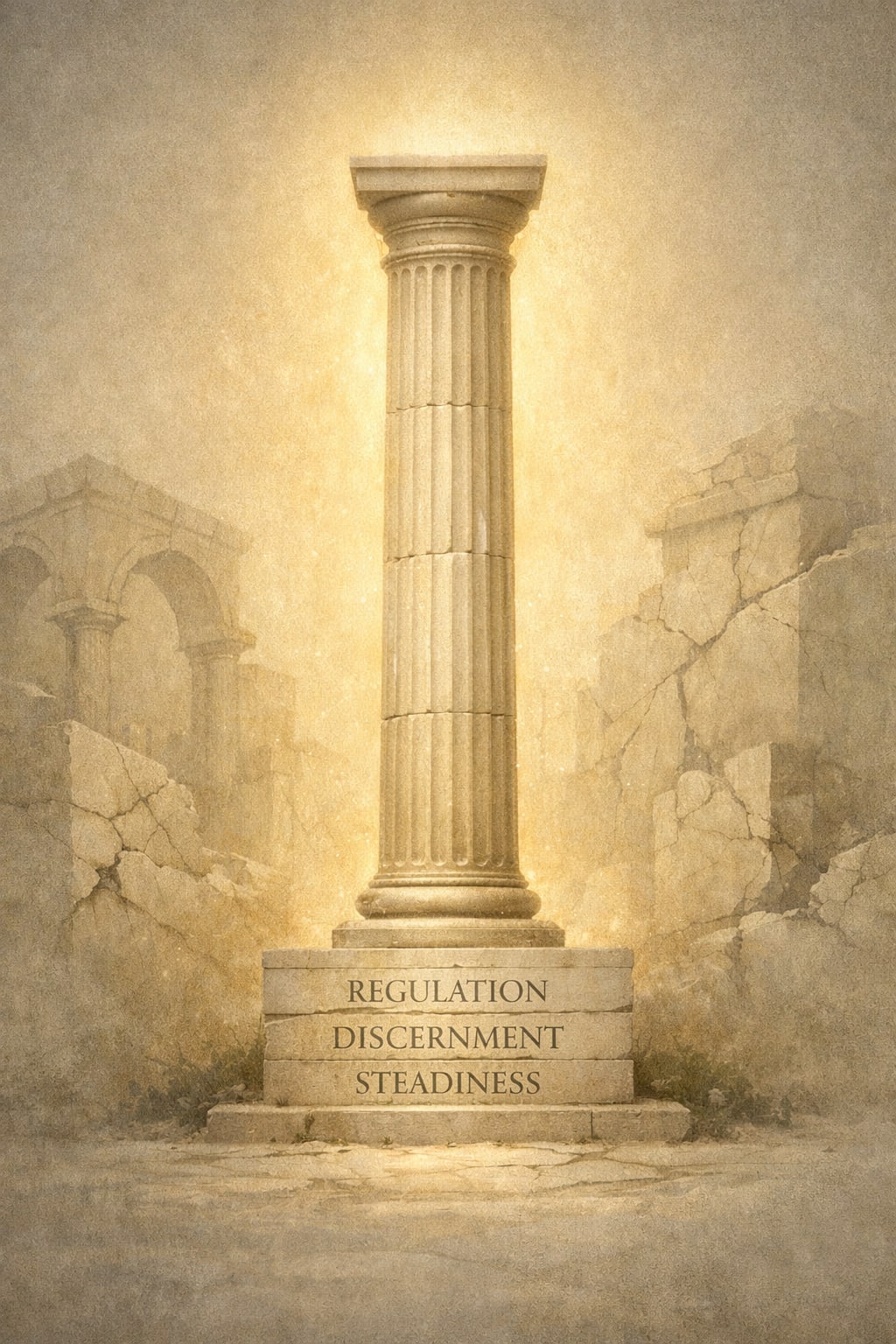
We are taught to recognize heroes by volume — by urgency, by sacrifice, by visible impact. But much of what sustains a life, a family, or a culture is quieter than that. This series explores heroism not as spectacle, but as structure: the steadiness that prevents collapse, the discernment that interrupts harm, and the regulation that builds something lasting. Here, strength is not dramatic. It is disciplined.
The Quiet Architecture of Heroes
Why Real Strength Rarely Announces Itself
We are taught to recognize heroes by spectacle.
They arrive in noise.
They interrupt catastrophe.
They are framed by fire, urgency, applause.
But most heroism does not look like that.
Most heroism looks like restraint.
It looks like the moment someone could humiliate you — and chooses not to.
It looks like a parent breaking a generational pattern without anyone knowing how hard that is.
It looks like someone regulating their nervous system in a room that is trying to pull them into chaos.
The loud version of heroism saves lives in emergencies.
The quiet version prevents emergencies from forming.
And we rarely celebrate that.
Real heroes often absorb impact without turning it outward.
They choose steadiness when escalation would be easier.
They redraw lines without demanding applause for doing so.
A firefighter running into a burning building is visible courage.
A human refusing to pass on inherited harm is invisible courage.
Both require strength.
Only one trends.
We glamorize the dramatic because it is easy to witness.
We overlook the disciplined because it looks ordinary.
But discipline is not ordinary.
To stay aligned when others collapse into reaction is not passive.
To tell the truth without aggression is not weak.
To remain vertical when comfort invites distortion — that is structural strength.
Heroes are not always rescuers.
Sometimes they are the first person in a family to say, “This stops with me.”
Sometimes they are the friend who does not emotionally dump back.
Sometimes they are the one who leaves quietly instead of retaliating loudly.
Heroism is not intensity.
It is responsibility.
It is the willingness to hold weight without transferring it to someone smaller.
And here is the uncomfortable truth:
We often want to be saved more than we want to become steady.
But the world does not change through rescue fantasies.
It changes through people who build internal infrastructure strong enough to interrupt harm.
The loud hero runs toward fire.
The quiet hero prevents it from spreading.
One is dramatic.
The other is architectural.
Both matter.
But only one sustains civilization.
And if we are honest — the future will depend less on capes, and more on nervous systems that can hold their own weight.
The Myth of the Martyr
When Self-Abandonment Masquerades as Strength
No one sets out to become a martyr.
It happens quietly.
You help because you care.
You stay because you’re strong.
You absorb because you can.
At first, it feels generous.
You are the steady one.
The reliable one.
The one who doesn’t need much.
People admire that.
They tell you you’re selfless.
They tell you you’re “so strong.”
They tell you they don’t know how you do it.
And somewhere in that praise, something subtle shifts.
You begin to measure your worth by how much you can carry.
You feel uneasy resting.
You feel guilty asking.
You feel uncomfortable when no one needs you.
Being needed becomes proof of value.
And this is where the myth forms.
The myth says:
If I collapse for others, I am noble.
If I endure silently, I am virtuous.
If I sacrifice enough, I am good.
But slowly — your body disagrees.
You feel the tightness in your chest after long conversations.
You feel the resentment you don’t want to admit.
You feel the exhaustion that no one sees because you hide it well.
The myth of the martyr does not begin with ego.
It begins with tenderness.
It begins with empathy that was never taught to include itself.
We confuse depletion with devotion.
We confuse overextension with love.
We confuse suffering with strength.
But strength does not require self-erasure.
True steadiness does not collapse to be called heroic.
The quiet hero prevents harm.
The martyr absorbs it — and eventually passes it on.
Not intentionally.
But inevitably.
Because what is unprocessed does not disappear.
It transfers.
The martyr believes they are holding the world together.
But often, they are holding a system in place that needs to change.
The shift is not dramatic.
It is subtle.
Instead of asking,
“How much can I carry?”
You begin asking,
“What is mine to carry?”
Instead of staying to prove love,
You stay because it is aligned.
Or you leave — without performance.
There is nothing shameful about having been a martyr.
Many of us learned that pattern early.
It kept us safe.
It kept us loved.
But at some point, protection becomes distortion.
And tenderness must mature into discernment.
You do not have to collapse to be compassionate.
You do not have to sacrifice yourself to be strong.
The most radical thing a former martyr can do
is remain steady
without overgiving.
Not cold.
Not withdrawn.
Not hardened.
Just regulated.
Just whole.
And when that happens, something unexpected occurs:
You are no longer admired for your exhaustion.
You are respected for your boundaries.
And that is not a loss.
That is evolution.
The Hero’s Oath
A Vow for Those Who Choose Architecture Over Applause
This vow is not spoken to impress.
It is practiced quietly.
It sounds like this:
I will not create crisis to feel important.
I will not confuse being needed with being aligned.
I will not abandon myself to be admired for endurance.
I will regulate before I rescue.
I will discern before I agree.
I will ask what is mine to carry — and release what is not.
I will not wear exhaustion as proof of love.
I will not mistake overextension for strength.
I will not collapse to preserve approval.
If I help, it will be from wholeness.
If I give, it will be sustainable.
If I stay, it will be because it is true — not because I am afraid to leave.
My steadiness is contribution.
My boundaries are protection.
My restraint is power.
I choose architecture over applause.
I choose regulation over reaction.
I choose strength that does not require spectators.
This is not rebellion.
It is refinement.
This is not detachment.
It is alignment.
And I will practice it —
even when no one is watching.
— Flower InBloom
Closing Benediction
May we release the need to be admired for endurance.
May we outgrow the myth that exhaustion proves love.
May we choose steadiness when spectacle tempts us.
May our strength become quiet enough
to build what does not burn.
And may we remember —
the most powerful architecture
is often invisible
while it is holding everything together.
— Flower InBloom
About the Creator
Flower InBloom
I write from lived truth, where healing meets awareness and spirituality stays grounded in real life. These words are an offering, not instruction — a mirror for those returning to themselves.
— Flower InBloom
Keep reading
More stories from Flower InBloom and writers in Humans and other communities.


Comments
There are no comments for this story
Be the first to respond and start the conversation.