science
The Science Behind Relationships; Humans Media explores the basis of our attraction, contempt, why we do what we do and to whom we do it.
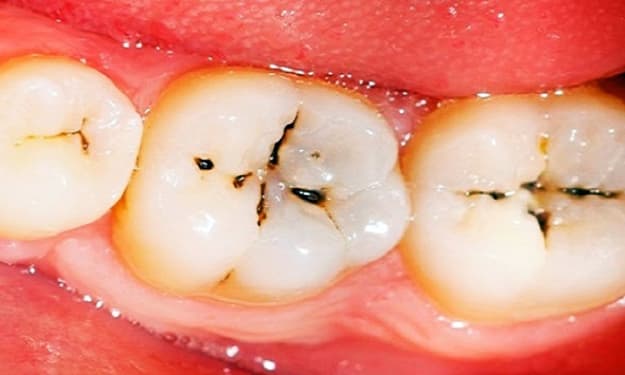
REVERSING CAVITIES
We're going to discuss a very sensitive subject: cavities. So, what are cavities? Cavities are a type of tooth decay in which the tooth's surface is continuously attacked by acids produced in your mouth by bacteria that cause decay. Over time, these acid attacks on the surface of the enamel might result in the formation of a small hole in the tooth, which is known as a cavity and can lead to other problems signaling tooth loss and infection if steps are not taken a treat at war if tooth health is not maintained where the formation cavity is not prevented and can lead to other problems such as tooth loss and infection if steps are not taken to treat it and if you've been to the dentist you know that sugar and trees combined with poor oral hygiene are frequently held responsible for tooth decay and cavities; however, another important factor in the process is when specific nutrients and vitamins are deficient in our diets; these deficiencies also significantly contribute to the development of cavities. I bring up cavities because, in this article, we're going to discuss the topic of holistic dentistry. However, the concept of holistic dentistry is not a complete one, a rejection of modern dental hygiene but in actual reality, it switches to focus more towards a dental hygiene in the setting the diet was developed by Weston Price, the founder of the National Dental Association and a pioneer of holistic dentistry the revelation of curtsy ham, who visited remote tribes in distant parts of the world spinning from Aboriginal to Native Americans. He was surprised to find that despite their extreme differences, all of these people shared one trait: they had perfectly healthy teeth without visiting a doctor every six months. When the indigenous people tried the westernized diet they soon developed cavities and other ailments similar to those on westernized diets, which is when Price integrated his findings to create a holistic approach. Price noticed that cavities were rare in these cultures and proposed it was because they did not have a westernized diet their main source of nutrients were fish, fatty meats, and butter meaning sugar and grains were missing from their intakes.
By DAYO ADEYEMI3 years ago in Humans
Second Chances
Second chances are an essential aspect of life, providing individuals with the opportunity to rectify past mistakes and move forward with their lives. While some people may argue that second chances are unnecessary and that once someone makes a mistake, they should be written off for good, others believe that everyone deserves a second chance.
By Shakira Scantlebury3 years ago in Humans
Are Cell Phones Changing How Our Bones Are Shaped?
What if smartphones were so potent that they could alter the shape of our bones? This intriguing new debate has recently erupted in the media. It is based on a scientific study that claims using smartphones and tablets can result in significant, long-lasting changes to our bodies—and not in the ways you might expect. David Shahar and Mark Sayers, biomechanics experts from Australia's University of the Sunshine Coast, conducted a study in recent years. Biomechanics examines how mechanical principles apply to live organisms, such as how humans move and how insects beat their wings.
By DAYO ADEYEMI3 years ago in Humans
The Future of Animal Intelligence:
Humans have long been the top species on the planet, with our high intelligence, ability to modify our environment, and advanced societies. However, with the continued threat of climate change and other factors that could cause human extinction, it's worth considering what animals could become the new top species if we were to disappear. While it's impossible to predict the future, scientists have some ideas about which animals might be most likely to develop the skills necessary to thrive in a post-human world.
By Ogunkeye Igbagbodayo3 years ago in Humans
"Why Ancient Humans Had Straight Teeth and How Our Modern Lifestyle Causes Dental Crowding"
The state of our teeth has changed dramatically over the course of human evolution. In the distant past, our ancestors had large jaws and teeth that were well-suited to a subsistence lifestyle, in which they had to work hard to make their food digestible. Their teeth show extensive wear and flattening, and they had to grind, crush, and pulverize their food in order to break it down.
By Ogunkeye Igbagbodayo3 years ago in Humans
Free medical services
Is "Free" Clinical benefits Genuinely Free for Untouchables Abroad? "Free" clinical consideration isn't free. Clinical consideration that is given by government workplaces is regularly upheld by occupants some way or another. The country's clinical benefits monetary arrangement could come clearly out of their costs, or it very well may be sponsored through finance charges which impact an inhabitant's compensation. Watchful pilgrims know not to offer unrehearsed remarks about how lucky neighborhood tenants are to have "free" clinical benefits in their country. Nobody can truly educate when you could get a taunting remark regarding how their cost bill didn't give off an impression of being so free!
By Akash shrivastav 3 years ago in Humans
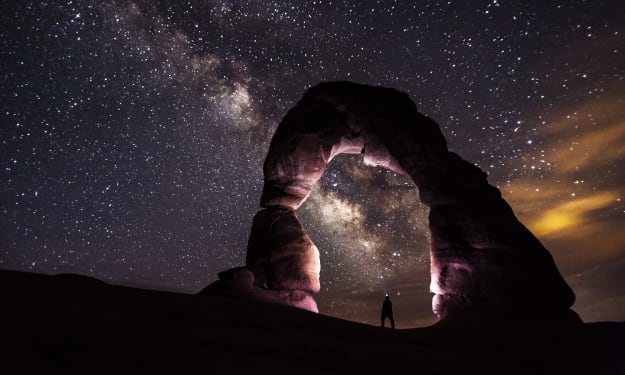
The universe is vast beyond comprehension
Welcome to Earth, your home planet and the center of your neighborhood, the solar system. Let's take a closer look at the distance between the Earth and the moon, which might not seem very far at first glance. However, at their farthest point, the Earth and the moon are actually 252,088 miles apart, which is large enough to contain every planet in our solar system. Speaking of planets, did you know that the Great Red Spot on Jupiter is twice as big as Earth, and Saturn is nine times wider than Earth? The rings of Saturn are so vast that some of the fragments within them are as large as mountains. But even these impressive planets pale in comparison to our Sun. Just remember that this is Earth, as seen from the moon, and this is what Earth looks like from Mars.
By Bob Oliver3 years ago in Humans
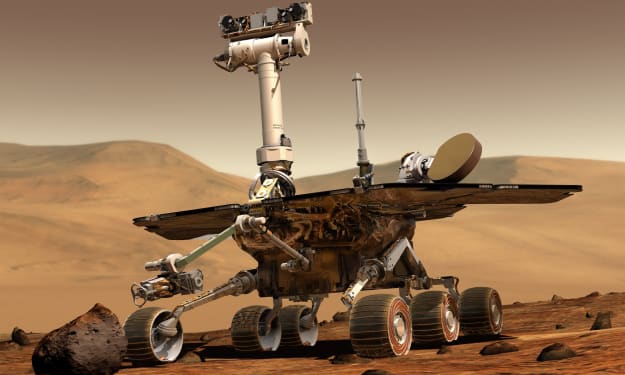
Exploring the Mysteries of Mars
There have been some unusual sightings on Mars, including a large angel-like figure, a mysterious forest, and a face that was once thought to belong to an ancient Martian civilization. However, scientists claim that these are merely random combinations of craters and lakes composed of carbon dioxide. In 1976, NASA published a photo of Sidonia, a region in the northern hemisphere of Mars, which was believed to show a giant face. Science fiction fans saw it as an analog of the Egyptian Sphinx created by a Martian civilization. This legend persisted for more than two decades until new photos from another angle revealed that the face was nothing more than a play of light and shadows on the uneven terrain. While there have been other unusual discoveries, such as floating spoons and a carved doorway, geologists explain that these are natural formations that are misinterpreted by our human minds. Therefore, it is unlikely that these strange things do not belong on the Red Planet.
By Bob Oliver3 years ago in Humans
The Emergence of Virtual Clinics: Transforming Healthcare Delivery
Introduction The healthcare landscape is undergoing a significant transformation due to the rapid advancements in technology. One of the most significant changes is the emergence of virtual clinics, which are revolutionizing the way patients access healthcare services. Virtual clinics are online platforms that allow patients to receive medical consultations, prescriptions, and follow-up care through video or audio calls, emails, or chat services. This blog post will delve into the concept of virtual clinics, their benefits, and how they are transforming the healthcare sector.
By Kelmed Clinic3 years ago in Humans