science
The Science Behind Relationships; Humans Media explores the basis of our attraction, contempt, why we do what we do and to whom we do it.
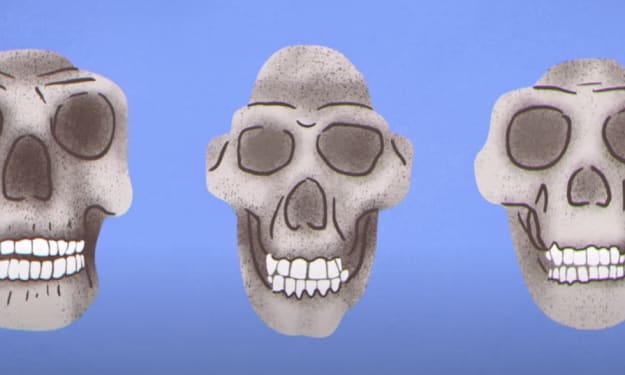
Why do we have crooked teeth when our ancestors didn’t?
The fossil record indicates that ancient humans had straight teeth and wisdom teeth without the need for braces or extractions. Dental issues requiring such treatments appear to be a more recent development. Scientists have a hypothesis about what happened a couple of million years ago.
By Mila G. Rose3 years ago in Humans
Technology's Effect on Fertility
Introduction: In recent decades, technology has revolutionized various aspects of human life, including healthcare, communication, and entertainment. While these advancements have undoubtedly brought numerous benefits, concerns have been raised about their potential impact on fertility rates. This article aims to explore the relationship between technology and fertility, shedding light on both the positive and negative effects and considering the implications for individuals and society as a whole.
By Ihsaan Raisdeen3 years ago in Humans
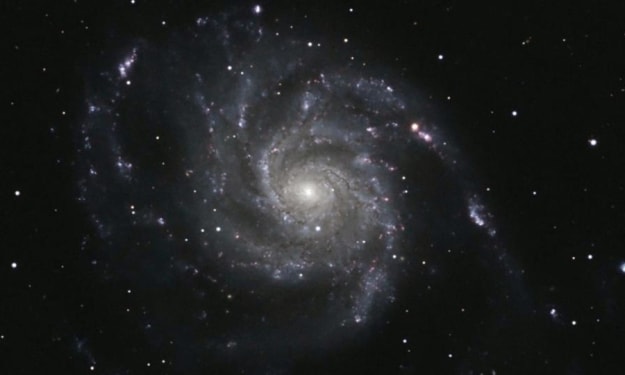
A Nearby Supernova Is Visible This Weekend With Even A Small Telescope
If you don't, but you know someone who does, ask them if you may look around. You don't get to see a massive star erupt before your eyes and glow brightly like a billion Suns very frequently. Even a tiny telescope will detect the new supernova under dark skies today, in contrast to when it originally made news and required a medium-sized home telescope to observe.
By Najmoos Sakib3 years ago in Humans
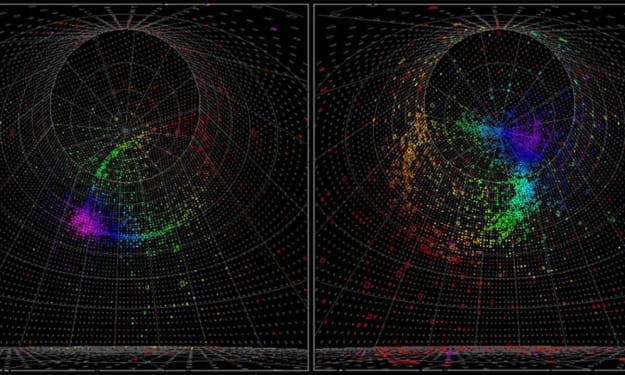
Early Universe Symmetry Violations May Be The Reason Why Matter Today Outweighs Anti-Matter
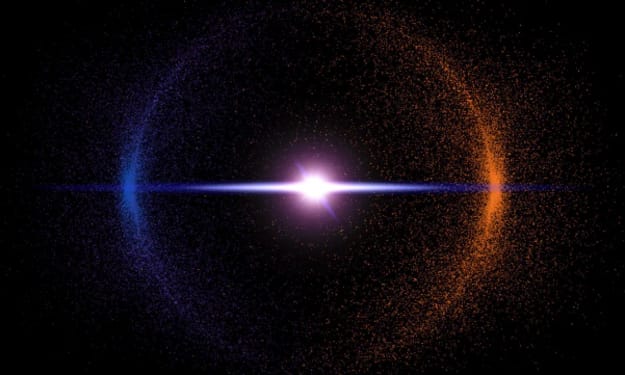
If matter and anti-matter were equally distributed across the cosmos, they would be continually annihilating one another in bursts of energy. Not a site where life is expected to evolve, much less travel a great distance to become creatures that can understand the rules of physics. However, according to those rules, as we presently understand them, the universe should have been formed with an equal number of each material.
By Najmoos Sakib3 years ago in Humans
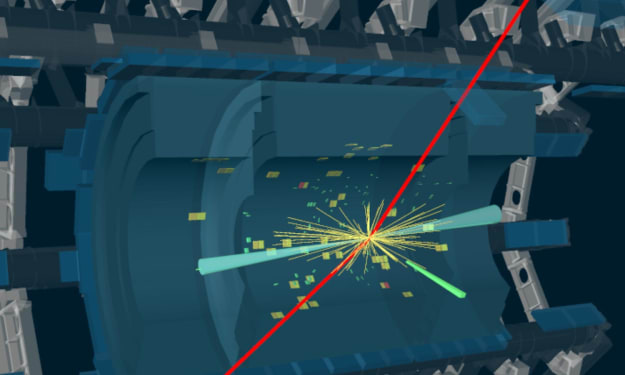
First Proof For Rare Higgs Report on Boson's Decay Ten Years After Discovery
The discovery of the Higgs boson marked the end of a six-decade search. The next year, it resulted in the physics Nobel Prize being given out, although in many respects, it was more like reaching base camp than the summit of Mount Everest. The adventure continues as physicists look for the particles that the Higgs eventually transforms into.
By Najmoos Sakib3 years ago in Humans
Why A Drinking Straw Is Not Allowed In Space
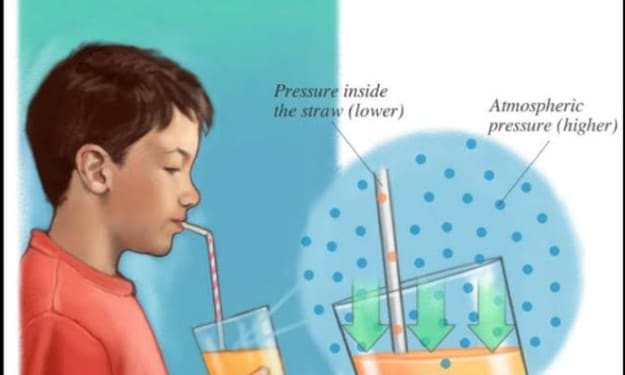
Now for the bad news: you cannot consume liquids with a straw in space. Let us explain as you perish, juiceless. You're not truly sucking up the liquid when you use a straw. You're sucking the air out of the straw, causing a vacuum or a drop in air pressure inside the straw. Outside of your drink, air pressure drives the liquid into the straw and up into your mouth.
By Najmoos Sakib3 years ago in Humans
Why The Universe's Center Is Absent
Since space and time were already constructed when the universe began, the actual event did not erupt into anything. When we see it as an explosion, we also assume that it began at a single discrete location, although this is not the case.
By Najmoos Sakib3 years ago in Humans
The Most Spectacular End To The Universe Is Here: "Vacuum Decay"
However, it is still unclear how the universe will end. Of course, there are speculative possibilities: the universe may keep expanding and cooling until it reaches absolute zero, or it could smash back together in the so-called Big Crunch. The "vacuum decay" theory is one of the alternatives to these two dominant ideas, and it is stunning - in an end-of-everything kind of manner.
By Najmoos Sakib3 years ago in Humans
The Implications of Human Identity Chips
Introduction Human identity chips, also known as identity implants, are a revolutionary technological advancement that has the potential to transform various aspects of our lives. These chips, typically implanted under the skin, are designed to store and transmit personal information, enabling seamless identification and authentication processes. While proponents argue that identity chips can enhance security and convenience, concerns have been raised regarding privacy, autonomy, and potential misuse. This article explores the implications of human identity chips, examining both their advancements and the associated ethical considerations.
By Ihsaan Raisdeen3 years ago in Humans
Black Hole Jet Variations Contest the Leading Theory of Their Formation
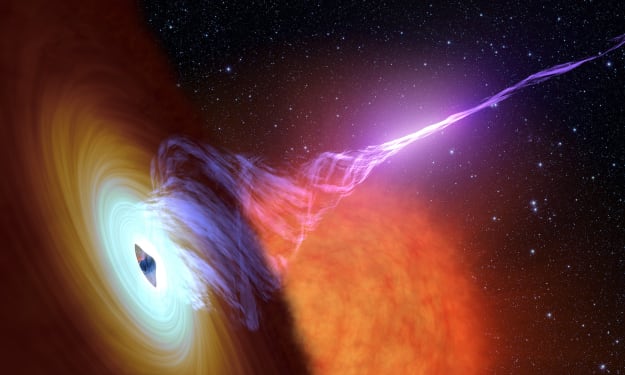
According to the current theory, these jets are stabilized as they extend far from the galaxy's center after being driven close to the supermassive black hole. X-rays are released by the accelerated charged particles, primarily electrons. It has been assumed that the stability of the jets is demonstrated by the stability of their X-ray emissions, however, a new study contends that this assumption is incorrect.
By Najmoos Sakib3 years ago in Humans