
Streets of Faith
How God Provides When We Can't See His Hand

Please tap the ❤️ to show some love, hit subscribe to follow me for more, and if you feel like it, you can leave a tip, totally optional, but always appreciated.
Streets of Faith
How God Provides When We Can't See His Hand
By Joey Raines
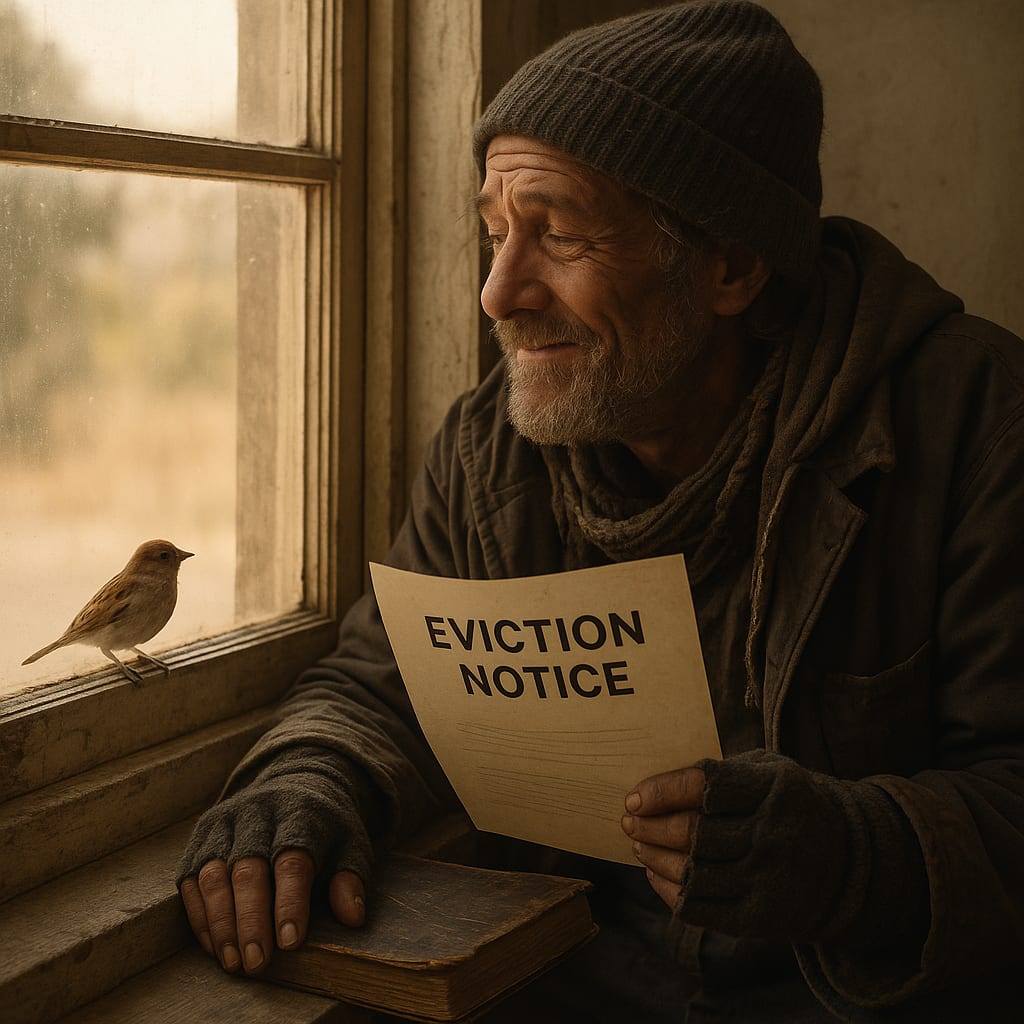
Tony sat at his kitchen table, the morning light filtering through blinds that hung crooked from one broken slat. Bills were stacked in front of him, their envelopes torn open, contents spread across the scarred wooden surface like evidence of his failure. Electric, water, phone, and an eviction notice he had pulled from his front door earlier that morning lay before him in a chaotic array of red ink and bold warnings. He stared at the notice, its harsh letters seeming to grow larger as he read: "You have three days to vacate the premises." The paper trembled slightly in his weathered hands.
The room was quiet except for the steady hum of the refrigerator, mostly empty now except for a half-full bottle of mustard and a carton of eggs nearing their expiration date. The silence felt heavy, pressing down on him like the weight of all his unpaid obligations. He had been laid off three months ago when the manufacturing plant where he'd worked for twelve years had downsized again. His unemployment benefits had run out weeks ago, and his savings account had been emptied long before that.
He lowered his head, hands folded in a gesture he hadn't made in years, eyes shut tight against the harsh reality surrounding him. "God, I need Your help," he whispered into the stillness. "I don't have anything left. I've tried everything I know to try, and nothing's working. I'm about to lose my home, and I don't know where to turn."
In the quiet of his heart, he felt something stir. Not an audible voice, but something deeper, more certain than his own thoughts. The response came clear and unmistakable: "Keep believing in Me. Spread My word, and I will provide for you abundantly. Trust in My timing, and you will see My provision."
Just then, a small bird landed on the windowsill outside his kitchen window and began to sing. Its song was soft and cheerful, a bright melody that seemed to cut through the heaviness in the room. Tony looked up, momentarily distracted by its presence, watching as the tiny creature perched fearlessly on the narrow ledge. At the same time, the old radio on the counter, left on for background noise all morning, crackled through the static. A voice came through clearly, as if the signal had suddenly strengthened: "The answer you're looking for always comes when you stay in faith."
Tony closed his eyes and exhaled slowly, feeling something shift inside his chest. This wasn't just coincidence or wishful thinking. He knew, with a certainty that surprised him, that God had just spoken to him through that quiet voice in his heart, confirmed by the bird's song and the radio's message. The pieces fit together too perfectly to be random chance.
He opened his eyes and looked around the kitchen with a new perspective. The bills were still there, the eviction notice still real, but something had changed. Hope had entered the room like sunlight breaking through storm clouds. Tony stood up, walked to the corner where his old Bible sat on a shelf, and picked it up. Its cover was worn, corners curled from years of handling, and a few pages were creased from past readings during better times. He dusted it off gently, enjoying the feeling of it in his hands.
Without another moment's hesitation, he slipped on his faded denim jacket, stepped outside into the crisp morning air, and began walking with no particular destination in mind. He only knew that he was supposed to share what he believed, to spread God's word as he'd been instructed. The sense of purpose was stronger than his fear, stronger than his embarrassment about his circumstances.
The streets were alive with the usual morning movement. Car horns echoed in the distance, mixing with the rumble of buses and the steady flow of traffic. Conversations from passing pedestrians blended into a low hum, interrupted occasionally by a barking dog or the ding of a city bus stopping to pick up passengers. Shoes clicked against the concrete in hurried rhythms as people rushed to work, their faces focused and determined. Tony walked slowly among them, scanning faces, waiting for the right moment to approach someone.
When he saw a middle-aged woman standing alone near a bus bench, checking her phone while waiting, he gently approached and offered a warm greeting. "Good morning. I hope you're having a blessed day." She looked up, slightly startled but not alarmed. He quoted a verse about hope that had always comforted him: "For I know the plans I have for you, declares the Lord, plans for welfare and not for evil, to give you a future and a hope." His voice was calm and sincere, never pushy or demanding.
The woman glanced at him, nodded politely, and returned to her phone, but he could see something soften in her expression. Others walking past him barely acknowledged his presence, as though he were invisible, just another part of the urban landscape they navigated daily without really seeing.
But a few people paused. One elderly man stopped and listened as Tony shared a verse about God's provision, then smiled and said, "I needed to hear that today, son. Thank you." A young mother with a stroller slowed her pace when he offered a gentle blessing for her and her child, giving him a small but genuine smile before continuing on her way. Their simple responses stirred something deep inside him, a warmth that had nothing to do with the temperature outside. It wasn't much in terms of measurable results, but it felt like confirmation that he was on the right path. He gripped his Bible a little tighter and kept walking.
As the days passed, Tony established a routine of sorts. Each morning, he would wake in his apartment, knowing his time there was limited, and prepare for another day of sharing his faith on the streets. He had no choice but to leave the apartment when the three days mentioned in the eviction notice came and went. Without money for rent, he packed what he could carry into two worn duffel bags and walked away from the only home he'd known for years. There was no dramatic scene, no confrontation with landlords or sheriffs. He simply left the key in the mailbox as instructed and never looked back.
Now he moved from place to place, carrying his Bible and his few remaining belongings. He continued approaching people wherever they gathered in public spaces: parks where office workers ate lunch, street corners with heavy foot traffic, the sidewalk outside the public library where people came and went throughout the day, near bus stops where commuters waited with a few minutes to spare. He never asked for money or made any demands. He simply talked, softly and sincerely, about the hope he still carried despite his circumstances.
Some people stopped to listen, most didn't. Many seemed to look right through him, their eyes sliding past as if he weren't even there. But he kept going, day after day, sustained by the memory of that clear voice in his heart and the promise of provision that would come.
As time passed and his situation became more desperate, his meals became fewer and farther between. Sometimes a church group would set up in the park and offer sandwiches and bottled water to anyone who needed them. Other days, he would settle for whatever snack a kind passerby might offer him, or a piece of fruit from someone's lunch. He ate slowly when food was available, stretching every bite, making it last as long as possible. His frame grew thinner week by week, his cheeks sinking in as the weight fell away. The constant hunger became a familiar companion, but his faith remained steady.
His clothes began to tell the story of his circumstances more clearly than words could. They were wrinkled from being stuffed in his duffel bag night after night, stained from wear and weather, and increasingly threadbare. His shoes were beginning to separate at the soles, the laces knotted and reknotted where they had broken. He tried to stay clean when possible, but opportunities were limited.
Some nights, he was fortunate enough to find space at a homeless shelter and secure a bed for the night. The shelters were crowded, noisy, and often smelled of unwashed bodies and industrial disinfectant, but they provided warmth and safety. Other nights, when no beds were available or when he couldn't reach a shelter before they closed, he would curl up on a park bench or under the awning of a closed business, his thin coat pulled tight around him. Cardboard from discarded boxes helped block the cold that seeped up from the ground. He didn't complain, even to himself. God had promised to provide, and he believed that promise. So he waited, and he continued sharing his faith with anyone who would listen.
One particularly difficult afternoon, carrying a crumpled plastic grocery bag filled with his only change of clothes, Tony stepped into a small laundromat tucked between a discount store and a diner that had been closed for months. The glass door chimed softly behind him as he entered, and the warmth hit him immediately. The place was filled with the steady rhythm of washers and dryers running their cycles, clothes tumbling behind fogged glass doors, some machines making gentle clunking sounds as they spun.
The smell of detergent and fabric softener hung heavy in the air, almost overwhelming after days of sleeping rough. A row of molded plastic chairs lined the back wall, and a vending machine hummed quietly beside them, its lights advertising cold sodas and snacks he couldn't afford. Tony stood near the entrance for a moment, uncertain about intruding on this space where people came to take care of the basic necessity of clean clothes.
He approached a woman who was methodically folding towels at one of the tables, her movements efficient and practiced. His voice was soft and respectful when he spoke. "Excuse me, ma'am. I don't mean to bother you, but do you happen to have a little change so I can wash my clothes? I'd be very grateful."
She paused in her folding, glanced at him briefly without making direct eye contact, then gave a tight smile that didn't reach her eyes. "I'm sorry, I really can't help you," she said, turning back to her laundry with deliberate focus.
Tony nodded and thanked her anyway, understanding that not everyone was in a position to help, even if they wanted to. He stepped toward another patron, a man loading wet clothes from a washer into a dryer, but before he could speak, the man shifted away and pretended not to hear his approach.
Finally, after several more polite rejections, a man in his forties with tired eyes and a Cleveland Browns hoodie sighed and dug into his pocket. "Here," he said, handing over two worn dollar bills that had seen better days. "Don't make a habit of asking if you end up seeing me around here again."
Tony accepted the money with both hands, his gratitude quiet but deeply sincere. "Thank you so much. I really mean that. God bless you."
He loaded his few pieces of clothing into the nearest available washer, poured in a small scoop of detergent that someone had left behind on the edge of the machine, and started the cycle. The sound of water filling the drum was surprisingly comforting. Then he settled into one of the hard plastic chairs, placed his Bible across his lap, and lowered his head in silent prayer, thanking God for this small provision and for the kindness of a stranger.
People came and went during the hour his clothes washed and dried, some glancing his way with curiosity or concern, others not noticing him at all. But Tony didn't mind the attention or lack thereof. He was warm for the first time in days, his clothes would be clean, and for this moment, that was enough.
As days stretched into weeks, Tony found that his routine became steady, if not easy. He would wake early, gather his few belongings, and walk the same familiar routes that he had mapped out through trial and error. The sidewalks near downtown offered the most foot traffic, the shaded areas in the city park provided respite during hot afternoons, and the area outside the library drew a steady stream of people throughout the day. With his Bible in hand, he would speak gently to anyone who seemed open to conversation, offering encouragement, sharing a verse, or simply providing a soft word of hope to brighten someone's day.
Most people continued to walk past without slowing down, their eyes focused straight ahead as they navigated their own busy lives. Some would glance his way briefly, then turn their heads and quicken their pace. Occasionally, a child would tug at their parent's hand and wave at him with innocent curiosity, but the parent would quickly pull the child close and hurry along, casting Tony a wary glance over their shoulder.
The rejection wasn't always silent. One afternoon, while speaking near a busy intersection about God's love and faithfulness, a teenager laughed loudly and called out, "Get a job, you crazy bum!" before crossing the street with his friends, all of them snickering. Another person walked by close enough for Tony to hear them mutter under their breath, "He's one of those crazy Bible guys. Someone should call someone about him."
The words stung more than he expected them to, cutting through his resolve like cold wind through thin clothing. He felt his face flush with embarrassment and hurt, but he didn't respond or defend himself. Instead, he adjusted his coat, gripped his Bible more tightly, and lowered his eyes for a moment to gather himself. The rejection weighed on him, each dismissive comment and averted gaze adding to a growing heaviness in his chest, but it didn't break his determination.
He found a quiet bench away from the busy intersection and sat down heavily, watching the flow of people passing by without really seeing them. He whispered the promise to himself again, the words that had started this journey: "Keep believing in Me. Spread My word, and I will provide for you." Despite the silence from heaven, despite the empty stomach and worn-out shoes, despite the looks and comments from strangers, he still believed. The alternative was too frightening to consider.
As more time passed, Tony found himself speaking to fewer and fewer people as each day went on. He still approached strangers with the same gentle voice and kind eyes, but most people seemed to pass by without even glancing in his direction. Many had earbuds in, lost in their own private soundtracks. Others were absorbed in their phones, scrolling through messages and social media feeds. Some would actually cross the street when they saw him coming, not out of fear necessarily, but out of a desire to avoid any interaction that might slow them down or complicate their day.
It wasn't hostility that he encountered most often, it was indifference. People simply acted as though he didn't exist, as though his words and presence had no impact on their world whatsoever. And somehow, that complete dismissal felt heavier and more discouraging than outright rejection would have been.
One gray morning, as he stood near the edge of a park path sharing a few verses aloud to no one in particular, a light rain began to fall. The drops were thin and steady, clinging to his face and hands, soaking slowly through the fabric of his jacket. He didn't move to find shelter or flinch away from the moisture. His clothes were already damp from the night before, when he had slept beneath an awning that barely kept out the persistent drizzle. The chill settled into his sleeves and collar, but he kept speaking in a low, steady voice, hoping that someone, anyone, might hear and be touched by the message of hope he carried.
He walked slowly down the sidewalk, his steps steady but increasingly tired, his energy depleted from weeks of poor nutrition and restless sleep. As he passed shuttered storefronts and busy shops, he found himself whispering quiet prayers under his breath, not for himself anymore, but for the people inside the buildings, for the strangers he passed, for anyone who might be struggling in ways he couldn't see. "Lord, help them find what they're looking for today. Give them peace in whatever they're facing. Let them know you're real and that you care about them." He didn't raise his voice or try to draw attention to himself. It was just him, the street, and the quiet rhythm of faith as he moved forward one step at a time.
One afternoon, a well-dressed man walking briskly past him paused long enough to throw a quarter in his direction, saying sarcastically, "Here, buy yourself a miracle, preacher man." The coin hit the sidewalk and rolled several feet before coming to rest right beside a storm drain, teetering precariously on the edge of disappearing forever.
Tony hurried over, expecting to lose even this small gesture, but when he reached the spot, the quarter had stopped just short of falling through the grate. As he bent to pick it up, marveling quietly that it had stayed on solid ground, someone nearby who had been walking past slowed their pace after overhearing his quiet recitation of a Bible verse. The woman stopped completely and listened for a moment as he continued speaking softly about God's faithfulness, then nodded with what seemed like genuine appreciation and said, "Thank you. I think I needed to hear that right now."
It wasn't dramatic or life-changing, but in that brief instant, Tony felt a quiet reassurance settle into his heart. Not every miracle announced itself with trumpets and bright lights. Sometimes they were as small as a coin that didn't fall and a stranger who paused to listen when they could have kept walking.
His physical energy continued to fade day by day as the inadequate nutrition took its toll. The persistent hunger had dulled his ability to focus clearly and slowed his movements. Some days, he was blessed to receive a handout from a church volunteer distributing sandwiches in the park, or a piece of fruit from a kind passerby, but more often than not, he went without any food at all. His stomach had stopped growling as loudly as it had in the beginning, but the weakness was becoming harder to ignore.
He began to talk to God out loud more frequently, even when other people were nearby and might overhear. Sometimes it was barely a whisper, other times just a soft murmur that could have been mistaken for someone talking to themselves. He prayed for strength to keep going, for direction about where to walk next, for understanding about why the promised provision seemed so delayed. "I'm still here, Lord," he would say while sitting alone on a bench, his eyes focused on the cracked pavement at his feet. "I haven't stopped believing. I haven't stopped doing what you told me to do. I'm still spreading your word, still trusting in your promise."
But beneath the faithful words, discouragement had begun to take root like weeds in untended soil. He didn't feel angry at God, exactly, but he was tired in a way that went deeper than physical exhaustion. He was confused about why nothing seemed to be changing, why no breakthrough had come, why the provision he'd been promised remained invisible. He had kept his end of the bargain, done everything he believed God had asked of him, and maintained his faith through circumstances that would have broken many people. And yet, he saw no evidence that his obedience was making any difference.
The doubt crept in during the quiet moments, usually late at night when he was trying to fall asleep on a hard bench or cold concrete. Had he misunderstood the voice he'd heard that morning in his kitchen? Was he deluding himself, interpreting his own desperate hopes as divine communication? The questions circled in his mind like vultures, but he pushed them away each morning and continued his routine of sharing his faith with whoever would listen.
At one of the shelters where he occasionally found a bed, a staff member noticed his increasingly frail appearance and gently suggested that he might benefit from talking to someone professional about his situation. "There are people who can help," she said kindly. "Sometimes talking through things can open up options you haven't considered." Eventually, a caseworker at the shelter helped him set up an appointment with a local clinic that provided services to people experiencing homelessness.
Over the next few weeks, Tony visited the clinic several times. The doctors and counselors were kind but clinical in their approach, asking detailed questions about his mental state, his living situation, his ability to care for himself, and his plans for the future. After a comprehensive evaluation that included both physical and psychological assessments, they delivered their conclusion: he qualified for Social Security disability benefits due to a combination of factors related to his current mental health status and his inability to maintain stable housing or employment.
The paperwork involved in applying for benefits was long and filled with unfamiliar terminology that made his head spin. Forms asked for information he didn't have readily available, dates he couldn't remember precisely, and details about his work history that seemed irrelevant to his current situation. But one of the caseworkers, a patient woman named Maria with graying hair and kind eyes, walked him through each document step by step, explaining the process in terms he could understand and helping him provide the necessary information.
Tony listened quietly as she explained what the approval would mean: a monthly check that would cover basic living expenses, assistance with finding permanent housing, access to healthcare services, and a measure of stability that had been absent from his life for months. He nodded along, not entirely sure how to feel about accepting what felt like charity, but knowing he was out of options and needed help to survive.
The waiting period for approval felt endless. Weeks passed with no word, and Tony continued his routine of sleeping wherever he could find shelter and speaking to strangers about his faith during the day. His physical condition continued to deteriorate, and he found himself spending more time resting than walking, more time sitting quietly than actively seeking people to talk to.
Then, on a Tuesday afternoon that had started like any other, a letter arrived at the shelter with his name written clearly on the envelope. Tony opened it slowly, his hands trembling slightly from nerves and malnutrition, reading each line twice to make sure he understood correctly. The letter was official, formal, and brief: his application for Social Security disability benefits had been approved. He would begin receiving monthly payments, and arrangements were being made to help him secure permanent housing.
He folded the letter carefully and placed it back in the envelope, his hands still for a long moment as the reality of the news settled in. After months of uncertainty, sleeping rough, and wondering where his next meal would come from, he would have a roof over his head and enough money to cover his basic needs.
Within two weeks, he had been assigned his own apartment in a subsidized housing complex a few blocks from downtown. It wasn't large or luxurious by any standard, but it was clean, safe, and most importantly, it was his. For the first time in months, he had a key to something that belonged to him, a door he could close behind him, a bed he could count on sleeping in night after night.
The apartment came furnished with basic necessities: a bed with clean sheets, a small kitchen table with two chairs, a couch that had seen better days but was comfortable enough, and even a television mounted on the wall. Tony walked through the space slowly, touching surfaces as if to confirm they were real, opening cabinets and drawers, testing the faucets and light switches like a child exploring a new playground.
That first evening in his new home, he sat on the edge of his bed with his worn Bible resting in his lap, looking around the room with a mixture of emotions swelling in his chest. Relief flooded through him like water breaking through a dam. The exhaustion of months of uncertainty and physical hardship finally had space to settle. Gratitude washed over him for this provision, unexpected as its form had been.
But underneath the positive emotions, something heavier lingered. A disappointment that felt almost like betrayal, though he couldn't quite identify who had betrayed whom. He bowed his head and began to pray, his voice barely above a whisper in the quiet apartment.
"Lord, thank You for this place. Thank you for helping me get off the streets and giving me somewhere safe to sleep. I know I should be grateful, and I am." He paused, struggling with how to voice the confusion and hurt that had been building for months. "But I don't understand what happened. I did what you asked me to do. I kept the faith even when it was hard. I shared your word with people every single day, even when they laughed at me or ignored me or treated me like I was invisible."
His voice grew softer as he continued. "You told me that if I believed and spread Your word, You would provide for me abundantly. I tried to believe that with everything in me. I really did. I waited and waited for the provision you promised, for some sign that my obedience mattered. Why didn't you come through the way you said you would? Why did I have to go through all of that suffering and end up depending on government assistance instead of your miraculous provision?"
The questions hung in the air like smoke, not accusatory but genuinely confused. Tony felt guilt creeping in around the edges of his relief. Was he being ungrateful? Should he have refused the Social Security benefits and continued waiting for God's provision to come in some other form? Had he somehow stepped outside of God's plan by accepting help from the government? The uncertainty weighed on him more heavily than he had expected.
He sat in the silence of his new home, the unfamiliar sounds of the building settling around him, car doors closing in the parking lot outside, muffled conversations from neighboring apartments. For the first time in months, he was warm, safe, and didn't have to worry about where he would sleep or whether he would eat. But the questions remained, unanswered and troubling.
The next morning, Tony woke in his own bed for the first time since he'd been evicted from his previous apartment. The sensation was surreal after so many nights of uncertain rest in shelters or on benches. He made himself a simple breakfast from groceries he'd been able to purchase with his first benefit payment, sitting at his small table by the window as morning light filtered through blinds that worked properly.
As he sat there, a movement outside caught his attention. A small bird had landed on the windowsill just outside the glass, its feathers a pale gray speckled with white. It began to chirp a light, cheerful song, seemingly without a care in the world as it perched fearlessly on the narrow ledge. Tony watched it with growing recognition, remembering another bird that had sung to him months earlier on the windowsill of the house he'd been forced to leave behind. That bird had appeared on the very morning he'd found the eviction notice taped to his door, the same morning he'd first heard God's voice promising provision.
The memory felt like a thread stretched across time, connecting that moment of loss and desperation to this moment of confusion and partial resolution. Was this the same type of bird? Was God trying to tell him something again?
Curious about what might be happening in his old neighborhood, Tony reached for the remote control and turned on the television mounted on his wall. The local news was just beginning, and he settled back to watch while finishing his breakfast. After a few minutes of weather reports and traffic updates, a story began that made him sit forward in his chair.
A reporter was standing in front of a construction site where bulldozers crawled over broken sidewalks and torn-up lawns. The camera panned across a scene of demolition and debris, showing houses being reduced to rubble and loaded into trucks. The headline scrolled across the bottom of the screen: "Redevelopment Underway: Entire Neighborhood to Be Demolished for Commercial Project."
Tony recognized the location immediately. It was his old street, his old neighborhood, the area where he'd lived for years before his eviction. He stared at the television screen in growing amazement as the reporter explained that the entire residential area had been purchased by developers and was being cleared to make way for a shopping center and office complex. The residents had been given notice to relocate, and most of the houses were already empty when the demolition began.
He set the remote down slowly, his breakfast forgotten as the implications sank in. If he had somehow managed to keep his apartment, if he had found the money to pay his rent and stayed in that neighborhood, he would have been forced out anyway when the developers came through. The eviction that had seemed like such a catastrophe at the time had actually removed him from a situation that would have displaced him regardless.
As he sat absorbing this revelation, Tony felt something shift inside his chest. In the quiet of his heart, as clear as it had been that morning months ago when he'd first heard it, came the voice again. Gentle, patient, tinged with what might have been divine amusement.
"I know you never received the money the way you expected, My child. I created Social Security for people exactly like you. There you go, My faithful son."
Tony felt his eyes fill with tears, but they weren't tears of sadness or frustration. Understanding washed over him like warm sunlight breaking through storm clouds. God hadn't forgotten about him. God hadn't ignored his prayers or dismissed his faithfulness. The promise had been kept, just not in the way he had anticipated or hoped for.
The provision had come through a system created by human hands but instituted by divine providence, a safety net designed to catch people who fell through the cracks of society. His months of homelessness and struggle hadn't been punishment or abandonment; they had been the path that led him to qualify for the help he needed. Without that documented period of instability, without the official recognition of his condition, he never would have been eligible for the benefits that now sustained him.
And if he had received a sudden windfall of money as he'd hoped and prayed for, he might have stayed in his old apartment right up until the bulldozers arrived to tear it down. Instead, he'd been moved out of harm's way months in advance, given time to establish residency elsewhere, and ultimately provided with housing that was more stable and affordable than what he'd lost.
Tony smiled through his tears, not because he was wealthy or because his life had become easy, but because he finally understood. God's provision had been at work all along, just behind the scenes, in ways too complex and far-reaching for him to see while he was in the middle of the struggle. The seemingly random bureaucracy of Social Security, the timing of his mental health evaluation, the availability of subsidized housing, even his eviction from an apartment that was doomed anyway, had all been part of a larger plan to take care of him.
The bird outside his window gave one final chirp and flew away, leaving Tony alone with his new understanding. He bowed his head again, but this time his prayer was simple and full of gratitude.
"Thank You, Lord. I'm sorry I doubted. I'm sorry I couldn't see what you were doing. Thank you for taking care of me even when I couldn't see how."
In the days that followed, Tony found himself approaching his daily routine with a different perspective. He still walked the streets of downtown, still carried his Bible, still spoke to people about faith and hope when the opportunity arose. But he no longer felt the desperate urgency that had driven him during his months of homelessness. He wasn't trying to earn God's provision anymore because he had learned that it had been there all along.
His conversations with strangers became more natural, less driven by his own need and more focused on whatever comfort or encouragement he might offer them. He spoke more gently now, with the wisdom that comes from having walked through fire and discovered that you're still whole on the other side.
One afternoon, as he stood outside the library where he'd spent so many days during his difficult months, a woman walked by carrying several heavy bags and looking harried. Tony offered a simple greeting: "God bless you today, and I hope your load gets lighter."
She paused, surprised by the kindness in his voice, and turned to look at him more carefully. After a moment, her expression softened and she smiled. "Thank you so much. I really needed to hear that. It's been such a hard week."
Tony nodded, understanding in his bones what it felt like to carry burdens that seemed too heavy to bear. "He sees what you're going through, even when it doesn't feel like it. Hold on."
She thanked him again before continuing on her way, and Tony watched her go with a sense of quiet satisfaction. This was what he'd been called to do, not to prove his faith or earn his provision, but simply to be a conduit of hope for people who needed it.
As the sun began to set over the city, painting the sky in shades of orange and pink, Tony made his way back to his apartment. He unlocked his door, stepped inside, and felt the familiar sense of gratitude for this space that was his own. He prepared a simple dinner, sat at his table by the window, and looked out at the world beyond the glass.
There was no dramatic sign from heaven, no voice speaking audibly, no moment of mystical revelation. Just peace settling into his heart like a gentle tide. The questions that had tormented him for months had been answered, not through explanation but through experience. God's provision had been real and present all along, working through channels he hadn't expected, arriving right on time even when it felt impossibly late.
Tony opened his Bible to a passage he'd read countless times but that now held new meaning: "And my God will supply every need of yours according to his riches in glory in Christ Jesus." He'd always focused on the word "supply," waiting for some dramatic intervention, some obvious miracle. Now he understood that the promise was about provision, not performance, about God's faithfulness, not his own worthiness.
As darkness settled over the city and lights began twinkling in windows across the neighborhood, Tony closed his Bible and prepared for bed. Tomorrow he would wake up in his own space, eat breakfast at his own table, and walk out into the world carrying the same message he'd always carried. But now he would speak from a place of deeper understanding, knowing that God's provision comes in many forms and that sometimes the most profound miracles look like ordinary bureaucracy working exactly when and how it's supposed to.
He turned off the lights and settled into his bed, pulling the clean sheets up to his chin. Outside his window, the city hummed with its usual nighttime sounds: traffic moving along distant streets, the occasional siren, voices of people walking past on the sidewalk below. But inside his apartment, there was quiet and warmth and the deep peace that comes from finally understanding that you are cared for, even when you can't see the hands doing the caring.
"Thank you," Tony whispered into the darkness, and meant it with every fiber of his being. Then he closed his eyes and slept the deep, restful sleep of someone who has found his way home.
Thank you for reading. If this story meant something to you, inspired you, made you think, or just kept you reading, I’d be honored if you’d tap the ❤️ to show some love, hit subscribe to follow me for more, and if you feel like it, you can leave a tip, totally optional, but always appreciated.
© 2025 Joey Raines. All rights reserved.
About the Creator
Joey Raines
I mostly write from raw events and spiritual encounters. True stories shaped by pain, clarity, and moments when God felt close. Each piece is a reflection of what I have lived, what I have learned, and what still lingers in the soul.
Keep reading
More stories from Joey Raines and writers in Humans and other communities.
Maps Are Not Always Paper
I didn’t go looking for writing. Writing found me. I did not start because I loved stories. I started because there were things inside me I could not explain. Memories with no proof. Moments that did not belong to the physical world. I needed somewhere to put them. Somewhere that could hold what my life could not carry in silence. Writing became the place where I could finally see the shape of what had happened to me, like tracing a map of something that had no outline. I did not know it then, but every strange moment and every unseen thing was pushing me toward the page, marking coordinates I would only understand years later.
By Joey Raines2 months ago in Humans




Comments (1)
This is deep. I didn't expect this. I love it.