
Something Old, Something New
Treasure Under the Cherry Tree

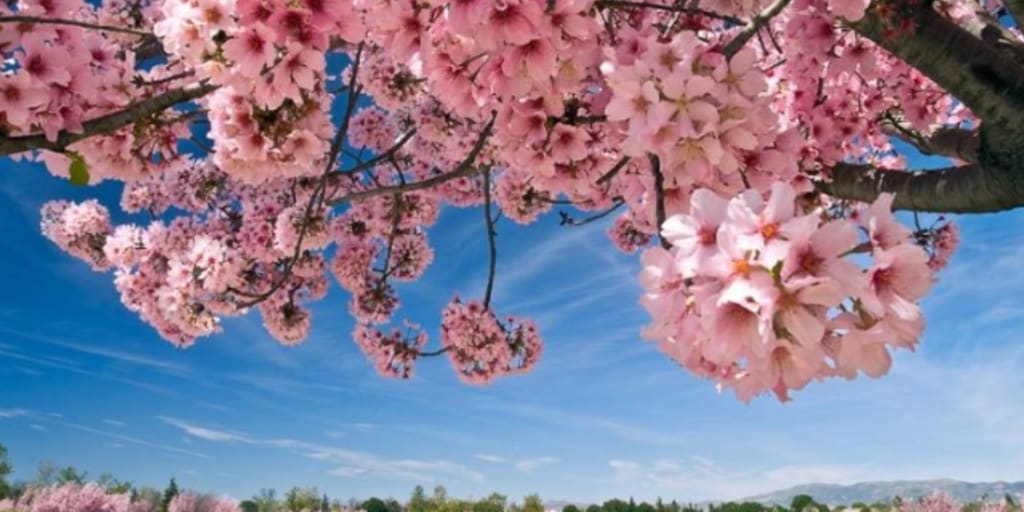
It was a bittersweet day. Hae-won, a 65-year-old Korean-American woman with ageless beauty, moved into a new house―a decision she made after losing her husband of 45 years. She had lived a hard but fruitful life. Hae-won and her husband were Korean-American immigrants, and along with raising three children, they ran a small local store and restaurant for over 35 years. They were a staple amongst the community. Because she had lived a life full of established routines and familiar faces, moving into a new house felt like the beginning of a new life.
The house, which was more of a quaint cottage than a cookie-cutter tract home, was full of character: blue stucco walls with white accents and a red tile roof. Yet the house almost seemed to disappear into its large yard with overgrown weeds and scattered, unkempt fruit trees. It almost looked like a vacant and abandoned lot. Despite its appearance, there was a warmth about it that made Hae-won feel right at home.
More than the house itself, Hae-won was drawn to this yard. It was messy and unsightly, especially from the street, but it was full of possibilities. In her mind, she saw a beautiful garden hiding behind the weeds. She imagined birds-of-paradise, gold poppies, lilacs, and daisies. She was excited to breathe new life into the property despite the bittersweetness of the moment. To her, discovering the splendor of this home was like rediscovering the beauty within herself. And she reminisced on how her parents always wanted to have a small home with a garden―a dream that was only briefly fulfilled. She felt connected to their memory here.
In the corner of the yard stood a cherry tree, covered in spring blossoms. Hae-won instantly loved this tree. It reminded her of spring trips she used to take with her husband and children, and she knew that this tree would be the shining star of her garden.
It wasn’t long before Hae-won started pulling weeds, removing litter, tilling the soil, pruning the shrubs and trees, and planting flowers and herbs. While working around her cherry tree, she noticed that one of the tree’s roots had displaced a nearby fencepost and flagstone walking path. With the help of a landscaper, she was able to remove the invasive root without harming the delicate tree. Within the root cavity, Hae-won saw a hardwood box. Although the box had seen better days, gold characters were still visible on its surface: 咲世.
Hae-won carefully opened the box to see what was inside. The first item she saw was a small, leather bound, black book and several old $100 bills, worth nearly $20,000. The series date on the bills indicated they were from the mid-1930s. Puzzled by the mysterious box and its contents, she decided to contact the previous owners of the home.
Emily and her husband, Kevin, were thrilled to be invited back to their old house. As a couple well into their 80s, they could no longer care for the house or its yard. They also made the decision to sell it so that they could cover Emily’s mounting medical bills.
The following Saturday, Hae-won had them over for tea. As the couple told many amusing stories about the property and the decades of memories made there, Hae-won placed the wooden box on the table. Emily and Kevin fell silent as they looked at the two traditional kanji characters etched on the box. In English, Emily uttered the words as she brushed her hand against the writing: “blessed, beautiful generation.” Hae-won had also understood these characters given her Hanja classes in high school, while still living in Korea.
It was obvious that Emily recognized this box. “That’s my birth name on the box: Emiyo. My name means ‘blessed, beautiful generation.’ The last time I saw this box was just before I went to Manzanar. My family and I were interned there during the war.” Tears filled her eyes. “Those were awful times. I hated the way I looked. When people stared at me, they only saw a little Japanese girl. They never saw me as an American.” Hae-won gave Emily a tissue to wipe her tears. “I was orphaned at Manzanar. My parents are both buried there.” Emily’s parents died from inadequate medical care at the camp—their conditions made worse by the immense emotional stress of losing their livelihood as a result of internment. “I never really got to know my parents, you know. But this house was how I remembered them. I was born here, and it belonged to my parents before it was taken from them. I thank God that Kevin and I were able to buy it in 1965.”
Hae-won listened intently to Emily’s words. She could relate to the pain of her parents’ generation. Her mother was orphaned at the hands of Imperial Japan, and her parents were robbed of their beautiful home, vegetable garden, and small cherry orchard during the Japanese occupation of Korea―a home they barely got to know. It was not lost on Hae-won that she was sitting in front of a woman with Japanese heritage―a heritage she was taught to fear as a girl. And it was not lost on Hae-won that because of this heritage, Emily and her family suffered persecution, marginalization, separation, isolation, and even death.
“I am a fourth generation American,” Emily said as she looked down at the box. “My family came to this country looking for a more fulfilling life. America was the land of opportunity; that’s what they were told anyway. It’s too bad that things went the way they did.” There the two women sat in solidarity, looking back on their shared generational pain.
“I am sorry for your parents’ suffering,” Hae-won said. “No one should have to endure the things your family went through.”
“And I am sorry for your family’s pain too,” Emily said without even knowing Hae-won’s story. These women connected with one another on a deeply spiritual level, and they intimately understood each other’s pain (and this history behind that pain). “The money isn’t the most valuable treasure in the box,” Emily said to Kevin as she rustled through the box’s contents. “This black book is my family’s genealogy book; it’s our history. This is what matters most to me.” She opened the book to show Hae-won and Kevin her family tree. “My name was the last name written inside it. See?”
Hae-won pointed to two black and white pictures above Emily’s name. “Your parents?”
“Yes. Aiko, my mother. Her name means ‘little loved one.’ And that’s Hiroshi, my father. His name means ‘generous.’” Emily studied the pictures and seemed to trace her father’s smile with her finger. “They were good people.”
Hae-won gently put her hand on Emily’s hand. “Don’t be ashamed of who you are, Emiyo” she said. Emily looked up at Hae-won and nodded.
“Thank you,” she said. In her heart, Emily felt free to reclaim the root of her identity as a Japanese-American which, for many years, had been waiting to sprout and bloom under the weight of pain, shame, and angst. Hae-won was a conduit in delivering what was always Emily’s: her identity as Emiyo—a cherry blossom of the “blessed, beautiful generation.” In giving this gift to Emily, Hae-won was also free to reclaim the beauty of her own name and its meaning: “graceful garden.” After all, it was in pulling weeds and planting flowers that Hae-won discovered Emily’s box, and it was in returning this box to Emily—to Emiyo—that both women found new healing through an acknowledgement of the past and through their shared struggles.
The blessed, beautiful generation blooms in the garden of grace.
About the Creator
Keep reading
More stories from writers in Humans and other communities.
The CEO of Everything
They say "jack of all trades, master of none," but they forgot to mention the part where the jack of all trades is also the camera woman, the makeup artist, and the person currently yelling at a tangled Wii microphone cable in a her own bathroom while recording herself singing and trying to make it look realistic and professional. (As professional as you can make it with nothing but a cell phone camera and a mic that doesn't work)
By Sara Wilson6 days ago in Humans


Comments
There are no comments for this story
Be the first to respond and start the conversation.