
SOCIAL NORMS AND VALUES
Defining the Foundations of Social Behavior

Social Norms and Values
Social norms and values are the cornerstones of human behavior and societal organization. These unwritten rules and shared beliefs guide interactions, promote order, and maintain the fabric of communities. While norms dictate acceptable behaviors, values represent the deeper principles that societies hold dear, influencing laws, traditions, and interpersonal relationships.
Understanding Social Norms
Social norms are the implicit or explicit expectations about how individuals should behave in specific contexts. They serve as guidelines for behavior and can vary widely between cultures, communities, and historical periods.
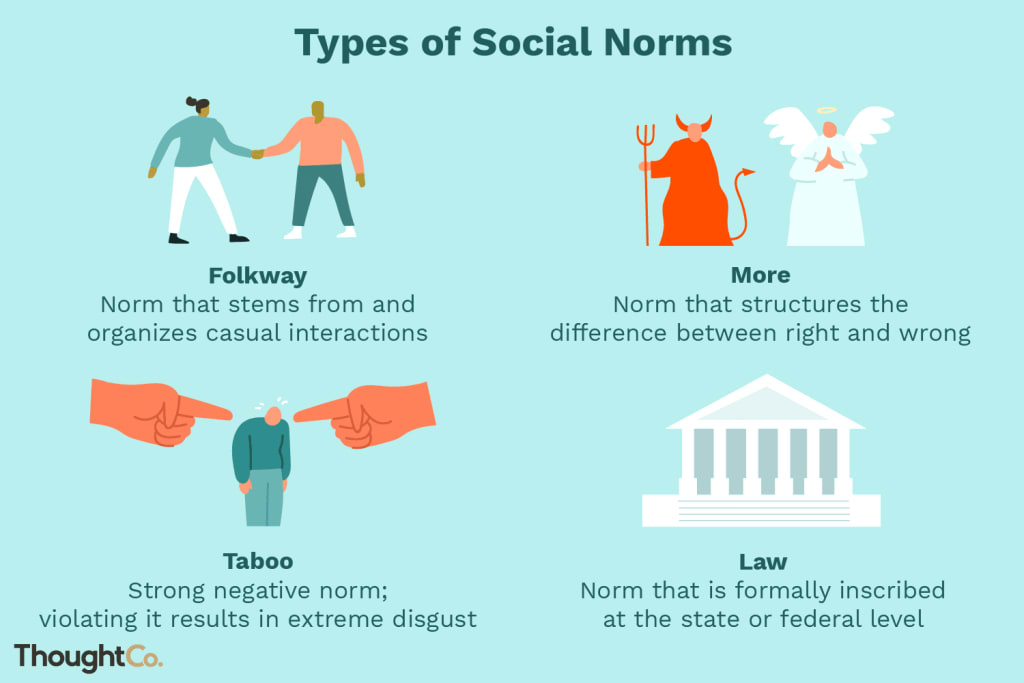
Types of Social Norms:
Folkways:- Everyday norms that govern casual interactions, like saying "please" and "thank you."
Mores:- Stronger norms tied to morality, such as respecting elders or prohibitions against theft.
Taboos:- Prohibited behaviors considered deeply offensive, such as incest or cannibalism.
Laws:-Formalized norms codified into legal systems to regulate conduct.
Functions of Social Norms:-
Promoting Social Order: -Norms reduce uncertainty by establishing expectations for behavior.
Facilitating Cooperation:- Shared norms encourage trust and collaboration within groups.
Maintaining Group Identity:- Norms reinforce cultural or societal identity, fostering belonging.
Enforcement of Norms:-
Norms are maintained through social sanctions. Positive reinforcement, like praise, encourages adherence, while negative reactions, such as criticism or ostracism, discourage violations.
Understanding Values
Values are deeply held beliefs about what is right, important, or desirable. Unlike norms, which guide behavior in specific situations, values shape broader worldviews and long-term goals.
Characteristics of Values:-
Universal and Contextual:- Some values, like honesty, are universal, while others, like individualism or collectivism, vary by culture.
Guiding Principles:-Values influence decision-making and ethical judgments.
Dynamic Nature:- Societal values can change over time, adapting to new challenges or perspectives.
Examples of Common Values:-
Freedom and Equality: -Foundational in democratic societies.
Family and Community:- Emphasized in collectivist cultures.
Achievement and Success:- Highly valued in individualistic, competitive cultures.
The Relationship Between Norms and Values
Social norms and values are interconnected. Norms often arise from shared values, translating abstract principles into concrete actions. For example:
Value: Respect for life → Norm: Prohibition against murder.
Value: Education → Norm: Mandatory schooling for children.
Conversely, changes in norms can signal shifts in societal values. The increasing acceptance of same-sex marriage reflects evolving values about equality and love.
Cultural Variations in Norms and Values
Norms and values are deeply rooted in cultural contexts:
Collectivist vs. Individualist Societies:-
Collectivist societies (e.g., Japan, India) prioritize group harmony, leading to norms that emphasize respect for authority and family ties.
Individualist societies (e.g., the U.S., Sweden) value independence, reflected in norms promoting personal freedom and self-expression.
Religious and Ethical Influences:-
Religious beliefs shape values and norms, such as dietary restrictions in Islam (halal) or Hinduism (vegetarianism).
Globalization and Cultural Exchange:-
Globalization has led to the blending of norms and values, creating challenges and opportunities for cross-cultural understanding.
Social Norms and Values in Modern Contexts
Impact of Technology:-
Social media influences norms by amplifying trends and shaping public opinion.
Digital etiquette, such as avoiding phone use during conversations, reflects new norms born of technological advancements.
Challenges to Traditional Norms:-
Movements for gender equality and LGBTQ+ rights challenge long-held norms, pushing societies to reevaluate values.
Climate change activism highlights the value of environmental sustainability, creating new norms around recycling and energy use.
The Role of Education:-
Education plays a vital role in transmitting and transforming norms and values, equipping individuals to navigate diverse social landscapes.
The Importance of Social Norms and Values
Norms and values are essential for maintaining societal cohesion and adaptability. While norms provide stability in daily interactions, values inspire long-term progress and ethical conduct. Balancing tradition with innovation ensures that societies remain both grounded and forward-looking.
In understanding norms and values, individuals gain insight into their cultural roots, fostering empathy and cooperation in an increasingly interconnected world. Recognizing the dynamic interplay between these forces enables societies to address challenges while staying true to their core principles.
About the Creator
Badhan Sen
Myself Badhan, I am a professional writer.I like to share some stories with my friends.
Keep reading
More stories from Badhan Sen and writers in Humans and other communities.
HUMAN SOCIAL ORDER AND CIVIC ESTABLISHMENT
Human social orders and civic establishments are the underpinnings of human advancement, mirroring the aggregate association, culture, and innovative headways of individuals from the beginning of time. The development of social orders and the ascent of civic establishments have been molded by geology, asset accessibility, advancement, and human coordinated effort. Investigating their qualities and improvements gives a more profound comprehension of humankind's excursion.
By Badhan Senabout a year ago in Humans
The Process of Strategic Planning: A Step-by-Step Guide That Actually Works
Strategic planning isn’t just a corporate buzzword—it’s the backbone of long-term success for any business, startup, or even personal brand. Without a clear strategy, you’re not moving forward; you’re just staying busy.
By M Yawer Yousaf5 days ago in Humans


Comments (1)
Good work on an article full of sociological theory and facts. What a good lecture for a Basic Sociology class.