
Silent Streets: The Unseen Lives Beneath the City Lights.
Finding Humanity in the Shadows of Urban Life.
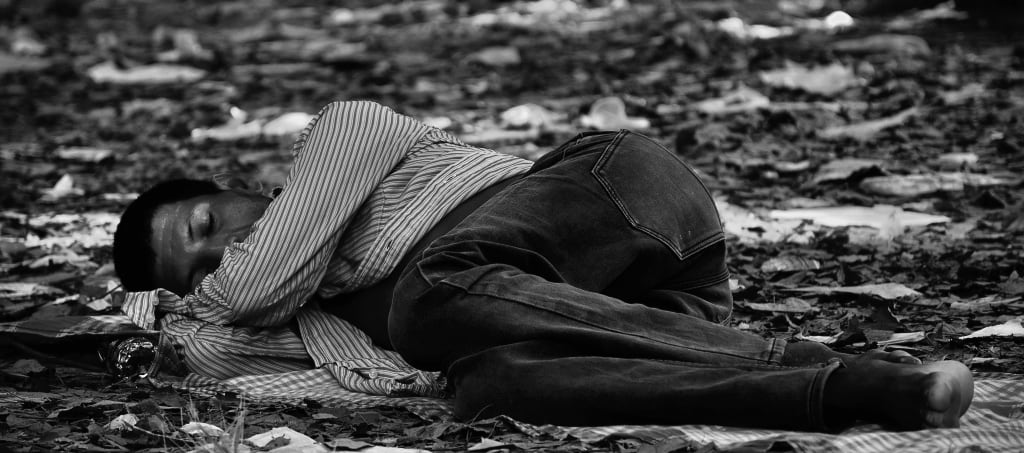
In the heart of every city, behind the steel and glass façades, beneath the towering billboards and endless rush of life, lies a reality that rarely enters public conversation. It’s a reality built not of concrete, but of silence. A silence occupied by those who live, sleep, and survive on the margins—often unseen, often forgotten. One image can bring this reality into stark relief: a man sleeping alone on the ground, his body curled tightly against the cold, surrounded by fallen leaves and the debris of a city that never stops moving.
This man could be anyone—a laborer displaced from home, a migrant worker without support, a person fallen through the cracks of an unforgiving system. There is no name attached to his story, no headline bearing his plight. And yet, in his vulnerability, he represents a much larger truth: urban homelessness is not an anomaly. It is a day-to-day occurrence for millions of people all over the world, hidden in alleyways, beneath bridges, or, as in this picture, out in the open and simply ignored.
The Human Behind the Image:
When we look at a homeless person sleeping on the street, we frequently see just that—a passerby on the margins. We rarely stop to consider the person they once were—their hopes and dreams as children, their families, their laughter, and their losses. That reduction, that failure to recognize humanity, is one of the most tragic consequences of societal indifference. The man in the image sleeps not because he is lazy or irresponsible, but because rest is all he can afford in a world that has denied him shelter.
This image tells us so much without a single word. The way he uses his shirt as a blanket, the leaves beneath him as a mattress—these are silent improvisations born of necessity. Each element of the photograph whispers a different chapter of hardship, endurance, and quiet dignity. His sleep is not peaceful because life is easy; it is peaceful because he is exhausted.
Urbanization and the Invisibility of Poverty:
Modern cities are celebrated for their progress: economic growth, technological innovation, cultural vibrance. But what is often omitted from that narrative is how this rapid urbanization exacerbates inequality. As property values rise and development projects take over open land, low-income communities are pushed out, both literally and figuratively.
In many developing and developed countries alike, access to affordable housing remains a distant dream for the marginalized. Policies are often shaped with middle- and upper-class citizens in mind, while the poor are left to fend for themselves. Public spaces, which once served as equalizers, are increasingly policed or privatized, leaving the urban poor with nowhere to go. Homelessness, then, becomes not just a personal misfortune but a systemic failure.
Mental Health, Addiction, and the Vicious Cycle:
It’s important to understand that homelessness is not merely an issue of lacking shelter. Often, it intersects with mental health challenges, substance abuse, unemployment, and past trauma. These factors don’t exist in isolation—they create a cycle that is incredibly hard to break without structural support.
Imagine facing daily judgment, insecurity, hunger, and danger. Imagine trying to apply for a job with no address, no clean clothes, no internet access. The barriers are staggering. And yet, the common narrative still places blame on the individual, ignoring the broader systems of neglect that perpetuate the cycle of poverty and exclusion.
A Crisis of Empathy:
What makes this issue particularly tragic is not just the widespread suffering, but society’s growing desensitization to it. In cities, we become experts at averting our eyes—at looking past the person on the sidewalk, past the one sleeping by the station, past the plea for food or help. We learn to move on, to walk faster, to justify our inaction.
But this is a crisis not just of infrastructure or economics—it is a crisis of empathy.
The man depicted in the image is not invisible because he conceals himself; rather, we have chosen not to see him. And that choice—conscious or not—is what allows injustice to persist.
Hope, Dignity, and What We Can Do :
There is hope despite the gloom. Across the world, many organizations, volunteers, and activists are working to provide support, from emergency shelters and food programs to vocational training and mental health services. But more than charity, what’s needed is structural change: investments in affordable housing, stronger safety nets, healthcare access, and inclusive urban planning.
And at an individual level, the change starts with acknowledgment—with seeing. The next time you pass someone sleeping rough, don’t look away. That insignificant act of acknowledgment can profoundly humanize. If possible, offer food, conversation, or direct them to resources. Support policies and leaders who prioritize social welfare. Understand that homelessness is not a personal failure—it is a societal one.
Art as a Mirror:
Photographs like the one above are not just art; they are documentation. They capture the truths many prefer to ignore. In a way, they serve as both mirror and megaphone—reflecting our collective apathy while urging us to listen. They cut through the noise, reminding us that every person, regardless of circumstance, deserves dignity, safety, and care.
There is no glory in suffering, no poetry in poverty. But there is humanity. And as long as we remember that, as long as we resist the urge to look away, there is hope for a world where no one is forced to sleep under open skies for lack of a home.
Conclusion:
The man in the image may never know his photo was taken. He may never hear how many people saw it or read this article. But his story—unspoken and unwritten—deserves to be told. It forces us to confront what kind of society we’ve built and challenges us to imagine one that includes everyone, not just those with power and privilege.
Let this not just be an image you scroll past. Let it be a reminder. That behind every face on the street, there is a name, a story, and a life worth acknowledging.
About the Creator
Keep reading
More stories from writers in Humans and other communities.
Libra Woman and Taurus Man Compatibility Score
When a Libra woman and a Taurus man come together, the relationship blends elegance with dependability, romance with realism, and charm with sensuality. Ruled by Venus, the planet of love, beauty, and pleasure, both signs share a deep appreciation for harmony, comfort, and meaningful connection. However, despite this shared ruler, their personalities and approaches to life can be quite different. Understanding these differences is key to evaluating their long-term compatibility.
By Inspire and Fun2 days ago in Humans


Comments
There are no comments for this story
Be the first to respond and start the conversation.