
"Shades of My Skin"
In a world that never saw him as beautiful, a young Black man learns to find power in his reflection.

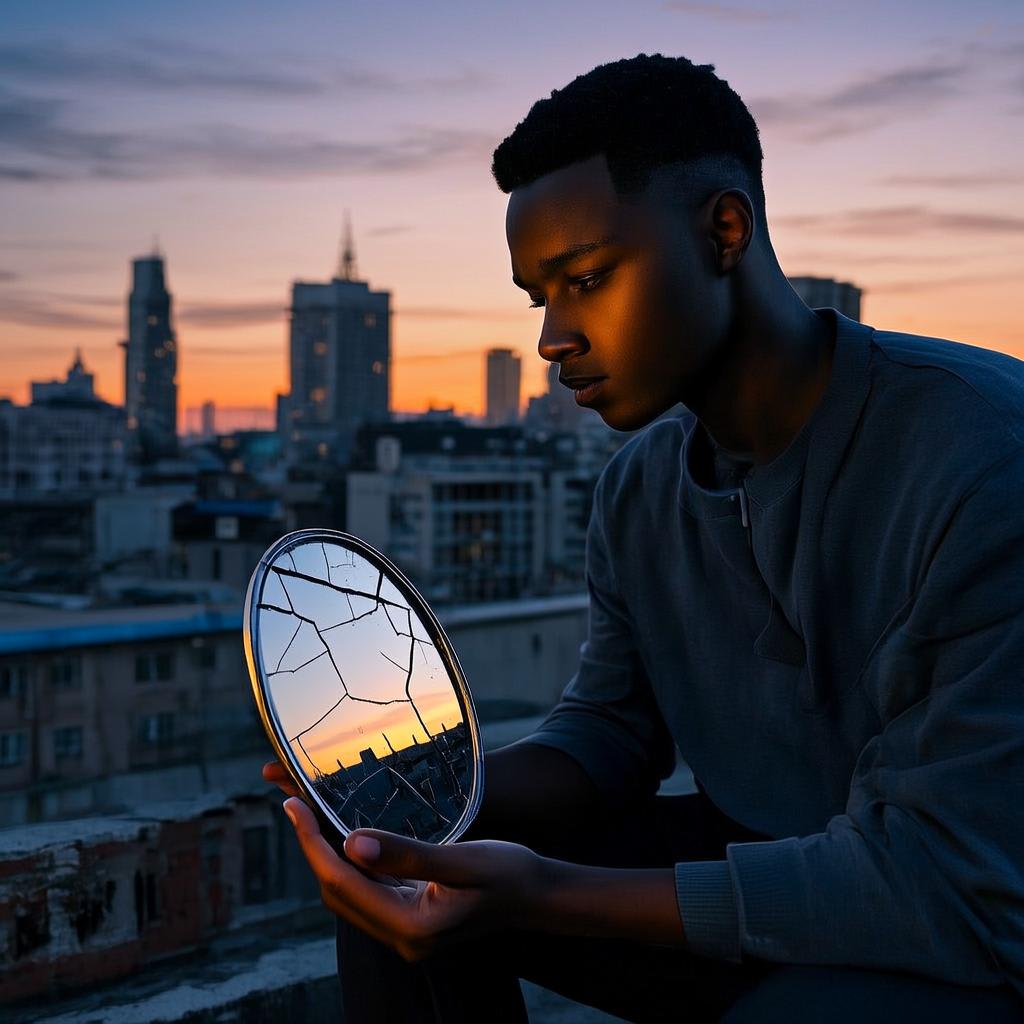
Shades of My Skin
I was ten the first time someone called me “too dark.”
Twelve when a girl at school told me I’d be handsome—if only my skin were “a little lighter.”
Fourteen when a teacher asked if I’d ever considered “bettering myself”—not with books, but with a smile that made it clear she meant something else entirely.
By sixteen, I’d stopped looking in mirrors.
They weren’t made for me anyway.
My name is Malik, and I’ve lived my whole life in a city that stares through me. Not because I’m invisible, but because I’m uncomfortable. The way I talk, the way I move, the shade of my skin—it all made people look the other way, or worse, look too long with suspicion, not curiosity.
Every magazine I saw growing up—every actor, singer, “influencer”—none looked like me. And when they did, they were the punchline, the sidekick, the shadow. Never the center. Never the light.
So I believed the lie the world told me.
That I wasn’t beautiful.
That my skin was a mistake.
That I had to earn my right to be seen.
---
My mom used to say, "They'll try to shame what they fear, Malik. And they fear your skin because they can't own it."
But I never really understood her then. I only knew that walking home felt like walking on glass. That smiling too wide made people nervous. That wearing a hoodie after dark could make me disappear in more ways than one.
Then came the mirror.
Not the one on my wall. That one had stayed covered since middle school.
This mirror was in a barbershop, old and dusty. The kind with faded photographs and jazz humming low in the background. I’d wandered in by accident—on a day when the world felt too loud, and I needed a place to just be.
The barber looked up. An old man with soft eyes and tired hands.
“You look like a boy running from himself,” he said.
I wanted to argue. But I was tired. So I sat.
As he trimmed my hair in silence, I caught a glimpse of my reflection. Just a sliver. Just enough.
There I was.
Brown skin deep like earth.
Eyes dark like winter nights—heavy, alert, searching.
Lips full of silence. A jawline hardened by grief.
And beneath it all—a softness the world had tried to beat out of me.
I looked away.
But the barber stopped.
“Don’t flinch from yourself, son. Look again.”
This time, I stared.
I saw someone who had survived.
Someone who had been called too loud, too angry, too dangerous—when all he wanted was to be held.
Someone whose skin wasn’t a flaw, but a flame.
Who carried generations of strength in every cell.
It hit me like thunder: They didn’t fear me because I was broken. They feared me because I was whole.
---
That night, I uncovered the mirror in my room.
Slowly, painfully—I began to speak to myself.
Not the fake confidence the world pretends to sell.
But the kind that grows from naming your wounds and not apologizing for the way they scarred over.
I whispered:
"My skin is not too dark—it is the color of courage."
"My voice is not too loud—it is the echo of ancestors who refused to be silenced."
"My beauty does not beg for permission—it breathes without asking."
And every day since, I’ve spoken a little louder.
---
I still walk streets where my reflection is feared.
Still get followed in stores.
Still hear people cross the street when I pass.
But now I understand:
My beauty is not defined by comfort.
It’s defined by truth.
And the truth is: I am not too much.
I am exactly enough.
About the Creator
Keep reading
More stories from VoiceWithin and writers in Humans and other communities.
"The Mirror That Never Lied"
The Mirror That Never Lied Evelyn sat in front of her mirror again. The one with the gold trim and the single crack running through its corner like a tear frozen in glass. It had been her mother’s. Passed down like an heirloom, like a curse. Every day, Evelyn would stare into it, searching for something beautiful, something lovable—never quite finding it.
By VoiceWithin8 months ago in Humans


Comments
There are no comments for this story
Be the first to respond and start the conversation.